
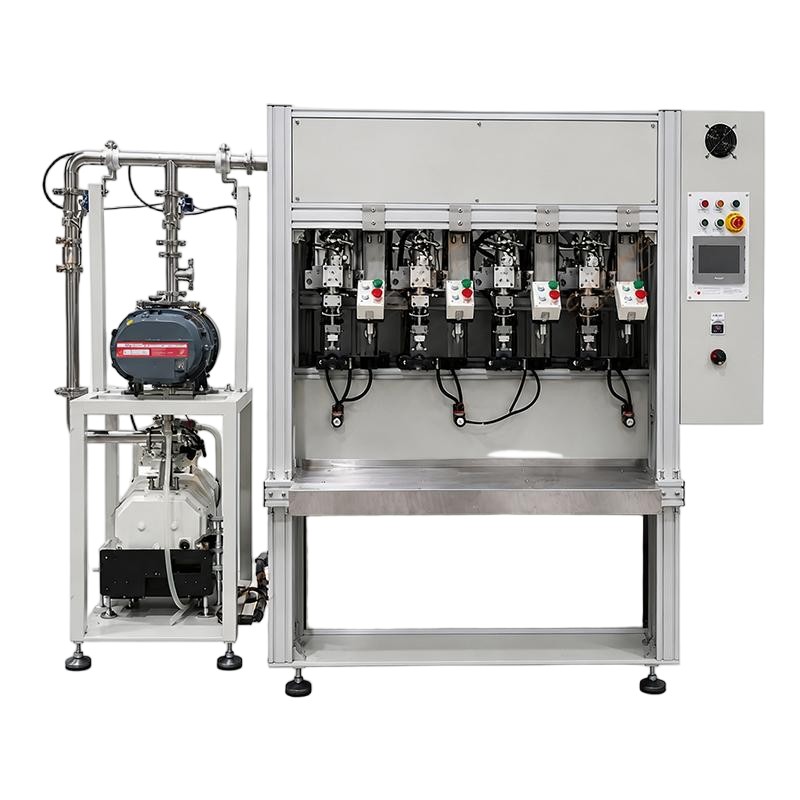
Heat Pipe Multi-station Dry-out Tester: Complete Guide
1. What Is a Heat Pipe Multi-station Dry-out Tester?
A Heat Pipe Multi-station Dry-out Tester is specialized equipment used in heat pipe manufacturing to support controlled drying, heating, and process evaluation across multiple workstations. Depending on its design, the equipment may help remove residual moisture or volatile contaminants from heat pipes or related components before subsequent manufacturing operations.
Heat pipes transfer heat through evaporation and condensation inside a sealed enclosure. Their performance depends on several factors, including the working fluid, internal wick structure, cleanliness, sealing integrity, and manufacturing process.
Residual moisture and unwanted contaminants can affect the internal environment. Therefore, manufacturers need suitable cleaning, drying, evacuation, and fluid-charging procedures.
A multi-station tester can process several workpieces or batches through a coordinated heating or drying cycle. This arrangement may improve production throughput and help standardize process conditions.
However, the exact function of a particular machine depends on its configuration. Some systems focus on drying components before assembly. Others may support thermal conditioning or a defined process test. Buyers should confirm whether the equipment performs drying alone, vacuum-assisted drying, or another validated operation.
For cncoolingthermal, this equipment belongs to the broader category of heat pipe manufacturing and thermal management production equipment. Its suitability should be evaluated against the actual heat pipe design and production workflow.
2. Why Dry-out Testing Matters in Heat Pipe Manufacturing
Drying and process conditioning can play an important role in preparing heat pipes for later manufacturing stages. The required method depends on the materials, internal structure, and manufacturing sequence.
2.1 Controlling Residual Moisture
Moisture may remain on surfaces or within accessible spaces after cleaning. If the manufacturing process does not remove it adequately, moisture may affect later evacuation, working-fluid charging, or internal cleanliness.
A controlled drying process can help reduce this risk. The appropriate temperature, duration, and atmosphere depend on the workpiece materials and process requirements.
Drying should follow a validated procedure. Excessive temperature or unsuitable conditions can damage sensitive materials or alter the condition of internal components.
2.2 Supporting Internal Cleanliness
Heat pipes may contain copper tubes, wick structures, and joining materials. Manufacturing residues can remain after cutting, forming, cleaning, or assembly.
A dry-out process may help remove certain moisture-related residues or volatile substances. However, it cannot remove every type of contamination.
Manufacturers should combine appropriate cleaning, rinsing where required, drying, and handling controls. This approach helps prevent contamination from carrying into later operations.
2.3 Preparing Workpieces for Vacuum Processing
Some heat pipe manufacturing processes require evacuation before working-fluid charging and sealing.
Residual moisture and material outgassing can influence pressure behavior during evacuation. Properly prepared workpieces can make the subsequent vacuum process more predictable.
Nevertheless, a drying cycle does not replace vacuum evacuation. The manufacturer must verify that the following process achieves its specified conditions.
2.4 Improving Process Repeatability
Manual drying can introduce variation in temperature, holding time, loading density, and workpiece positioning.
A multi-station tester can standardize these parameters when its control system supports programmable recipes and monitoring.
Consistent process conditions make it easier to compare batches and investigate production deviations. Actual repeatability still depends on equipment design, calibration, maintenance, and validated operating procedures.
2.5 Supporting Downstream Product Quality
Drying is one part of a larger manufacturing process. It supports workpiece preparation but does not independently guarantee finished heat pipe performance.
Working-fluid charging, sealing, leak testing, and thermal performance testing remain important. Manufacturers should define acceptance criteria for each stage.
3. How a Heat Pipe Multi-station Dry-out Tester Works
The operating principle depends on the machine’s design. A typical system may use controlled heating, timed holding, temperature monitoring, and multiple fixtures or stations to process workpieces.
Some configurations may also include vacuum assistance. Others operate under a different controlled environment. The equipment specification should clarify the available functions.
3.1 Loading the Workpieces
Operators place heat pipes or components into designated fixtures at each station.
Fixtures help position the workpieces consistently and maintain suitable spacing for heat transfer. Their design should accommodate the product’s dimensions and avoid unnecessary mechanical stress.
Before starting a cycle, operators should verify the product type, loading arrangement, and selected recipe.
3.2 Setting the Process Recipe
The controller may allow operators to select parameters such as temperature, holding time, and cycle sequence.
If the machine includes vacuum functions, the recipe may also include pressure-related settings. These settings must reflect the validated requirements for the actual product.
A recipe should not be copied between different heat pipe designs without confirming material compatibility and process suitability.
3.3 Applying Controlled Heating
The equipment raises the workpiece or processing chamber to the specified temperature.
Heating helps moisture evaporate from suitable surfaces and may support the release of certain volatile substances. The effectiveness depends on the temperature, exposure time, material characteristics, and available gas-removal path.
The process must avoid excessive thermal exposure. Thin-walled tubes, wick materials, coatings, and joining areas may have different temperature limits.
3.4 Maintaining the Dry-out Cycle
The machine holds the workpieces under the selected conditions for a defined period.
Temperature sensors and control logic can help maintain the programmed cycle. In a multi-station system, the design should provide sufficiently consistent conditions across the loaded workpieces.
If the machine includes vacuum monitoring, pressure trends can help operators assess process behavior. However, pressure readings alone cannot prove that every workpiece has reached the required dryness.
3.5 Completing the Cycle and Unloading
Once the cycle reaches its defined endpoint, the equipment follows its programmed shutdown or cooling sequence.
Operators then unload the workpieces and transfer them to the next manufacturing operation. Depending on the process, this may involve assembly, vacuum evacuation, fluid charging, or another preparation step.
Workpieces should be handled and stored in a way that prevents recontamination or moisture absorption.
4. Main Components of the Equipment
The exact configuration varies by manufacturer and application. Common components may include the following.
Component | Function |
Processing chamber or station assembly | Holds the workpieces during the drying cycle |
Heating system | Supplies controlled thermal energy |
Temperature sensors | Monitors temperature at selected locations |
Fixtures and workpiece holders | Positions workpieces consistently |
Industrial controller | Executes the programmed process sequence |
HMI interface | Allows operators to select recipes and view machine status |
Timing and control modules | Regulates cycle duration and process transitions |
Safety interlocks | Helps prevent unsafe operation |
Vacuum system, if equipped | Provides reduced-pressure processing where required |
Pressure sensors, if equipped | Monitors vacuum conditions |
Data logging, if equipped | Records process values and cycle information |
Not every Heat Pipe Multi-station Dry-out Tester includes a vacuum system or the same number of stations. Buyers should confirm these details before comparing equipment.
The station count, heating method, temperature range, control accuracy, loading method, and cycle time all influence practical performance.
5. Key Features of a Multi-station Dry-out Tester
5.1 Multiple Workstations
Multiple stations allow the machine to accommodate several workpieces or batches during a production cycle.
This arrangement can increase processing capacity when the station layout and cycle time match production demand.
However, more stations do not automatically produce higher throughput. Loading time, heating uniformity, unloading time, and downstream bottlenecks also affect overall output.
5.2 Temperature Control
Temperature control helps maintain the specified drying conditions.
The relevant criteria include the available temperature range, control accuracy, sensor placement, and temperature uniformity under representative loading conditions.
Manufacturers should request validation data rather than rely only on the controller’s displayed setpoint.
5.3 Programmable Process Recipes
Recipe management allows operators to select approved settings for different workpiece types.
Where supported, the controller may store cycle duration, temperature profiles, and other parameters. Access controls can help prevent unauthorized changes.
A documented recipe system also supports repeatable operation across production shifts.
5.4 Process Monitoring
Process monitoring helps operators identify abnormal cycles.
Depending on the machine configuration, it may include temperature readings, elapsed time, alarms, vacuum pressure, or cycle status.
Monitoring should focus on values that meaningfully indicate process performance. The manufacturer should define alarm limits and the response required when a cycle deviates.
5.5 Data Recording
Some systems record cycle information for quality assurance and traceability.
Recorded data may help engineers compare batches, investigate process deviations, and identify recurring equipment issues.
However, data logging is only useful when the factory links records to product or batch identifiers and defines suitable retention and review procedures.
5.6 Production-friendly Loading
Fixture design and access affect loading speed, operator ergonomics, and product handling.
A well-planned layout should make it easy to position workpieces consistently without damaging tube surfaces or internal structures.
For high-mix production, adjustable fixtures and quick changeovers can be especially valuable.
6. Benefits of Multi-station Dry-out Testing
6.1 Increased Processing Capacity
A multi-station arrangement can process several workpieces or batches within a coordinated cycle.
This may reduce the number of separate drying operations needed for a given production volume. The actual benefit depends on station count, cycle time, and loading efficiency.
6.2 More Consistent Drying Conditions
Automated control can standardize the temperature profile and holding time.
This reduces dependence on manual timing and helps operators follow the approved process. Manufacturers should still verify temperature uniformity across all occupied stations.
6.3 Reduced Manual Intervention
A programmed cycle can reduce the need for operators to monitor every process step manually.
This may improve workflow efficiency and free operators to manage other production activities. The level of labor reduction depends on how the equipment is loaded and integrated.
6.4 Better Process Traceability
When data logging is available, production teams can review recorded cycle parameters.
This information supports quality investigations and process improvement. It can also help identify whether deviations correlate with specific recipes, stations, or operating conditions.
6.5 Improved Workflow Coordination
A multi-station tester can be integrated with upstream cleaning and downstream vacuum processing.
This helps coordinate material movement and reduce unnecessary waiting. Nevertheless, drying capacity must match the requirements of connected machines to avoid creating a new bottleneck.
6.6 Potential Reduction in Process Variation
Standardized recipes and fixtures may reduce variation between workpieces.
However, process variation can also originate from inconsistent cleaning, material differences, loading patterns, or storage conditions. Equipment automation should be supported by effective upstream and downstream controls.
7. Applications in Heat Pipe Manufacturing
A Heat Pipe Multi-station Dry-out Tester may support several stages of heat pipe manufacturing, depending on the equipment’s verified functions.
7.1 Copper Heat Pipe Preparation
Copper heat pipes are widely used in electronics and thermal management applications.
After tube cutting, forming, or cleaning, selected components may require controlled drying before assembly or vacuum processing.
The drying method must suit the copper tube, wick structure, and any associated materials.
7.2 Wick Structure Preparation
Certain wick manufacturing processes involve cleaning or moisture-sensitive preparation steps.
A suitable drying system may support these operations before subsequent assembly or thermal processing. However, the required conditions depend on the wick material and manufacturing method.
7.3 Heat Pipe Assembly Preparation
Assembled heat pipes may require drying or conditioning before evacuation and fluid charging.
The machine must be compatible with the assembly’s dimensions, joining materials, and internal structure. Manufacturers should validate the cycle using representative workpieces.
7.4 High-volume Heat Pipe Manufacturing
Multiple stations may suit factories producing repeated batches of similar heat pipes.
Automated recipes and standardized fixtures can help maintain consistent processing. For factories with many product variations, changeover time and recipe management become important selection criteria.
7.5 Thermal Management Component Production
Heat pipes support applications in laptops, telecommunications equipment, power electronics, and other thermal management systems.
The dry-out tester supports manufacturing preparation rather than directly establishing final thermal performance. Finished products still need the applicable quality and performance tests.
8. How to Choose the Right Dry-out Tester
Selecting equipment requires a clear understanding of the product, process, and production target.
8.1 Confirm the Machine’s Actual Function
First, determine whether the machine performs component drying, assembled heat pipe drying, vacuum-assisted dry-out, or another type of process conditioning.
The name “dry-out tester” may be used differently by different suppliers. Ask for a detailed process description and confirm which functions the machine actually provides.
8.2 Define Product Dimensions and Loading Requirements
Prepare drawings and dimensions for the workpieces.
Consider tube length, diameter, shape, wall thickness, fixture requirements, and the number of workpieces per cycle.
The loading arrangement should not compromise heating uniformity or damage the workpieces.
8.3 Evaluate Temperature Performance
Confirm the required temperature range, control accuracy, uniformity, and ramping capabilities.
Ask the supplier how temperature uniformity is verified under representative loading conditions. Sensor readings should reflect the actual process requirements rather than only the chamber setpoint.
8.4 Confirm the Number of Stations
Choose a station count based on production volume and cycle time.
A higher station count may increase capacity, but it can also increase equipment footprint, power demand, and loading complexity.
Request a throughput estimate that includes loading, processing, unloading, and changeovers.
8.5 Review Vacuum Capability if Required
If the process needs vacuum assistance, confirm the pressure range, pump configuration, pressure measurement capability, and leak-management provisions.
Do not assume that every multi-station dry-out tester includes vacuum processing.
8.6 Check Control and Data Features
Determine whether the equipment supports programmable recipes, alarms, cycle records, and data export.
For traceable production, ask how each cycle can be associated with a batch or product identifier.
8.7 Evaluate Maintenance and Safety
Review heating-element maintenance, sensor calibration, fixture wear, electrical safety, and access for cleaning.
The supplier should provide operating instructions, preventive maintenance recommendations, and training requirements.
8.8 Compare Total Operating Cost
Consider more than the purchase price.
Evaluate energy use, maintenance, consumables, labor, floor space, cycle time, and the cost of potential production interruptions.
The most suitable machine is the one that meets validated process requirements at an acceptable total cost.
9. Process Control and Quality Assurance
A reliable dry-out process needs clear parameters and documented acceptance criteria.
9.1 Define Temperature and Time Limits
Specify the approved temperature profile and holding time for each product family.
These values should come from process development and validation. Avoid applying one universal recipe to different materials and heat pipe designs.
9.2 Verify Temperature Uniformity
The temperature at the controller sensor may differ from the temperature experienced by workpieces at different stations.
Manufacturers should validate the equipment using representative loads and appropriate measurement methods.
This helps identify cold spots, uneven heating, and other potential process limitations.
9.3 Control Loading and Spacing
Loading density and fixture arrangement can influence heat transfer and airflow.
Operators should follow a defined loading pattern. If the workpiece size or batch quantity changes, manufacturers should determine whether the process requires revalidation.
9.4 Prevent Recontamination
After drying, workpieces may absorb moisture or collect contaminants during handling and storage.
Use suitable transfer and storage procedures to preserve the required condition before the next manufacturing stage.
9.5 Maintain Equipment Calibration
Temperature sensors, pressure sensors where fitted, and control systems should be checked according to a documented maintenance plan.
Calibration and verification records help support process consistency and identify measurement problems.
9.6 Verify Downstream Results
A successful drying cycle does not independently guarantee a finished heat pipe’s performance.
Manufacturers should verify subsequent evacuation, working-fluid charging, sealing, and testing according to the product specification.
10. Common Problems and Troubleshooting
Symptom | Possible cause | Recommended action |
Inconsistent drying results | Uneven temperature, inconsistent loading, or different initial moisture levels | Verify loading patterns, temperature uniformity, and upstream cleaning |
Cycle takes too long | Unsuitable recipe, excessive load, or insufficient heating capacity | Review cycle data and validate the process under realistic loading |
Different results between stations | Sensor placement, heating distribution, or fixture arrangement | Measure representative workpiece temperatures and inspect station configuration |
Workpieces become discolored | Excessive temperature, surface contamination, or material incompatibility | Review the temperature profile and material preparation procedure |
Process results change between batches | Variation in cleaning, storage, loading, or recipe selection | Standardize upstream handling and verify approved recipes |
Moisture appears after drying | Recontamination, condensation, or unsuitable storage conditions | Review cooling, transfer, and storage practices |
Equipment frequently alarms | Sensor faults, control problems, or operation outside approved limits | Review alarm records and follow the maintenance procedure |
These symptoms can have several causes. Engineers should use controlled investigations to identify the underlying problem before changing process settings.
11. Integration Into a Heat Pipe Production Line
A Heat Pipe Multi-station Dry-out Tester may form part of a broader manufacturing workflow.
Depending on the heat pipe design, the line may include:
- Tube cutting and material preparation.
- Forming and wick structure preparation.
- Cleaning and rinsing.
- Controlled drying or dry-out processing.
- Assembly and joining.
- Vacuum evacuation.
- Working-fluid charging.
- Final sealing.
- Leak testing.
- Thermal performance testing.
This sequence is illustrative. Actual process order depends on the product design and whether the dry-out operation applies to components, an assembled heat pipe, or a specific manufacturing stage.
11.1 Coordination With Cleaning Equipment
Cleaning removes unwanted residues, while drying helps remove moisture remaining after cleaning.
These processes should be designed together. A drying machine cannot reliably compensate for inadequate cleaning.
Related internal link opportunity: Heat Pipe Equipment Production Line.
11.2 Coordination With Vacuum Filling Equipment
Drying may prepare workpieces for subsequent vacuum evacuation and fluid charging.
The process should minimize exposure to moisture and contaminants between operations. If vacuum filling follows drying, manufacturers should define transfer and storage conditions.
Related internal link opportunity: Heat Pipe Filling & Welding Machine.
11.3 Coordination With Testing Equipment
After filling and sealing, finished heat pipes may require leak testing and thermal performance evaluation.
These tests assess different aspects of product quality. A dry-out cycle should not be treated as a substitute for finished-product testing.
Related internal link opportunities:
Multi-station Thermal Performance Tester
Heat Pipe Equipment Production Line
11.4 Production Data Integration
Where equipment supports data recording, dry-out results can be linked to subsequent process records.
This can help manufacturers trace quality issues and compare batches. The value depends on reliable product identification and consistent record management.
12. Frequently Asked Questions
12.1 What is a Heat Pipe Multi-station Dry-out Tester?
It is equipment designed to support controlled drying, heating, or process conditioning at multiple workstations during heat pipe manufacturing. Its exact functions depend on the machine configuration.
12.2 Why is dry-out processing important?
Dry-out processing can help reduce residual moisture and certain volatile contaminants before subsequent manufacturing steps. It supports process preparation but does not replace cleaning, vacuum evacuation, fluid charging, or sealing.
12.3 Does every dry-out tester include a vacuum system?
No. Some machines use controlled heating without vacuum assistance. Others may combine heating with vacuum processing. Buyers should confirm the available functions and pressure specifications.
12.4 How many stations should a manufacturer choose?
The number depends on the production target, cycle time, workpiece dimensions, and loading method. Manufacturers should compare total cycle capacity rather than selecting the largest station count by default.
12.5 What temperature should be used for heat pipe dry-out?
There is no universal temperature for every heat pipe. The correct profile depends on the materials, wick structure, assembly condition, and process objective. Manufacturers should establish and validate suitable settings for each product family.
12.6 Can a dry-out tester improve heat pipe thermal performance?
It can support manufacturing quality by helping control moisture and process conditions where appropriate. However, finished thermal performance also depends on the wick structure, working-fluid charge, internal cleanliness, sealing integrity, and overall design.
12.7 What is the difference between dry-out testing and thermal performance testing?
Dry-out processing focuses on removing moisture or preparing workpieces under controlled conditions. Thermal performance testing evaluates how a finished or specified heat pipe transfers heat under defined test conditions.
12.8 What information should buyers provide when requesting a quotation?
Provide workpiece dimensions, materials, loading quantity, process purpose, required temperature range, cycle-time target, vacuum requirements if applicable, and automation preferences.
12.9 Can the equipment handle different heat pipe sizes?
It may, provided its fixtures, chamber dimensions, heating capacity, and control recipes support the required range. Buyers should confirm changeover procedures and process validation requirements.
12.10 How should a dry-out tester be maintained?
Maintenance may include checking heating elements, temperature sensors, fixtures, electrical connections, safety interlocks, and vacuum components where fitted. Follow the manufacturer’s maintenance schedule and document relevant checks.
13. Conclusion
A Heat Pipe Multi-station Dry-out Tester can support controlled drying and process preparation in heat pipe manufacturing. Multiple stations may help manufacturers process workpieces efficiently while maintaining defined operating conditions.
The right equipment depends on the product design, required drying conditions, station capacity, temperature control, and integration needs. Manufacturers should confirm the machine’s actual functions and validate the process using representative workpieces.
Dry-out processing remains one part of the complete manufacturing workflow. Cleaning, vacuum evacuation, working-fluid charging, sealing, leak testing, and thermal performance testing all contribute to finished-product quality.
For manufacturers planning or upgrading a heat pipe production line, cncoolingthermal can be referenced as the brand associated with the website’s thermal manufacturing equipment offerings. Confirm available machine specifications, station configurations, and customization options against the actual equipment range.