
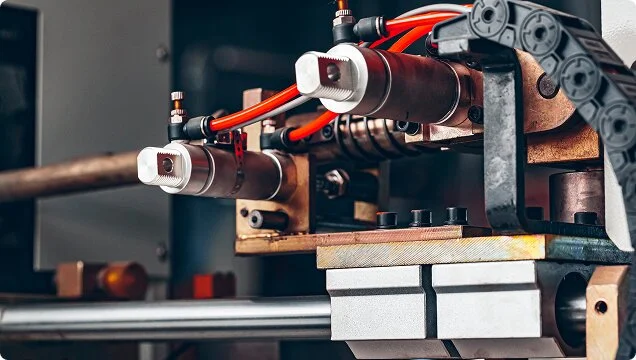
Vapor Chamber Vacuum Filling & Welding Machine Guide
Introduction
A Vapor Chamber Vacuum Filling & Welding Machine plays an important role in vapor chamber manufacturing. It helps manufacturers remove unwanted gases, introduce working fluid, and seal designated filling ports.
Vapor chambers transfer heat through evaporation and condensation. Therefore, manufacturers must control internal pressure, working fluid quantity, and enclosure integrity.
However, these requirements demand precise manufacturing processes. Residual gases can affect thermal performance. Incorrect fluid quantities can also reduce heat transfer efficiency.
Furthermore, an unreliable filling-port seal can cause fluid leakage. Consequently, manufacturers need dependable vacuum processing, accurate fluid dosing, and consistent welding operations.
An integrated vacuum filling and welding machine combines several production steps. As a result, it can reduce manual handling and improve process repeatability.
cncoolingthermal provides information about thermal manufacturing equipment and vapor chamber production solutions through its official website, cncoolingthermal.com.
This guide explains machine functions, operating principles, production workflows, technical considerations, quality control, and equipment selection.
1. What Is a Vapor Chamber Vacuum Filling & Welding Machine?
A Vapor Chamber Vacuum Filling & Welding Machine integrates vacuum processing, working fluid filling, and filling-port sealing into a coordinated manufacturing system.
Manufacturers use this equipment during the final stages of vapor chamber production. The exact sequence depends on the chamber design and machine configuration.
First, the system connects the vapor chamber to a vacuum circuit. Next, a vacuum pump removes unwanted gases from the chamber.
Then, the filling system introduces a controlled quantity of working fluid. Finally, a compatible welding mechanism seals the designated filling port.
Consequently, manufacturers can perform several critical operations within one workstation.
Main Functions
A suitable machine may support the following operations:
Vacuum evacuation of vapor chambers
Removal of residual non-condensable gases
Controlled working fluid filling
Filling quantity management
Filling-port positioning
Laser or other compatible sealing methods
Automatic process sequencing
Parameter monitoring and recording
Integration with upstream and downstream equipment
However, not every model supports every function. Buyers should confirm the available configuration before selecting equipment.
Why Is Integration Important?
Separate machines require additional transfer and positioning steps.
Furthermore, repeated handling can increase cycle time and create opportunities for contamination.
An integrated system coordinates vacuum, filling, and sealing operations. Therefore, it can simplify production management and improve process consistency.
2. Why Vacuum Filling and Welding Matter
Vapor chambers rely on a sealed internal environment. Therefore, manufacturers must carefully control the evacuation, fluid charging, and sealing processes.
2.1 Removing Non-Condensable Gases
A vapor chamber transfers heat through working fluid evaporation and condensation.
However, non-condensable gases can interfere with vapor movement and condensation.
Consequently, effective evacuation helps establish the required internal conditions.
Manufacturers must select suitable vacuum levels and holding times for their chamber designs.
2.2 Controlling Working Fluid Quantity
The working fluid circulates through the vapor chamber during operation.
Therefore, manufacturers must introduce an appropriate fluid quantity.
Too little fluid can cause dry-out under certain operating conditions. Conversely, excessive fluid can affect vapor space and thermal performance.
The optimal quantity depends on chamber dimensions, wick structure, internal volume, and operating requirements.
2.3 Ensuring Reliable Sealing
After filling, manufacturers must seal the filling port.
The joint must retain the working fluid and maintain the required internal environment.
Therefore, suitable sealing methods and validated process parameters remain essential.
2.4 Improving Manufacturing Consistency
Manual evacuation, filling, and sealing can introduce process variation.
In contrast, automated equipment follows programmed sequences.
Furthermore, controlled dosing helps standardize working fluid quantities.
Consequently, manufacturers can improve production repeatability and traceability.
3. How Does the Machine Work?
A Vapor Chamber Vacuum Filling & Welding Machine coordinates several operations through a controlled production sequence.
Step 1: Workpiece Loading
First, the operator or automatic handling system loads the assembled vapor chamber.
Next, a fixture positions the chamber and filling port.
Proper positioning supports reliable connections and consistent sealing.
Step 2: Vacuum Connection
The machine connects the vapor chamber to its vacuum circuit.
Depending on the design, a sealing fixture or specialized interface establishes the connection.
Furthermore, the system checks the connection before evacuation.
Step 3: Vacuum Evacuation
The vacuum pump removes gas from the chamber.
Meanwhile, sensors monitor pressure changes.
The system continues evacuation until it reaches the programmed conditions.
However, the appropriate pressure and holding time depend on the product and process validation.
Step 4: Working Fluid Filling
Next, the filling system introduces the specified working fluid.
A metering mechanism controls the filling quantity.
Additionally, temperature and pressure conditions can influence the filling process.
Therefore, manufacturers should validate the filling method against their product specifications.
Step 5: Filling-Port Welding
After filling, the system prepares the designated port for sealing.
A compatible welding unit closes the port according to the programmed procedure.
Depending on the machine, this operation may use laser welding or another suitable sealing technology.
Step 6: Process Verification
The machine completes its programmed cycle.
Where supported, the controller records pressure, filling, timing, and welding parameters.
However, process records alone cannot prove that every chamber meets hermeticity requirements.
Therefore, manufacturers should perform suitable leak testing and final inspection.
Step 7: Unloading
Finally, the operator or automatic handling system removes the completed chamber.
The production line can then transfer it to inspection and thermal performance testing.
4. Main Components of the Equipment
A typical vacuum filling and welding system contains several coordinated subsystems.
4.1 Vacuum Pumping System
The vacuum pump removes gases from the chamber.
Depending on the application, the system may combine different pump types to achieve the required vacuum conditions.
Additionally, suitable valves and pipelines control gas flow.
Manufacturers should evaluate pump capacity, target pressure, and evacuation time together.
4.2 Vacuum Chamber Interface and Fixtures
The fixture holds the workpiece and connects it to the vacuum circuit.
Furthermore, appropriate seals reduce unwanted air leakage.
Precise positioning also helps the machine connect with the filling port.
4.3 Working Fluid Filling System
The filling system stores, meters, and delivers the working fluid.
Depending on the design, it may use a precision dosing mechanism and controlled fluid delivery lines.
Consequently, the system can introduce the specified quantity into each chamber.
Manufacturers should confirm compatibility with the working fluid and required dosing accuracy.
4.4 Welding System
The welding unit seals the filling port after charging.
A laser welding system may suit certain copper chamber designs.
However, manufacturers should evaluate port geometry, material thickness, and sealing requirements before selecting the welding method.
4.5 Sensors and Measurement Instruments
Pressure sensors monitor vacuum conditions.
Additional sensors may monitor fluid temperature, equipment status, and other process variables.
Furthermore, selected systems can record production parameters for quality management.
4.6 PLC and HMI Control System
A programmable logic controller coordinates the machine sequence.
Meanwhile, the human-machine interface allows operators to select recipes and review machine status.
Consequently, the control system can simplify operation and improve process consistency.
4.7 Cooling and Safety Systems
Certain machine configurations require cooling for the laser or other equipment.
Additionally, the system needs appropriate electrical protection, emergency stops, and process safeguards.
The manufacturer should design fluid handling and ventilation according to the working fluid’s properties.
5. The Complete Vacuum Filling and Welding Process
Manufacturers should establish a validated process for each vapor chamber design.
5.1 Prepare the Vapor Chamber
First, inspect the assembled chamber.
Check dimensions, surface condition, and filling-port integrity.
Additionally, confirm that the chamber meets the requirements for vacuum processing.
5.2 Verify the Filling System
Next, confirm the working fluid specification and required quantity.
Inspect the fluid supply and metering equipment.
Furthermore, check for contamination that could affect filling quality.
5.3 Evacuate the Chamber
Connect the chamber to the vacuum circuit.
Then, operate the vacuum system according to the validated recipe.
Monitor the pressure response and evacuation time.
Consequently, operators can identify unusual pressure behavior before proceeding.
5.4 Introduce the Working Fluid
After evacuation, introduce the specified fluid quantity.
The machine should follow the validated filling sequence.
Additionally, manufacturers should prevent unwanted contamination during fluid transfer.
5.5 Seal the Filling Port
Position the filling port for the selected sealing process.
Next, execute the welding program.
Suitable fixtures help maintain alignment throughout the operation.
5.6 Inspect the Sealed Chamber
Inspect the sealing area for visible defects.
Then, conduct an appropriate leak test.
Furthermore, confirm that the completed chamber meets dimensional requirements.
5.7 Test Thermal Performance
Finally, evaluate the chamber’s thermal performance.
Depending on the product, tests may assess thermal resistance, temperature distribution, and operating stability.
Therefore, manufacturers can evaluate the combined effects of evacuation, fluid filling, and sealing.
6. Key Features and Advantages
6.1 Integrated Processing
The machine combines vacuum evacuation, fluid filling, and port sealing.
Therefore, manufacturers can reduce transfers between separate workstations.
6.2 Controlled Fluid Dosing
A precision filling system delivers the target working fluid quantity.
Furthermore, programmable recipes help maintain consistency across production batches.
6.3 Repeatable Vacuum Processing
Controlled evacuation supports consistent internal conditions.
Additionally, pressure monitoring helps operators identify process deviations.
6.4 Automated Sealing
A compatible welding system closes the filling port.
Consequently, manufacturers can reduce variation associated with manual sealing.
6.5 Reduced Manual Handling
Integrated processing reduces the need to move workpieces between separate machines.
Therefore, manufacturers can simplify material handling.
6.6 Improved Process Traceability
Selected systems record key process parameters.
For example, records may include evacuation time, pressure readings, filling quantities, and welding settings.
Consequently, quality teams can investigate production deviations more effectively.
6.7 Production Line Compatibility
Manufacturers can integrate the machine with assembly, leak testing, and thermal testing stations.
Furthermore, automatic loading can improve production continuity.
However, actual benefits depend on the equipment configuration and factory workflow.
7. Vacuum Filling and Welding vs. Separate Processing
Manufacturers can use an integrated machine or separate equipment for evacuation, charging, and sealing.
Comparison | Integrated Machine | Separate Equipment |
Process coordination | Centralized sequence | Requires coordination between stations |
Workpiece handling | Potentially reduced | Often requires additional transfers |
Footprint | May reduce total station area | Depends on layout |
Process monitoring | Can centralize records | May require separate data systems |
Configuration flexibility | Depends on machine design | Individual stations offer flexibility |
Initial investment | Depends on integration level | Can spread investment across stages |
Maintenance | Multiple subsystems in one station | Separate maintenance arrangements |
Best fit | Coordinated repeat production | Flexible or specialized workflows |
Neither approach suits every factory.
Therefore, buyers should compare throughput, product variation, maintenance needs, and investment costs.
8. Applications in Thermal Management
Vapor chambers support heat spreading across multiple electronic applications.
8.1 CPU Cooling Systems
Processors generate concentrated heat during operation.
Therefore, vapor chambers help distribute heat across compatible cooling assemblies.
Reliable fluid filling and sealing support consistent product performance.
8.2 GPU Cooling Modules
High-performance graphics processors require efficient heat transfer.
Consequently, manufacturers use vapor chambers in suitable graphics cooling designs.
8.3 Gaming Laptops
Gaming laptops require compact cooling solutions.
Furthermore, thin vapor chambers can spread heat within limited spaces.
Precise manufacturing helps maintain chamber geometry and sealing quality.
8.4 Smartphones and Tablets
Mobile devices need lightweight thermal management components.
Therefore, ultra-thin vapor chambers can support selected designs.
However, their small dimensions require careful process control.
8.5 Data Center Equipment
Servers operate under sustained thermal loads.
Consequently, vapor chambers can support selected high-performance cooling systems.
8.6 Industrial Electronics
Industrial controllers and power electronics also require effective thermal management.
Therefore, vapor chambers can serve specialized applications with demanding heat dissipation requirements.
9. Technical Specifications to Consider
Before purchasing a Vapor Chamber Vacuum Filling & Welding Machine, manufacturers should review the following parameters.
Parameter | What to Confirm |
Compatible workpiece | Vapor chamber dimensions and design |
Working fluid | Fluid type and material compatibility |
Vacuum performance | Target pressure and measurement method |
Evacuation time | Required cycle time for each product |
Filling accuracy | Required dosing range and tolerance |
Filling method | Metering and fluid delivery design |
Sealing method | Laser welding or another compatible process |
Port dimensions | Geometry, material, and thickness |
Automation level | Manual, semi-automatic, or automatic |
Process monitoring | Pressure, filling, and welding records |
Leak testing | Required test method and acceptance criteria |
Production capacity | Target output per hour or shift |
Control system | PLC, HMI, and recipe management |
Safety provisions | Fluid handling, ventilation, and machine protection |
Actual specifications vary by model and configuration.
Therefore, buyers should request model-specific technical documents and sample testing.
10. Integration With a Vapor Chamber Production Line
A vacuum filling and welding machine typically operates near the final stages of vapor chamber manufacturing.
A representative production workflow includes:
Copper material cutting and forming
Wick structure preparation
Vacuum sintering
Chamber assembly
Enclosure welding
Vacuum evacuation
Working fluid filling
Filling-port sealing
Leak testing
Thermal performance testing
Final inspection and packaging
However, the exact sequence depends on the chamber design and sealing technology.
Recommended Internal Links
Link the following anchor texts to relevant product pages on cncoolingthermal.com, provided those pages exist.
Vapor Chamber Production Line — Complete manufacturing solutions.
Vapor Chamber Fully Automatic Laser Sealing Machine — Automated enclosure or port sealing.
Vapor Chamber Hot Press Hydraulic Machine — Forming and pressing operations.
Laser Welding Machine for Vapor Chamber — Precision joining applications.
Vacuum Sintering Furnace — Porous wick manufacturing.
Automatic Powder Filling Machine — Copper powder distribution.
Vapor Chamber Thermal Performance Tester — Final thermal evaluation.
These links help visitors explore related equipment and understand how individual machines support the broader manufacturing process.
11. Quality Control and Testing
Reliable production requires more than automated filling and welding.
Manufacturers should establish quality checks throughout the process.
11.1 Vacuum Verification
Monitor pressure during evacuation.
Furthermore, evaluate pressure stability and evacuation time.
These measurements help identify potential leaks or process deviations.
11.2 Filling Quantity Verification
Check the fluid dosing system against the specified tolerance.
Additionally, verify the metering process during routine calibration.
11.3 Weld Inspection
Inspect the sealed port for visible defects.
However, visual inspection cannot confirm hermetic integrity.
Therefore, manufacturers should perform suitable leak testing.
11.4 Leak Testing
Select an appropriate leak test according to the product specification.
For demanding applications, helium leak testing may offer useful sensitivity.
However, the correct method and acceptance limits depend on the chamber design.
11.5 Thermal Performance Testing
Evaluate the finished chamber under defined test conditions.
Measure relevant parameters, such as temperature distribution and thermal resistance.
Consequently, manufacturers can assess the final product’s performance.
12. Common Production Problems and Solutions
12.1 Insufficient Vacuum
A contaminated seal, leaking connection, or unsuitable pump configuration can prevent the system from reaching its target pressure.
Therefore, inspect connections, seals, valves, and vacuum performance.
12.2 Incorrect Fluid Quantity
Poor calibration or unstable fluid delivery can produce filling variation.
Consequently, manufacturers should calibrate the dosing system and verify the filling recipe.
12.3 Filling-Port Leakage
Poor alignment or unsuitable welding parameters can compromise the seal.
Therefore, review fixture positioning, port geometry, and welding conditions.
12.4 Excessive Cycle Time
Long evacuation times can reduce production capacity.
Furthermore, unsuitable loading arrangements can create additional delays.
Therefore, evaluate vacuum system performance and the complete machine cycle.
12.5 Inconsistent Thermal Performance
Variations in fluid quantity, internal cleanliness, sealing quality, or wick structure can affect thermal results.
Consequently, manufacturers should evaluate the complete production process rather than adjusting one parameter alone.
13. How to Choose the Right Machine
13.1 Define Product Specifications
First, provide chamber drawings and dimensions.
Next, identify the working fluid, target quantity, and sealing requirements.
13.2 Confirm Vacuum Requirements
Specify the required pressure and acceptable evacuation time.
Furthermore, ask the supplier to explain its measurement and verification methods.
13.3 Verify Filling Accuracy
Define the required dosing range and tolerance.
Additionally, request evidence from representative filling trials.
13.4 Evaluate Welding Compatibility
Confirm the port material, geometry, and thickness.
Then, validate the sealing method with sample workpieces.
13.5 Calculate Production Capacity
Estimate the required output per shift.
Include loading, evacuation, filling, welding, and unloading in the cycle-time calculation.
13.6 Review Quality Control Options
Determine whether the machine needs automatic parameter logging or integrated inspection.
Additionally, define the required leak testing process.
13.7 Assess Technical Support
Review installation, commissioning, operator training, and spare parts availability.
Consequently, you can evaluate the equipment beyond its purchase price.
14. Maintenance and Safety
Routine maintenance helps maintain stable vacuum and filling performance.
Maintain the Vacuum System
Inspect vacuum lines, seals, valves, and pump condition.
Additionally, follow the manufacturer’s service schedule.
Calibrate the Filling System
Verify dosing accuracy at defined intervals.
Furthermore, use compatible materials throughout the fluid delivery circuit.
Inspect the Welding Unit
Check protective optics and other wear components when the machine uses laser welding.
Maintain fixtures and alignment components according to the supplier’s instructions.
Verify Sensors
Check pressure sensors and other measurement instruments.
Consequently, operators can rely on process readings.
Follow Safety Procedures
Working fluids require suitable storage and handling procedures.
Furthermore, laser welding requires appropriate guarding and interlocks.
Provide ventilation, operator training, and protective equipment according to the machine design and applicable regulations.
For laser safety guidance, consult the Laser Institute of America.
15. Why Consider cncoolingthermal?
cncoolingthermal provides information about thermal manufacturing equipment and vapor chamber production solutions through its official website.
Visit https://cncoolingthermal.com/ to explore the company’s available equipment information.
When evaluating a vacuum filling and welding machine, manufacturers should consider the complete process rather than focusing only on the filling station.
Prepare Your Technical Requirements
Before requesting equipment information, prepare:
- Vapor chamber drawings
- Workpiece dimensions and material
- Working fluid specifications
- Required vacuum conditions
- Target filling quantity and tolerance
- Filling-port design
- Required sealing method
- Expected production capacity
- Quality testing requirements
These details help equipment suppliers evaluate the application.
Consider Complete Production Integration
A vapor chamber production line may require forming, sintering, assembly, vacuum processing, filling, sealing, and testing equipment.
Therefore, manufacturers should evaluate how each machine supports the complete workflow.
Visit cncoolingthermal.com to learn more about available thermal manufacturing equipment and production solutions.
16. Frequently Asked Questions
16.1 What is a Vapor Chamber Vacuum Filling & Welding Machine?
It combines vacuum evacuation, working fluid filling, and filling-port sealing in one coordinated system.
Manufacturers use it to control important stages of vapor chamber production.
16.2 Why does a vapor chamber require vacuum filling?
Vacuum evacuation removes unwanted gases before fluid charging.
Consequently, the process helps establish the required internal operating conditions.
16.3 Which working fluids do vapor chambers use?
Many copper vapor chambers use water as the working fluid.
However, other designs may use different fluids according to operating temperatures, materials, and application requirements.
16.4 How does the machine control fluid quantity?
A metering system delivers the specified working fluid quantity.
Manufacturers should confirm dosing accuracy and calibration procedures before purchasing.
16.5 How does the machine seal the filling port?
A compatible welding system seals the designated port after filling.
Depending on the configuration, the machine may use laser welding or another suitable process.
16.6 Can the machine automatically complete the entire process?
Some configurations coordinate evacuation, filling, and sealing automatically.
However, loading, inspection, and leak testing may require separate equipment or operator involvement.
16.7 How do manufacturers verify sealing quality?
They inspect the sealed area and perform appropriate leak tests.
Additionally, manufacturers may evaluate thermal performance after completing production.
16.8 What affects vacuum filling cycle time?
Pump performance, chamber volume, initial gas conditions, target pressure, and process settings influence evacuation time.
Filling and welding also contribute to the total cycle.
16.9 Can the machine support different vapor chamber sizes?
Some machines support multiple products through adjustable fixtures and programmable recipes.
However, buyers should confirm the supported size range and changeover requirements.
16.10 What should buyers provide when requesting a quotation?
Provide product drawings, dimensions, working fluid information, vacuum requirements, filling tolerance, and expected output.
Additionally, include the filling-port design and sealing requirements.
16.11 Does vacuum filling guarantee high thermal performance?
No. Vacuum filling supports important manufacturing requirements, but thermal performance also depends on wick structure, internal cleanliness, fluid quantity, and chamber design.
Therefore, manufacturers should perform final thermal testing.
16.12 Where can I find vapor chamber production equipment?
Visit cncoolingthermal.com to explore available thermal manufacturing equipment and vapor chamber production solutions.
Confirm specific machine availability and technical configurations directly with the supplier.
17. Conclusion
A Vapor Chamber Vacuum Filling & Welding Machine combines several critical manufacturing operations within one coordinated system.
Vacuum evacuation removes unwanted gases. Controlled fluid filling establishes the specified working fluid quantity. Meanwhile, welding seals the filling port.
Furthermore, automated process control can improve repeatability and reduce manual handling.
However, reliable results require suitable vacuum conditions, accurate dosing, compatible sealing technology, and comprehensive quality testing.
Therefore, manufacturers should define their product specifications and production targets before selecting equipment.
For companies planning vapor chamber manufacturing, cncoolingthermal offers a starting point for exploring thermal production equipment.
Visit https://cncoolingthermal.com/ for more information about the company’s equipment offerings.