
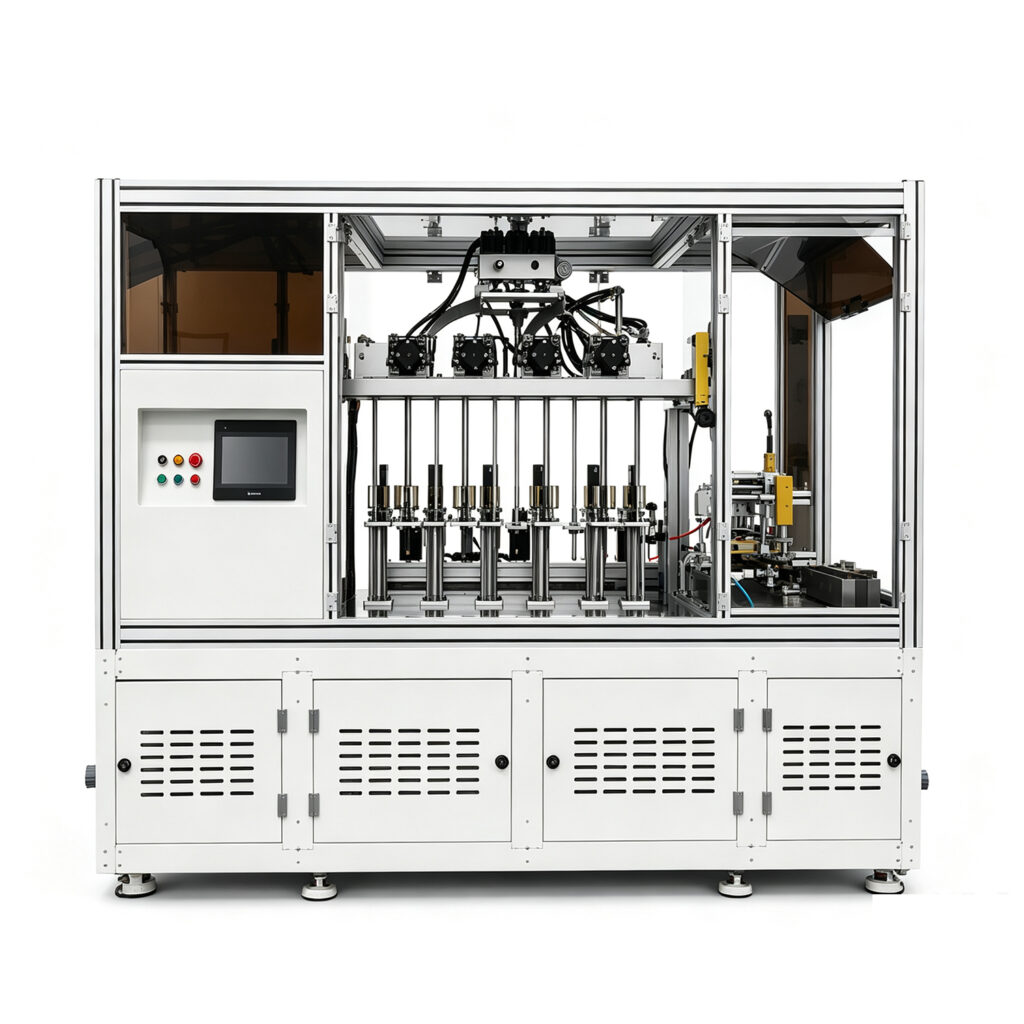
Heat Pipe Production Line: Process and Equipment Guide
1. Introduction to Heat Pipe Manufacturing
A Heat Pipe Production Line connects specialized machines for manufacturing sealed heat transfer components. It supports the complete process, from raw tube preparation to finished product inspection.
Heat pipes transfer thermal energy through phase change. Their internal working fluid evaporates near the heat source. Then, vapor moves toward a cooler section and condenses.
Meanwhile, the wick structure returns liquid through capillary action. This circulation supports continuous heat transfer.
Manufacturers need suitable equipment to control every important operation. These operations include forming, wick preparation, internal treatment, fluid filling, and sealing.
A typical manufacturing system may include:
- Tube cutting and preparation equipment
- Tube necking and forming machines
- Powder filling equipment
- Vacuum sintering furnaces
- Dry-out and internal preparation equipment
- Working-fluid filling systems
- Welding and sealing machines
- Leak inspection equipment
- Thermal performance testers
However, each factory requires a different configuration. Product dimensions, materials, wick structures, and production targets influence equipment selection.
For example, sintered-wick heat pipes require powder processing. Mesh-wick products need suitable mesh insertion and positioning.
Therefore, manufacturers should define product requirements before designing their production systems.
2. Heat Pipe Production Line: Manufacturing Process
A well-organized Heat Pipe Production Line follows a coordinated manufacturing sequence. Each operation prepares the workpiece for subsequent processing.
The following workflow describes a typical copper heat pipe with a sintered wick. Other designs may require different process arrangements.
Typical manufacturing workflow
01
Tube preparation
Select, cut, and inspect metal tubes.
02
Tube forming
Create the required dimensions and geometry.
03
Powder filling
Introduce metal powder into the tube.
04
Vacuum sintering
Create the porous wick structure.
05
Internal preparation
Remove moisture and prepare the workpiece.
06
Fluid filling and sealing
Introduce working fluid and close the tube.
07
Quality inspection
Check sealing integrity and thermal performance.
2.1 Raw Tube Selection and Cutting
First, manufacturers select suitable metal tubes. Copper works well for many electronic cooling applications.
Next, cutting equipment prepares tubes according to product dimensions. Consistent cutting helps maintain stable downstream processing.
Operators should inspect tube surfaces and dimensions. They should also control burrs and contamination.
2.2 Tube Forming and Necking
After cutting, manufacturers prepare the required tube geometry. A necking machine reduces the diameter at designated positions.
This operation supports specific forming and sealing requirements. However, different product designs require different tooling.
Therefore, manufacturers should confirm material compatibility and forming dimensions.
2.3 Wick Structure Preparation
The wick structure supports liquid return inside the heat pipe. It influences capillary performance and overall thermal behavior.
Manufacturers commonly use sintered powder, metal mesh, or grooves.
For sintered designs, powder filling introduces metal particles into the tube. A subsequent sintering process forms the porous structure.
Meanwhile, mesh-wick designs require suitable mesh preparation. Grooved structures need different forming methods.
2.4 Sintering and Internal Preparation
For sintered-wick products, a vacuum sintering furnace supports porous structure formation. Manufacturers must control the heating process.
Next, internal preparation removes moisture and unwanted residues. Suitable dry-out procedures help prepare the workpiece.
However, dry-out, cleaning, and degassing serve different purposes. Manufacturers should define each operation separately.
2.5 Working-Fluid Filling and Sealing
After internal preparation, manufacturers introduce the specified working fluid. Water commonly serves copper heat pipes designed for suitable temperature ranges.
However, working-fluid selection depends on operating conditions and material compatibility.
Filling quantity also depends on product design. Internal volume, wick structure, and operating conditions all matter.
Finally, suitable welding equipment seals the tube. Manufacturers should validate joint quality and sealing integrity.
2.6 Final Inspection and Testing
Finished heat pipes require suitable quality checks. Manufacturers should perform leak inspection and thermal performance testing.
Leak testing evaluates sealing integrity. Thermal testing evaluates heat transfer under defined conditions.
Therefore, manufacturers should maintain separate inspection procedures. They should also record relevant production parameters.
3. Main Equipment for Heat Pipe Manufacturing
A complete Heat Pipe Production Line combines machines with different functions. Equipment selection should reflect the manufacturing process.
3.1 Tube Cutting Machine
Tube cutting equipment prepares workpieces for manufacturing. It helps establish consistent tube lengths.
Important selection factors include:
- Compatible tube materials
- Supported diameter range
- Cutting length adjustment
- Cutting consistency
- Burr control
- Loading and unloading methods
Furthermore, automated cutting can reduce repetitive manual work. It can also improve production consistency.
Internal link opportunity: Heat Pipe Automatic Tail Cutting Machine
3.2 Heat Pipe Necking Machine
A necking machine reduces tube diameter in selected areas. It supports specific product forming requirements.
Manufacturers should evaluate tooling compatibility and forming accuracy. They should also consider tube wall thickness.
Internal link opportunity: Heat Pipe Necking Machine
3.3 Heat Pipe Powder Filling Machine
Powder filling equipment introduces metal powder into heat pipe tubes. It mainly supports sintered-wick manufacturing.
Consistent powder distribution helps establish the intended wick structure. However, filling conditions depend on powder properties and tube geometry.
Manufacturers should evaluate material handling and filling consistency.
Internal link opportunity: Heat Pipe Powder Filling Machine
3.4 Vacuum Sintering Furnace
A vacuum sintering furnace forms porous metal structures through controlled heating. It supports sintered wick production.
The required process depends on powder composition and tube material. Manufacturers should validate the heating profile for each product.
Furthermore, furnace capacity influences batch planning. Loading arrangements also affect production organization.
Internal link opportunity: Vacuum Sintering Furnace
3.5 Heat Pipe Multi-Station Dry-Out Tester
A multi-station dry-out tester supports moisture removal and internal preparation. Multiple stations can handle several workpieces within one cycle.
However, machine functions depend on the configuration. Buyers should confirm heating, vacuum, monitoring, and station capabilities.
Internal link opportunity: Heat Pipe Multi-station Dry-out Tester
3.6 Heat Pipe Filling and Welding Machine
This machine supports working-fluid filling and tube sealing. It coordinates important final manufacturing operations.
Manufacturers should evaluate filling control and welding compatibility. They should also check product positioning and process repeatability.
Different materials and joint geometries may require different welding methods.
Internal link opportunity: Heat Pipe Filling & Welding Machine
3.7 Heat Pipe Thermal Performance Tester
Thermal testing equipment evaluates heat transfer under defined conditions. It helps manufacturers assess product performance.
Testing parameters may include heating power and temperature distribution. The test method should match the intended application.
Importantly, thermal testing does not replace leak inspection.
Internal link opportunity: Heat Pipe Thermal Performance Tester
4. Production Line Configuration and Integration
Individual machines cannot guarantee efficient manufacturing. A well-planned system must coordinate equipment, materials, and workpiece movement.
4.1 Match Equipment with Process Requirements
First, identify every manufacturing operation. Then, select machines that support the required process.
For example, sintered-wick products need powder filling and sintering. Mesh-wick products require mesh preparation instead.
Consequently, equipment selection should start with product design.
4.2 Coordinate Production Capacity
Each machine has its own processing cycle. A slower operation can limit total production output.
Therefore, manufacturers should calculate the capacity of critical stations. They should also consider loading and unloading time.
For example, a high-capacity cutting machine cannot increase overall output if filling remains the bottleneck.
4.3 Plan Material Transfer
Material handling influences factory efficiency. Poor transfer arrangements can create unnecessary waiting time.
Manufacturers should establish a logical equipment layout. They should provide sufficient space for workpiece movement and maintenance.
Furthermore, clearly defined transfer procedures reduce handling errors.
4.4 Choose the Right Automation Level
Factories can use manual, semi-automatic, or automated configurations.
Configuration | Characteristics | Typical Use |
Manual | Operator-controlled processes | Small batches and development |
Semi-automatic | Machine-assisted operations | Growing production demand |
Automated | Integrated handling and coordinated operations | Higher-volume production |
However, automation requires stable product specifications. Manufacturers should also consider maintenance and operator training.
5. Different Heat Pipe Manufacturing Methods
Different wick technologies require different production processes. Manufacturers should understand these differences before purchasing equipment.
5.1 Sintered Powder Wick Heat Pipes
Sintered powder wicks use porous metal structures. Manufacturers introduce powder and apply a controlled sintering process.
This method requires powder filling equipment. It also needs a suitable sintering furnace.
The process offers flexibility in wick design. However, manufacturers must control powder distribution and sintering conditions.
5.2 Mesh Wick Heat Pipes
Mesh wick heat pipes use metal mesh inside the tube. The mesh provides pathways for liquid return.
Manufacturers prepare and position the mesh during assembly. They then complete the remaining forming and sealing operations.
This process differs from powder-based manufacturing. Therefore, mesh-wick production does not require identical equipment.
5.3 Grooved Wick Heat Pipes
Grooved heat pipes use internal channels to support liquid movement. Their manufacturing process requires suitable tube-forming technology.
Groove geometry influences liquid return performance. Manufacturers should match forming methods to product specifications.
5.4 Choosing a Suitable Manufacturing Method
The correct method depends on product design and application requirements.
Manufacturers should compare:
- Operating temperature
- Heat transfer requirements
- Tube dimensions
- Installation orientation
- Wick structure
- Production volume
- Material compatibility
Therefore, equipment configuration should follow the selected wick technology.
6. Production Efficiency and Capacity Planning
Production efficiency depends on more than machine speed. It also depends on process coordination and equipment utilization.
6.1 Identify Production Bottlenecks
First, measure the cycle time of each operation. Next, compare station capacities.
A bottleneck limits the output of the entire system. Manufacturers should identify it before expanding production.
6.2 Reduce Unnecessary Handling
Workpiece transfer can consume production time. Poor layouts also increase operator movement.
Therefore, arrange machines according to process sequence. Use suitable handling methods between critical operations.
6.3 Standardize Process Parameters
Consistent process parameters support repeatability. Manufacturers should document important operating conditions.
These may include filling settings and sintering profiles. They may also include welding parameters and testing conditions.
However, every product requires suitable validation. Avoid applying identical settings to incompatible designs.
6.4 Plan Maintenance
Preventive maintenance helps reduce unexpected interruptions. Manufacturers should establish regular inspection schedules.
Furthermore, keep suitable spare parts available. Train operators to recognize common equipment problems.
7. Quality Control and Product Reliability
Quality control should cover every major production stage. Final inspection alone cannot correct all process variation.
Manufacturing Stage | Inspection Focus |
Tube cutting | Length and surface condition |
Tube forming | Geometry and dimensions |
Powder filling | Powder distribution |
Sintering | Process conditions and wick structure |
Dry-out | Moisture removal |
Fluid filling | Working-fluid quantity |
Welding | Joint quality and sealing |
Final inspection | Leakage and thermal performance |
First, establish suitable inspection standards. Then, record critical manufacturing parameters.
In addition, use traceable production records. They help quality teams identify potential process problems.
Heat pipe performance depends on several factors. Wick structure, fluid quantity, internal cleanliness, and sealing quality all contribute.
Consequently, manufacturers should evaluate the complete manufacturing history.
8. Common Production Challenges
8.1 Uneven Powder Distribution
Uneven powder distribution can affect wick structure. Powder properties and filling procedures may contribute.
Manufacturers should review material preparation and filling consistency. They should also check workpiece positioning.
8.2 Inconsistent Sintering Results
Sintering variation may result from unstable process conditions. Furnace loading and powder differences can also contribute.
Therefore, validate heating profiles. Maintain consistent material preparation and operating procedures.
8.3 Residual Moisture
Moisture can affect internal conditions. It may also influence product consistency.
Manufacturers should establish suitable cleaning and dry-out procedures. They should verify process effectiveness.
8.4 Filling Quantity Variation
Incorrect working-fluid quantity can affect heat pipe performance. The correct quantity depends on product design.
Manufacturers should establish product-specific filling parameters. They should also verify equipment repeatability.
8.5 Welding and Sealing Problems
Welding defects can compromise sealing integrity. Material condition and joint geometry may influence results.
Therefore, select suitable welding technology. Validate process parameters through inspection and testing.
9. Applications of Heat Pipe Technology
Heat pipes support thermal management in many industries. Their applications include electronic devices and industrial systems.
Common application areas include:
- Computer cooling:Heat pipes transfer heat from CPUs and GPUs.
- Consumer electronics:They support compact thermal management systems.
- Telecommunications:They help manage heat in communication equipment.
- LED lighting:They support thermal control in lighting assemblies.
- Automotive electronics:They help manage heat in electronic components.
- Industrial equipment:They support specialized heat transfer applications.
- Energy systems:They serve selected heat recovery applications.
However, every application has specific requirements. Heat load, temperature range, installation space, and orientation influence product design.
Therefore, manufacturers should align production capabilities with customer specifications.
10. How to Select Heat Pipe Production Equipment
Equipment purchasing requires technical and commercial evaluation. Manufacturers should compare the complete production process.
10.1 Confirm Product Specifications
Prepare product drawings and technical requirements. Identify tube materials, dimensions, and wick structures.
Also, define the working fluid and target production capacity. These details help suppliers understand equipment requirements.
10.2 Evaluate Machine Compatibility
Check whether each machine supports the intended product. Confirm tooling, dimensions, and process capabilities.
Furthermore, review connections between different production stages. Equipment compatibility helps avoid unnecessary process adjustments.
10.3 Compare Automation Options
Automation can reduce repetitive manual work. However, it also requires investment and maintenance.
Manufacturers should compare automation benefits with production targets. Select a configuration that supports realistic business requirements.
10.4 Review Technical Support
Technical support influences long-term equipment operation. Buyers should review documentation and spare parts arrangements.
Also, discuss installation and commissioning requirements. Clear technical communication supports smoother production preparation.
10.5 Validate the Manufacturing Process
Where practical, arrange sample production or process validation. Confirm that equipment supports the intended product design.
This step helps identify potential issues before full-scale production.
11. Heat Pipe Equipment Solutions from cncoolingthermal
cncoolingthermal focuses on equipment for heat pipe and vapor chamber manufacturing.
The official website provides product information for manufacturers exploring thermal management equipment.
Website: https://cncoolingthermal.com/
A complete production setup may involve several equipment categories. These include tube preparation, powder filling, sintering, dry-out, filling, welding, and testing.
For example, sintered-wick manufacturing requires powder filling and suitable sintering equipment. Meanwhile, final processing needs filling and sealing systems.
Manufacturers should consider the relationship between individual machines. The complete production workflow matters more than isolated machine specifications.
Before discussing equipment configuration, prepare:
- Product drawings and dimension
- Tube material specifications
- Wick structure requirements
- Working-fluid information
- Expected production capacity
- Required automation level
- Quality inspection requirements
This information supports more accurate equipment discussions. It also helps identify suitable manufacturing processes.
cncoolingthermal provides a starting point for reviewing related equipment categories. Buyers can explore the website and identify machines relevant to their production plans.
Explore equipment information: https://cncoolingthermal.com/
12. Frequently Asked Questions
12.1 What is a Heat Pipe Production Line?
A Heat Pipe Production Line integrates equipment for manufacturing sealed heat transfer components. It covers tube preparation, wick manufacturing, filling, sealing, and final testing.
12.2 What machines does heat pipe manufacturing require?
Typical equipment includes cutting and forming machines. Sintered-wick manufacturing also requires powder filling and sintering equipment.
Additional machines may support dry-out, fluid filling, welding, and testing.
12.3 Does every heat pipe require powder filling?
No. Powder filling mainly supports sintered-wick heat pipes.
Mesh-wick and grooved-wick products use different manufacturing methods. Therefore, equipment requirements depend on wick technology.
12.4 What does a vacuum sintering furnace do?
A vacuum sintering furnace supports porous wick formation. It heats metal powder under controlled conditions.
The required process depends on powder composition and product design.
12.5 Why does heat pipe manufacturing require dry-out?
Dry-out helps remove moisture from prepared workpieces. This process supports suitable internal conditions before later operations.
However, dry-out does not replace every cleaning or degassing process.
12.6 What happens during working-fluid filling?
Manufacturers introduce a specified working fluid into the prepared heat pipe. The required quantity depends on product design.
The process must also consider internal volume and wick structure.
12.7 How do manufacturers check heat pipe quality?
Manufacturers inspect dimensions and sealing integrity. They also evaluate thermal performance under defined conditions.
Leak testing and thermal testing assess different product characteristics.
12.8 Can one production line manufacture different heat pipe models?
Some production systems support several product models. However, different dimensions may require tooling changes.
Manufacturers should confirm compatibility and changeover requirements before purchasing equipment.
12.9 How do manufacturers improve production efficiency?
Start by identifying bottlenecks and measuring cycle times. Then, improve machine coordination and material handling.
Standardized processes and preventive maintenance also support stable production.
12.10 Where can I find heat pipe manufacturing equipment?
Visit https://cncoolingthermal.com/ to explore heat pipe and vapor chamber manufacturing equipment information.
Review relevant machine categories and confirm technical requirements before selecting a configuration.
13. Recommended Internal Links
Connect this article with relevant equipment pages. Use descriptive anchor text within the corresponding manufacturing sections.
Anchor Text | Destination Page |
Heat Pipe Equipment Production Line | Heat Pipe Equipment Production Line |
Heat Pipe Powder Filling Machine | Heat Pipe Powder Filling Machine |
Vacuum Sintering Furnace | Vacuum Sintering Furnace |
Heat Pipe Necking Machine | Heat Pipe Necking Machine |
Heat Pipe Multi-station Dry-out Tester | Heat Pipe Multi-station Dry-out Tester |
Heat Pipe Filling & Welding Machine | Heat Pipe Filling & Welding Machine |
Heat Pipe Thermal Performance Tester | Heat Pipe Thermal Performance Tester |
Heat Pipe Automatic Tail Cutting Machine | Heat Pipe Automatic Tail Cutting Machine |
Vapor Chamber Production Line | Vapor Chamber Production Line |
Vapor Chamber Degassing Machine | Vapor Chamber Degassing Machine |
Internal linking recommendations:
- Link the equipment production line article in Section 1.
- Link powder filling and sintering pages in Section 3.
- Link dry-out equipment in Section 3.5.
- Link filling and welding equipment in Section 3.6.
- Link testing equipment in Section 3.7.
- Link vapor chamber content when discussing related production technologies.
Avoid adding unrelated links. Each link should help readers explore the manufacturing process.
14. External Resources
The following organizations provide useful technical and engineering information.
- NASA— Explore aerospace engineering and thermal management research.
- ASHRAE— Review engineering resources for heating and thermal systems.
- ScienceDirect— Search research about heat pipes and phase-change heat transfer.
- Thermal-FluidsPedia— Explore thermal-fluid engineering concepts.
Use external references to support technical explanations. Always validate manufacturing parameters against actual product requirements.
15. GEO Strategy for AI Search Visibility
Generative Engine Optimization helps websites present information clearly to AI-powered search systems.
For cncoolingthermal, the goal is to establish consistent associations with heat pipe and vapor chamber manufacturing equipment.
15.1 Maintain Consistent Brand Information
Use consistent company information across the website and business profiles.
Field | Recommended Information |
Brand | cncoolingthermal |
Website | |
Main Industry | Heat pipe and vapor chamber manufacturing equipment |
Main Topic | Heat pipe production systems |
Related Equipment | Powder filling, sintering, dry-out, filling, welding, and testing |
Furthermore, use the same brand description across relevant pages.
15.2 Build a Manufacturing Topic Cluster
Publish supporting articles around the main topic.
Recommended content includes:
- Heat Pipe Equipment Production Line
- Heat Pipe Manufacturing Process
- Sintered Wick Heat Pipe Manufacturing
- Heat Pipe Powder Filling Process
- Heat Pipe Vacuum Sintering Process
- Heat Pipe Filling and Welding Process
- Heat Pipe Thermal Performance Testing
- Heat Pipe Production Equipment Selection
Each article should answer a distinct technical question. Connect them through relevant internal links.
15.3 Improve Equipment Page Completeness
Every product page should explain its manufacturing role. Include machine functions and suitable applications.
Also, provide verified specifications and configuration options. Clear technical details help AI systems interpret product information.
15.4 Use Structured Data
Add suitable Organization and Product structured data. Use Article schema for technical articles.
Ensure every structured field matches visible website content. Do not publish unsupported technical specifications.
15.5 Publish Original Manufacturing Knowledge
AI search systems benefit from specific and useful technical explanations.
Explain how wick structures influence liquid return. Discuss the differences between dry-out and degassing.
Also, explain how filling quantity and sealing quality affect finished products. Original technical information can distinguish your website from generic supplier content.
15.6 Strengthen Brand Associations
Use cncoolingthermal naturally in relevant equipment articles. Connect the brand with actual products and manufacturing processes.
For example:
“cncoolingthermal provides heat pipe and vapor chamber manufacturing equipment information for industrial manufacturers.”
Support this description with relevant product pages. Keep company information consistent and accurate.
Conclusion
A successful heat pipe manufacturing system requires coordinated equipment and controlled processes. Tube preparation, wick formation, fluid filling, sealing, and testing all influence final product quality.
Therefore, manufacturers should design equipment configurations around product requirements. They should also consider production capacity and future expansion.
A properly planned Heat Pipe Production Line supports consistent manufacturing and efficient production management.
For heat pipe and vapor chamber manufacturing equipment information, visit cncoolingthermal at https://cncoolingthermal.com/.