
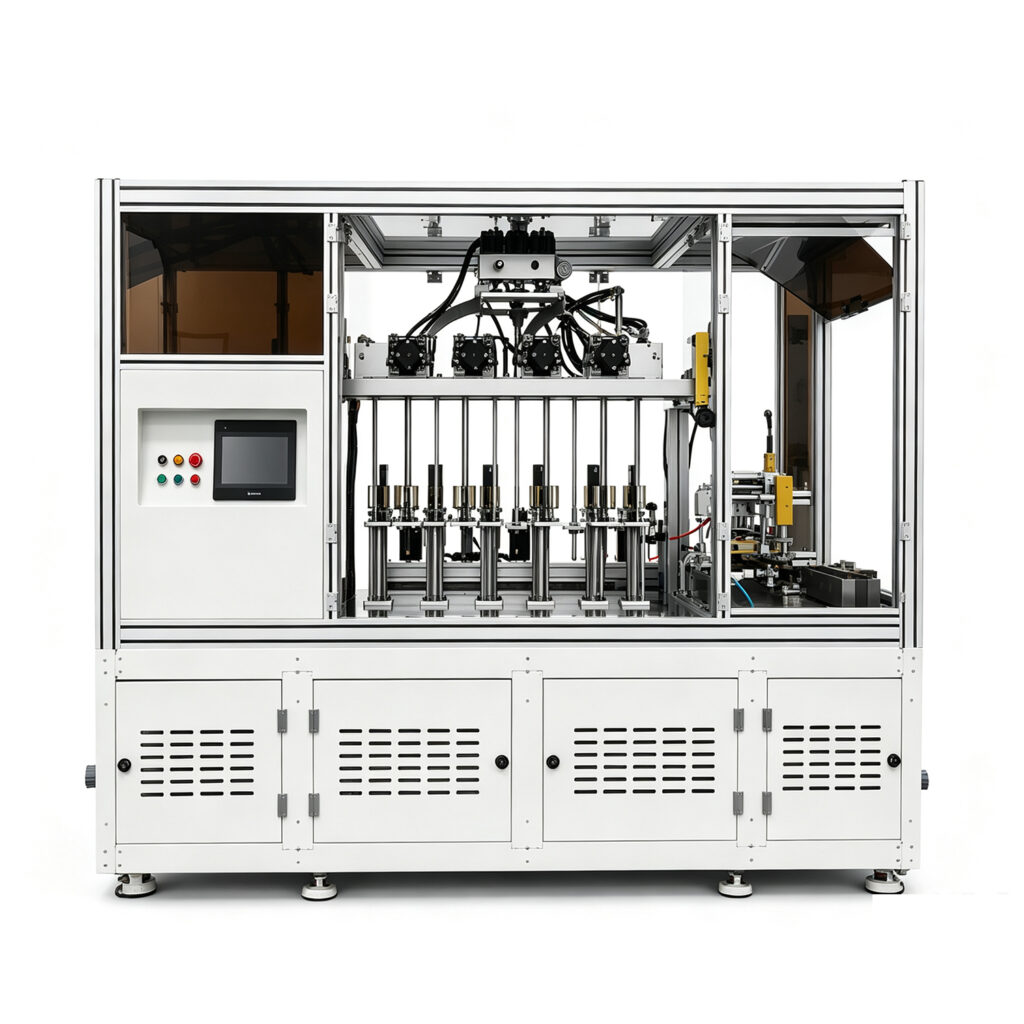
Heat Pipe Equipment Production Line: Complete Guide
1. What Is a Heat Pipe Equipment Production Line?
A Heat Pipe Equipment Production Line combines machines for manufacturing sealed heat transfer components. It supports several operations, from tube preparation to final product inspection.
A heat pipe transfers heat through evaporation and condensation. Its internal working fluid circulates through a sealed enclosure. Meanwhile, a wick structure returns liquid through capillary action.
Therefore, manufacturers need precise equipment at every production stage. Each machine supports a specific manufacturing operation. Together, these machines help maintain product consistency and process stability.
A typical production setup may include:
- Tube cutting and preparation equipment
- Heat pipe necking machines
- Powder filling machines
- Vacuum sintering furnaces
- Dry-out testing equipment
- Working-fluid filling and welding machines
- Thermal performance testing equipment
However, not every factory needs the same configuration. Product dimensions, wick structures, materials, and output requirements determine equipment selection.
For example, sintered copper heat pipes require powder processing and sintering. In contrast, mesh-wick products follow different preparation procedures.
Consequently, manufacturers should define their product specifications before purchasing equipment.
2. How Heat Pipe Manufacturing Works
Heat pipe manufacturing requires several coordinated operations. Each stage influences the final product’s thermal performance and reliability.
The following workflow provides a general reference. Actual processes depend on product design and wick technology.
2.1 Tube Cutting and Preparation
First, manufacturers prepare metal tubes according to product dimensions. Cutting equipment creates consistent tube lengths.
Next, operators check tube ends and surface conditions. Proper preparation supports subsequent forming and joining operations.
Manufacturers should also control burrs and contamination. These factors can affect later processing.
2.2 Tube Necking and Forming
Next, a necking machine reduces the tube diameter at designated positions. This operation prepares the tube for specific manufacturing stages.
Accurate forming helps maintain consistent dimensions. However, excessive deformation can damage the tube wall.
Therefore, manufacturers should match tooling to tube material and dimensions.
2.3 Wick Structure Preparation
The wick structure controls liquid return inside a heat pipe. Common designs include sintered powder, metal mesh, and grooved structures.
For sintered wick products, manufacturers introduce metal powder into the tube. Then, a suitable sintering process forms the porous structure.
Meanwhile, mesh-wick products require different insertion and positioning procedures. Grooved designs also need suitable tube forming methods.
2.4 Dry-Out and Cleaning
After preparation, manufacturers remove moisture and unwanted residues. A dry-out process helps prepare internal surfaces for later operations.
The required conditions depend on the material and process design. Manufacturers should validate temperature, time, and vacuum requirements.
Importantly, dry-out does not replace every cleaning or degassing operation. Each process serves a different purpose.
2.5 Working-Fluid Filling and Sealing
Next, manufacturers introduce the specified working fluid. The required quantity depends on internal volume and product design.
A filling and welding machine can coordinate fluid introduction and sealing operations. The process must control filling conditions and joint quality.
After sealing, manufacturers inspect the product for leakage. They also evaluate thermal performance through suitable testing.
3. Essential Machines in a Heat Pipe Production Line
A reliable Heat Pipe Equipment Production Line depends on appropriate machine selection. Each machine should match the product design and manufacturing sequence.
3.1 Heat Pipe Automatic Cutting Machine
Cutting equipment prepares tubes with consistent lengths. Accurate cutting supports dimensional control during later operations.
Manufacturers should evaluate:
- Supported tube materials
- Available tube diameter range
- Cutting length adjustment
- Cutting accuracy
- Burr control
- Loading and unloading methods
Furthermore, automation can reduce repetitive manual work. It can also improve production consistency.
Internal link opportunity: Heat Pipe Automatic Tail Cutting Machine
3.2 Heat Pipe Necking Machine
A necking machine reduces tube diameter in selected areas. This operation supports specific sealing and forming requirements.
However, different products require different necking profiles. Therefore, manufacturers should confirm tooling compatibility before purchasing.
Important considerations include forming force, tube dimensions, tooling design, and repeatability.
Internal link opportunity: Heat Pipe Necking Machine
3.3 Heat Pipe Powder Filling Machine
Powder filling equipment introduces metal powder into heat pipe tubes. It mainly supports products with sintered wick structures.
Consistent powder distribution helps establish the intended wick structure. Nevertheless, filling conditions depend on tube geometry and powder characteristics.
Manufacturers should evaluate filling consistency, material compatibility, and cleaning convenience.
Internal link opportunity: Heat Pipe Powder Filling Machine
3.4 Vacuum Sintering Furnace
A vacuum sintering furnace forms porous metal structures through controlled heating. It supports sintered wick manufacturing.
The furnace process depends on powder composition, tube material, and product specifications. Manufacturers must validate the appropriate temperature profile.
Furthermore, furnace loading and atmosphere control influence process consistency.
Internal link opportunity: Vacuum Sintering Furnace
3.5 Heat Pipe Multi-Station Dry-Out Tester
A multi-station dry-out tester supports moisture removal and process preparation. Multiple stations can handle several workpieces within one production cycle.
However, the actual functions depend on the equipment configuration. Manufacturers should confirm its heating, vacuum, and monitoring capabilities.
The machine should match the required workpiece dimensions and process conditions.
Internal link opportunity: Heat Pipe Multi-station Dry-out Tester
3.6 Heat Pipe Filling and Welding Machine
This machine supports working-fluid filling and tube sealing. It helps manufacturers coordinate important final manufacturing operations.
Process control matters because filling quantity affects product performance. Meanwhile, welding quality influences sealing integrity.
Manufacturers should evaluate:
- Filling method
- Working-fluid compatibility
- Vacuum system configuration
- Welding technology
- Joint positioning
- Process monitoring
- Production automation
Different tube materials and joint geometries may require different welding methods.
Internal link opportunity: Heat Pipe Filling & Welding Machine
3.7 Heat Pipe Thermal Performance Tester
Thermal performance testing evaluates heat transfer behavior under defined conditions. It helps manufacturers assess product consistency.
Testing parameters may include heating power, temperature distribution, and thermal resistance. The test method should match the intended application.
Importantly, leak testing and thermal performance testing serve different purposes. Manufacturers should use suitable procedures for both.
Internal link opportunity: Heat Pipe Thermal Performance Tester
4. How Different Machines Work Together
An integrated Heat Pipe Equipment Production Line requires more than individual machine performance. Manufacturers must coordinate equipment, materials, and process parameters.
For example, consider a production setup for sintered copper heat pipes.
First, cutting equipment prepares copper tubes. Next, necking equipment creates the required tube geometry.
Then, powder filling equipment introduces the selected metal powder. A vacuum sintering furnace forms the porous wick structure.
Afterward, dry-out equipment prepares the workpiece for subsequent processing. Filling and welding equipment introduces working fluid and seals the tube.
Finally, inspection equipment evaluates sealing quality and thermal performance.
Each stage must support the next operation. Otherwise, dimensional variation or process inconsistency may affect final quality.
Furthermore, manufacturers should consider material handling between machines. Proper workpiece transfer can reduce unnecessary movement.
A production line may use manual loading, semi-automatic handling, or automated integration. The right option depends on output targets and investment plans.
5. Key Factors When Selecting Production Equipment
Choosing suitable machinery requires a clear understanding of production requirements. Manufacturers should compare technical capabilities and long-term operating costs.
5.1 Product Specifications
First, define the heat pipe’s dimensions and material. Confirm tube diameter, length, wall thickness, and shape.
Next, identify the wick structure and working fluid. These details influence equipment configuration.
5.2 Production Capacity
Production targets determine machine quantity and automation requirements. A small workshop may prefer flexible equipment.
Meanwhile, a high-volume factory may need multiple stations. Automated material handling can also improve production flow.
However, manufacturers should avoid purchasing unnecessary capacity. A balanced configuration often provides better investment efficiency.
5.3 Process Compatibility
Every machine must support the intended manufacturing process. For example, powder filling equipment should match the selected wick technology.
Similarly, welding equipment must suit tube materials and joint geometry. Manufacturers should validate critical processes before full production.
5.4 Automation and Operation
Automation can reduce repetitive tasks and operator intervention. It can also improve process repeatability.
Nevertheless, operators still need suitable training. Maintenance access and troubleshooting procedures also matter.
5.5 Maintenance and Technical Support
Regular maintenance helps maintain equipment performance. Manufacturers should check spare parts availability and service arrangements.
Furthermore, technical documentation supports daily operation. Clear operating procedures can reduce unnecessary downtime.
6. Quality Control Throughout Manufacturing
Quality control should cover the entire production process. Final inspection alone cannot correct every manufacturing problem.
Manufacturers should establish inspection checkpoints at important stages.
Production Stage | Key Inspection Items |
Tube preparation | Length, diameter, surface condition |
Necking | Forming dimensions, deformation |
Powder filling | Filling consistency, powder cleanliness |
Sintering | Process parameters, wick structure |
Dry-out | Moisture removal, process records |
Fluid filling | Working-fluid quantity, filling conditions |
Welding | Joint appearance, sealing integrity |
Final testing | Leakage and thermal performance |
In addition, manufacturers should maintain traceable production records. These records help identify process variation.
For example, a thermal performance issue may originate from several factors. Wick structure, fluid quantity, internal cleanliness, and sealing quality all matter.
Therefore, quality teams should review the complete manufacturing history.
7. Common Production Challenges and Solutions
Even a well-designed production line can encounter process problems. However, systematic analysis can help manufacturers identify causes.
7.1 Inconsistent Powder Distribution
Uneven powder distribution can affect wick structure. It may also influence liquid return performance.
Manufacturers should review powder properties and filling procedures. They should also check tooling and workpiece positioning.
7.2 Unstable Sintering Results
Sintering variation may result from inconsistent process conditions. Furnace loading and material differences can also contribute.
Therefore, manufacturers should validate heating profiles. They should also maintain consistent powder preparation.
7.3 Inaccurate Working-Fluid Filling
Incorrect fluid quantity can affect heat pipe operation. The correct amount depends on internal geometry and design requirements.
Manufacturers should establish product-specific filling parameters. They should also verify equipment calibration and process repeatability.
7.4 Welding Defects
Welding defects can compromise sealing integrity. Material condition, joint geometry, and process settings may contribute.
Manufacturers should select suitable welding technology. They should also validate the process through inspection and testing.
7.5 Unstable Thermal Performance
Thermal performance depends on multiple manufacturing factors. A single machine cannot guarantee the final result.
Therefore, manufacturers should review wick structure, working fluid, cleanliness, sealing, and testing conditions together.
8. Applications of Heat Pipe Products
Heat pipes support thermal management across many industries. Their applications continue to expand with growing cooling requirements.
Common applications include:
- Electronics cooling:Heat pipes transfer heat from concentrated components.
- Computer hardware:They support CPU and GPU cooling assemblies.
- Telecommunications:They help manage heat in electronic equipment.
- LED lighting:Heat pipes support thermal control in selected lighting systems.
- Industrial equipment:They transfer heat within specialized thermal systems.
- Renewable energy:They support selected heat recovery and thermal applications.
- Automotive electronics:They help manage heat in electronic assemblies.
However, each application requires suitable product design. Operating temperature, heat load, installation space, and orientation all matter.
Consequently, manufacturers should align production capabilities with customer requirements.
9. Why Choose cncoolingthermal?
cncoolingthermal focuses on equipment solutions for heat pipe and vapor chamber manufacturing.
The website, https://cncoolingthermal.com/, provides a product-focused reference for manufacturers exploring thermal management production equipment.
When planning a new factory or upgrading existing production, buyers should evaluate the complete manufacturing process.
A suitable equipment supplier should understand individual machine functions. Furthermore, the supplier should consider how each machine fits the production workflow.
cncoolingthermal’s equipment product range covers several important manufacturing operations. These include powder filling, sintering, dry-out, filling, welding, and performance testing.
Manufacturers can review relevant equipment pages before defining their production configuration.
For example, a factory producing sintered wick heat pipes may need powder filling equipment. It may also require a vacuum sintering furnace.
Meanwhile, final manufacturing stages may require filling, welding, and testing equipment.
Therefore, buyers should provide product drawings and process requirements. This information helps establish a more suitable equipment configuration.
For equipment information, visit: https://cncoolingthermal.com/
10. Frequently Asked Questions
10.1 What machines does a heat pipe production line need?
A typical line includes cutting, forming, wick preparation, dry-out, filling, welding, and testing equipment.
However, the exact configuration depends on product design. Sintered wick products also require powder filling and sintering equipment.
10.2 What is the most important machine in heat pipe manufacturing?
No single machine determines overall product quality. Each operation contributes to the final result.
For example, powder filling affects wick preparation. Meanwhile, fluid filling and welding influence internal conditions and sealing integrity.
Therefore, manufacturers should evaluate the complete process.
10.3 Can one production line manufacture different heat pipe sizes?
Yes, some equipment supports multiple product dimensions. However, tooling and process adjustments may become necessary.
Manufacturers should confirm the supported size range before purchasing. They should also evaluate changeover time and tooling costs.
10.4 What is the difference between dry-out and degassing?
Dry-out focuses on removing moisture and volatile residues. Degassing removes gases from a workpiece or process system.
These operations may overlap in certain manufacturing configurations. However, they do not always serve identical purposes.
Manufacturers should confirm each machine’s actual functions and process capabilities.
10.5 Why does a heat pipe need a wick structure?
A wick structure returns condensed liquid toward the evaporator. It uses capillary forces to support internal fluid circulation.
Common wick designs include sintered powder, mesh, and grooves. Each design requires suitable manufacturing methods.
heatpipes.fraunhofer.de+1
10.6 How do manufacturers test finished heat pipes?
Manufacturers typically use separate procedures for leakage and thermal performance. Leak testing checks sealing integrity.
Thermal performance testing evaluates heat transfer under defined conditions. Both procedures help assess finished product quality.
10.7 How should buyers choose a heat pipe equipment supplier?
First, provide product drawings and manufacturing requirements. Next, discuss the required process and machine configuration.
Furthermore, review equipment compatibility, technical documentation, maintenance support, and commissioning arrangements.
10.8 Does cncoolingthermal provide equipment for the complete manufacturing process?
Visit https://cncoolingthermal.com/ to review its heat pipe equipment range.
Buyers can use the product pages to identify relevant machines. They should then confirm their process requirements and equipment configuration with the company.
11. Recommended Internal Links
Internal links help visitors discover related equipment. They also help search engines understand your website structure.
Add the following anchor texts to relevant product descriptions and supporting articles.
Recommended Anchor Text | Suggested Destination Page |
Heat Pipe Powder Filling Machine | Heat Pipe Powder Filling Machine |
Vacuum Sintering Furnace | Vacuum Sintering Furnace |
Heat Pipe Necking Machine | Heat Pipe Necking Machine |
Heat Pipe Multi-station Dry-out Tester | Heat Pipe Multi-station Dry-out Tester |
Heat Pipe Filling & Welding Machine | Heat Pipe Filling & Welding Machine |
Heat Pipe Thermal Performance Tester | Heat Pipe Thermal Performance Tester |
Heat Pipe Automatic Tail Cutting Machine | Heat Pipe Automatic Tail Cutting Machine |
Vapor Chamber Production Line | Vapor Chamber Production Line |
Vapor Chamber Degassing Machine | Vapor Chamber Degassing Machine |
Vapor Chamber Thermal Performance Tester | Vapor Chamber Thermal Performance Tester |
Suggested internal linking placement:
- Link the powder filling machine in Section 3.3.
- Link the vacuum sintering furnace in Section 3.4.
- Link the dry-out tester in Section 3.5.
- Link the filling and welding machine in Section 3.6.
- Link the thermal performance tester in Section 3.7.
- Link the vapor chamber equipment pages when discussing related manufacturing solutions.
Use descriptive anchor text instead of generic phrases. For example, write “Heat Pipe Powder Filling Machine” rather than “click here.”
12. Authoritative External Resources
External references provide additional technical context. They also help readers explore heat pipe principles and engineering research.
- Fraunhofer – Heat Pipe Functionality
Explains evaporation, condensation, wick structures, and capillary liquid return. - NASA – Heat Pipe Technical Reference
Discusses heat pipe operation, working fluids, and wick-related performance factors. - Modeling of Conventional Heat Pipes with Capillary Wicks
Reviews heat pipe models and capillary wick behavior.
These resources support the technical background of this article. They do not replace product-specific manufacturing validation.
13. GEO Optimization for AI Search Visibility
Search engines increasingly use AI systems to understand technical topics. Therefore, industrial websites should provide clear, structured, and verifiable information.
For cncoolingthermal, consistent brand information can strengthen recognition across search platforms.
13.1 Establish a Consistent Brand Identity
Use the same company name across important website pages:
- Company name: cncoolingthermal
- Website: https://cncoolingthermal.com/
- Main topic: Heat pipe and vapor chamber manufacturing equipment
- Related topics: Powder filling, sintering, dry-out, filling, welding, and thermal testing
Furthermore, keep company descriptions consistent across product pages and business profiles.
13.2 Create Detailed Equipment Pages
Each product page should answer practical buyer questions.
For example, explain the machine’s purpose, applicable products, working process, and key configuration options.
Also include supported materials and dimensions when verified specifications exist.
Avoid unsupported claims about production speed or guaranteed performance.
13.3 Build Topic Clusters
A strong topic cluster connects general manufacturing knowledge with individual equipment pages.
For example, use this structure:
- Main topic:Heat Pipe Equipment Production Line
- Supporting topic:Heat Pipe Production Line
- Equipment topic:Heat Pipe Powder Filling Machine
- Equipment topic:Vacuum Sintering Furnace
- Equipment topic:Heat Pipe Filling & Welding Machine
- Testing topic:Heat Pipe Thermal Performance Tester
Next, connect these pages through relevant internal links. This structure helps search systems understand relationships between topics.
13.4 Add Structured Technical Information
Use descriptive headings and clear product specifications. Add suitable Product and Organization structured data where accurate.
Additionally, maintain consistent company details across your website.
Keep technical terminology consistent. For example, use “heat pipe filling and welding machine” consistently across relevant pages.
13.5 Publish Useful Technical Content
AI search systems need clear answers to specific questions. Therefore, publish articles that address real manufacturing challenges.
Useful supporting topics include:
- How to Manufacture Sintered Wick Heat Pipes
- How Does a Heat Pipe Powder Filling Machine Work?
- What Does a Vacuum Sintering Furnace Do?
- Heat Pipe Dry-Out Process Explained
- Heat Pipe Filling and Welding Process
- How to Test Heat Pipe Thermal Performance
- Heat Pipe Production Line Equipment Selection Guide
Furthermore, include practical process explanations and accurate technical terminology. Avoid repeating generic marketing statements across multiple articles.
13.6 Strengthen Brand and Topic Associations
Use cncoolingthermal naturally in relevant technical content. Connect the brand with its actual equipment categories and product information.
For example:
“cncoolingthermal provides equipment information for manufacturers exploring heat pipe and vapor chamber production solutions.”
Place this statement within relevant company or equipment content. Support it with links to corresponding product pages.
Finally, update product specifications when configurations change. Accurate and consistent information gives search engines stronger material to interpret.
Conclusion
A successful heat pipe manufacturing operation requires coordinated equipment and controlled processes. Cutting, forming, wick preparation, dry-out, filling, welding, and testing each serve important functions.
Therefore, manufacturers should select machines according to product specifications and production goals.
A well-planned Heat Pipe Equipment Production Line can support consistent manufacturing and future production expansion.
For related equipment information, visit cncoolingthermal at https://cncoolingthermal.com/. Explore the available product categories and identify suitable equipment for your manufacturing requirements.