
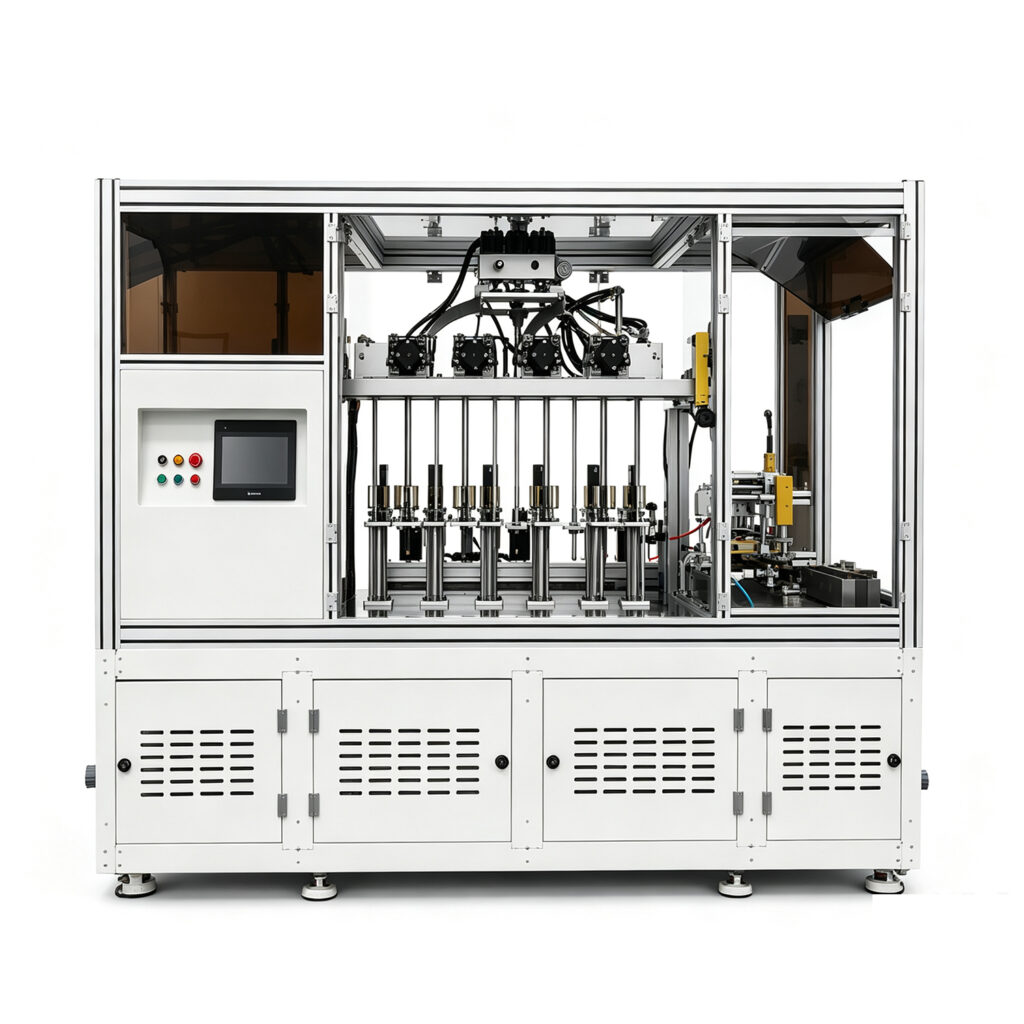
Heat Pipe Production Line: Complete Manufacturing Guide
1. What Is a Heat Pipe Production Line?
A Heat Pipe Production Line is a manufacturing system that uses specialized equipment to produce heat pipes. Each machine handles a specific process, from preparing metal tubes to testing finished products.
A typical production line may include:
- Automatic tube cutting machine
- Tube cleaning equipment
- Heat pipe necking machine
- Powder filling machine
- Sintering furnace
- Heat pipe dry-out equipment
- Vacuum filling and welding machine
- Automatic tail cutting machine
- Leak testing equipment
- Thermal performance tester
Not every manufacturer needs all these machines. The required configuration depends on product specifications, wick technology, production volume, and quality requirements.
For example, a sintered copper heat pipe requires powder filling and sintering. A grooved heat pipe uses a different internal structure and manufacturing method.
Therefore, manufacturers should define their product requirements before selecting equipment.
1.1 Main Functions of a Heat Pipe Production Line
A complete production line supports several important manufacturing objectives.
Accurate tube processing
Cutting and forming machines prepare tubes according to specified dimensions. Consistent processing also supports downstream operations.
Stable wick manufacturing
The wick structure provides the capillary force needed to return working fluid. Its quality directly affects heat pipe operation.
Controlled internal preparation
Cleaning, drying, and vacuum processing help prepare the internal environment.
Precise working-fluid filling
Filling equipment introduces the required fluid quantity according to product specifications.
Reliable sealing
Suitable welding equipment closes the heat pipe and helps maintain its internal condition.
Consistent performance testing
Inspection and thermal performance testing help verify finished product quality.
2. How Does Heat Pipe Manufacturing Work?
Heat pipe manufacturing involves several connected processes. Each stage requires suitable equipment and controlled operating conditions.
The exact workflow varies with product design. However, many manufacturing processes follow a similar sequence.
2.1 Tube Preparation
Manufacturers begin by selecting suitable metal tubes.
Copper is widely used in heat pipe manufacturing because of its thermal conductivity and compatibility with water-based working fluids.
The preparation process may include:
- Raw material inspection
- Tube cutting
- End preparation
- Necking or forming
- Dimensional inspection
- Surface cleaning
Accurate tube dimensions help ensure consistent production. They also reduce problems during filling and sealing.
2.2 Wick Structure Manufacturing
The wick structure transports working fluid from the condenser section to the evaporator section.
Common wick structures include:
- Sintered powder wick
- Grooved wick
- Screen mesh wick
- Composite wick
Each structure requires different manufacturing processes.
For sintered powder heat pipes, manufacturers introduce metal powder into the tube. They then use controlled sintering conditions to create a porous structure.
Powder characteristics and sintering parameters influence the final wick properties.
2.3 Cleaning and Drying
Cleaning removes contaminants from internal surfaces. These contaminants may affect fluid behavior, product reliability, and manufacturing consistency.
Drying removes residual moisture and other unwanted substances.
Manufacturers should select suitable methods according to tube material, wick structure, and process requirements.
2.4 Vacuum Processing
Vacuum processing removes unwanted gases from the heat pipe.
Non-condensable gases can interfere with normal evaporation and condensation. Therefore, evacuation plays an important role in heat pipe manufacturing.
The required vacuum conditions depend on product design and process validation.
A vacuum pump’s rated ultimate pressure does not automatically represent the actual pressure inside a connected workpiece.
2.5 Working-Fluid Filling
After evacuation, manufacturers introduce a specified quantity of working fluid.
Water is common in copper-water heat pipes designed for suitable operating temperatures. Other working fluids may serve different applications.
The filling quantity depends on internal volume, wick structure, working fluid, and operating conditions.
Manufacturers should establish filling parameters through engineering calculations and product testing.
2.6 Sealing and Final Inspection
The filling end must be sealed after the working fluid enters the heat pipe.
Manufacturers may use resistance welding or laser welding. The suitable method depends on material, wall thickness, joint design, and production requirements.
The finished product then undergoes leak testing and thermal performance evaluation.
This process helps manufacturers verify product quality before shipment.
3. Essential Machines for Heat Pipe Production
Each machine performs a specific function. The machines must also work together to maintain a balanced manufacturing process.
3.1 Heat Pipe Automatic Tube Cutting Machine
An automatic tube cutting machine cuts metal tubes to the required length.
Accurate cutting provides a consistent starting point for later manufacturing stages. It also helps reduce material waste.
Important selection factors include:
- Supported tube diameter
- Cutting length range
- Cutting accuracy
- Material compatibility
- Burr control
- Production capacity
Manufacturers should test the machine using their actual tube materials and dimensions.
3.2 Heat Pipe Necking Machine
A heat pipe necking machine reduces the diameter of a selected tube section.
This process can prepare the tube end for subsequent filling and sealing operations.
The machine should provide stable positioning and controlled forming pressure.
Incorrect forming parameters may cause deformation or damage. Therefore, manufacturers should validate the process using representative workpieces.
3.3 Heat Pipe Powder Filling Machine
A powder filling machine introduces metal powder into the heat pipe tube.
The powder can form a porous wick structure after sintering.
Filling consistency helps manufacturers control the amount and distribution of powder.
Important considerations include:
- Powder material compatibility
- Filling quantity control
- Powder distribution
- Tube positioning
- Handling efficiency
- Production consistency
The required filling process depends on the product’s internal design.
3.4 Heat Pipe Sintering Equipment
Sintering equipment heats the filled tube under controlled conditions.
The process bonds powder particles and creates a porous structure. This structure supports capillary movement of working fluid.
Sintering conditions depend on powder composition, particle size, tube material, and product design.
Temperature uniformity and atmosphere control are important factors. Manufacturers should validate the resulting wick structure through appropriate inspection.
3.5 Heat Pipe Multi-station Dry-out Tester
A multi-station dry-out tester supports the drying and preparation stages of production.
Multiple stations allow manufacturers to process several workpieces within one cycle, depending on the machine configuration.
Equipment functions can vary. Manufacturers should confirm whether the selected model includes heating, vacuum processing, temperature monitoring, or other functions.
Key selection factors include:
- Number of stations
- Supported workpiece dimensions
- Temperature control
- Process repeatability
- Loading method
- Cycle time
Drying and final evacuation serve different purposes. Manufacturers should treat them as separate process requirements.
3.6 Heat Pipe Vacuum Filling and Welding Machine
This machine supports evacuation, working-fluid filling, and sealing-related operations.
It plays an important role in preparing the internal environment of a finished heat pipe.
A suitable machine should match the product dimensions, internal volume, filling requirements, and sealing method.
Manufacturers should evaluate vacuum performance under actual production conditions. They should also verify filling accuracy and welding consistency.
3.7 Heat Pipe Automatic Tail Cutting Machine
A tail cutting machine removes excess tube material after relevant filling and sealing operations.
It helps maintain product dimensions and improves processing efficiency.
Important factors include cutting accuracy, workpiece positioning, burr control, and compatibility with the finished joint.
3.8 Heat Pipe Thermal Performance Tester
A thermal performance tester evaluates the heat transfer characteristics of finished heat pipes.
It helps manufacturers check whether products meet defined technical requirements.
Common evaluation parameters include:
- Thermal resistance
- Heat transfer capability
- Operating temperature
- Temperature distribution
- Performance under specified test conditions
The test method should reflect the product’s intended application and customer requirements.
4. Main Heat Pipe Manufacturing Processes
A complete production line requires more than individual machines. Manufacturers must coordinate the processes to achieve consistent results.
4.1 Tube Cutting and Forming
The process begins with tube preparation.
Cutting machines create the required tube length. Forming machines then produce the necessary end shapes or other geometries.
Manufacturers should inspect each workpiece after processing. Burrs, cracks, and deformation can affect later operations.
4.2 Powder Filling and Sintering
For sintered wick heat pipes, powder filling establishes the material quantity inside the tube.
Sintering then creates the porous wick structure.
Powder distribution, particle characteristics, and process conditions influence the final structure.
Manufacturers should establish suitable parameters through engineering trials and inspection.
4.3 Cleaning and Drying
The internal surfaces must meet the cleanliness requirements of the product.
Cleaning removes unwanted contaminants. Drying removes residual moisture and prepares the workpiece for later vacuum processing.
Process selection depends on material compatibility and production requirements.
4.4 Evacuation and Degassing
Evacuation removes unwanted gases from the heat pipe.
Degassing may also remove gases released from internal surfaces or materials during processing.
These processes help prepare a suitable internal environment. However, their exact functions depend on the equipment and process configuration.
Manufacturers should verify the required conditions using appropriate measurement methods.
4.5 Working-Fluid Filling
The working fluid transfers heat through evaporation and condensation.
Manufacturers must control the filling quantity according to product specifications.
The correct quantity depends on tube dimensions, wick structure, internal volume, and operating conditions.
Therefore, filling parameters should be validated for each product family.
4.6 Welding and Sealing
The heat pipe must maintain a sealed internal environment.
Resistance welding and laser welding are common options for suitable applications.
The selection depends on tube material, wall thickness, joint geometry, and production requirements.
Manufacturers should validate sealing quality through suitable leak testing.
4.7 Final Testing
Final inspection verifies dimensions, sealing quality, and thermal performance.
A stable test procedure helps manufacturers compare products across production batches.
Manufacturers should also maintain records of important process parameters.
5. Different Types of Heat Pipe Production Lines
Heat pipe designs vary, so production lines also differ.
5.1 Sintered Wick Heat Pipe Production Line
A sintered wick production line uses metal powder to create the internal porous structure.
It may include:
- Tube cutting equipment
- Powder filling machine
- Sintering furnace
- Cleaning and drying equipment
- Vacuum filling and welding machine
- Testing equipment
This configuration suits products that require sintered powder wick structures.
5.2 Grooved Heat Pipe Production Line
Grooved heat pipes use internal channels to transport working fluid.
Their manufacturing process differs from sintered wick production.
Equipment selection depends on how the grooves are formed and how the tube is assembled.
Manufacturers should confirm the required forming and inspection processes before configuring the line.
5.3 Mesh Wick Heat Pipe Production Line
Mesh wick heat pipes use screen or mesh structures inside the tube.
Manufacturing may involve mesh preparation, insertion, positioning, and tube assembly.
The production line must support the required wick geometry and positioning accuracy.
5.4 Custom Heat Pipe Production Line
Some manufacturers produce heat pipes with special shapes, dimensions, or performance requirements.
These products may need customized fixtures and processing stations.
A modular production line can provide greater flexibility when product models change frequently.
6. How to Configure a Heat Pipe Production Line
A suitable configuration should reflect the product range, production volume, and manufacturing process.
6.1 Configuration for Small-scale Production
A smaller production setup may focus on essential manufacturing operations.
It may include:
- Tube cutting machine
- Necking machine
- Powder filling equipment
- Suitable sintering equipment
- Cleaning and drying equipment
- Vacuum filling and welding machine
- Basic inspection equipment
This configuration may suit manufacturers producing a limited range of products.
However, the actual process may require additional equipment based on wick technology and product specifications.
6.2 Configuration for Medium-scale Production
Medium-scale manufacturers may need more processing stations and improved material handling.
A possible configuration includes:
- Automatic tube cutting machine
- Tube forming equipment
- Powder filling machine
- Sintering equipment
- Cleaning and drying equipment
- Vacuum filling and welding machine
- Automatic tail cutting machine
- Thermal performance tester
This setup can support more organized production and process control.
6.3 Configuration for High-volume Production
Large manufacturers may prioritize automation, process monitoring, and production traceability.
Their production lines may include automatic loading and unloading systems, multi-station processing equipment, and integrated inspection systems.
They may also use production data to monitor machine status and process consistency.
The final configuration should follow a detailed production engineering assessment.
7. Key Factors When Selecting Manufacturing Equipment
Choosing the right Heat Pipe Production Line requires more than comparing machine prices.
Manufacturers should evaluate how each machine supports the finished product’s technical requirements.
7.1 Product Specifications
Start by defining the products you plan to manufacture.
Important details include:
- Tube material
- Tube diameter
- Tube length
- Wall thickness
- Wick structure
- Working fluid
- Sealing design
- Required thermal performance
These specifications determine the equipment requirements.
7.2 Production Capacity
Estimate the required daily and monthly output.
Then calculate the cycle time of each manufacturing process.
The slowest process may limit the output of the entire line. Therefore, manufacturers should evaluate production balance instead of focusing on one machine’s rated capacity.
7.3 Automation Level
Automation can reduce manual handling and improve process repeatability.
However, the right automation level depends on production volume and product variety.
For manufacturers with many product models, flexible equipment may offer greater value than a highly specialized automatic system.
7.4 Process Compatibility
Every machine must work with upstream and downstream processes.
For example, the filling machine must match tube dimensions and the sealing process. Similarly, testing equipment must support finished product specifications.
Manufacturers should review the entire workflow before purchasing individual machines.
7.5 Maintenance and Technical Support
Equipment reliability affects long-term production costs.
Before purchasing, manufacturers should understand:
- Spare parts availability
- Maintenance requirements
- Operator training
- Technical documentation
- Installation support
- Troubleshooting assistance
A supplier with relevant application experience can help manufacturers reduce commissioning risks.
8. Quality Control in Heat Pipe Manufacturing
Quality control should cover the entire manufacturing process. Final inspection alone cannot identify every source of production variation.
8.1 Incoming Material Inspection
Inspect metal tubes, powders, and other materials before production.
Check material specifications, dimensions, surface condition, and supplier documentation.
Consistent incoming materials help stabilize downstream processes.
8.2 Process Inspection
Manufacturers should establish inspection points throughout production.
These may include:
- Tube dimensions after cutting
- Tube condition after forming
- Powder filling consistency
- Sintering process records
- Cleanliness after preparation
- Vacuum process records
- Working-fluid filling records
- Welding quality
Process inspection helps identify deviations early.
8.3 Leak Testing
Leak testing checks whether the finished heat pipe has a reliable sealed structure.
The selected test method should match the product design and acceptance criteria.
A suitable inspection method helps detect sealing defects before shipment.
8.4 Thermal Performance Testing
Thermal performance testing evaluates the heat pipe under defined operating conditions.
Manufacturers should control the test setup, heating input, cooling conditions, measurement positions, and environmental factors.
Consistent test conditions make results more useful for quality comparison.
9. Common Production Problems and Solutions
Even with suitable equipment, manufacturers may encounter production problems.
Understanding their causes helps improve process stability.
Production problem | Possible cause | Recommended action |
Inconsistent thermal performance | Wick variation or incorrect filling quantity | Review wick production and filling parameters |
Poor sealing quality | Incorrect welding parameters or joint preparation | Validate the welding process |
Excessive non-condensable gases | Incomplete evacuation or contamination | Review cleaning and vacuum procedures |
Tube deformation | Excessive forming pressure | Adjust tooling and forming parameters |
Uneven powder distribution | Inconsistent filling process | Check powder handling and filling equipment |
Unstable test results | Inconsistent test conditions | Standardize the testing procedure |
Low production efficiency | Unbalanced machine cycle times | Review the complete production workflow |
Manufacturers should investigate each problem using process records and product inspections. Changing machine settings without identifying the root cause may create additional quality issues.
10. Applications of Heat Pipe Production Equipment
A Heat Pipe Production Line supports the manufacture of thermal management components for many industries.
10.1 Consumer Electronics
Heat pipes help transfer heat away from concentrated heat sources.
They are used in suitable cooling designs for laptops, gaming devices, and other electronic products.
10.2 Computer and Server Cooling
High-performance computing systems generate substantial heat.
Heat pipes can transfer heat from processors and other components toward cooling structures.
10.3 Telecommunications Equipment
Telecommunications devices often operate continuously.
Heat pipes can support thermal management in compact equipment and communication systems.
10.4 Industrial Electronics
Industrial control systems and power electronics require stable operating temperatures.
Heat pipes can help manage heat in applications where conventional cooling methods face design limitations.
10.5 Automotive Electronics
Vehicle electronic systems increasingly require effective thermal management.
Heat pipes may support selected battery, power electronics, and electronic control applications, depending on design requirements.
11. Benefits of an Integrated Heat Pipe Production Line
An integrated Heat Pipe Production Line offers several advantages when properly configured.
11.1 Improved Production Coordination
Connecting machines into a defined workflow helps reduce unnecessary handling.
It also makes production planning easier.
11.2 Better Process Consistency
Dedicated equipment provides more controlled processing conditions.
This can improve repeatability when manufacturers establish suitable operating parameters.
11.3 Higher Production Efficiency
Automation and multi-station processing can reduce manual work.
They can also improve material flow between manufacturing stages.
11.4 Easier Quality Management
An organized production line creates clearer inspection points.
Manufacturers can collect process data and compare results across batches.
11.5 Flexible Production Planning
A modular equipment configuration can support different product models.
Manufacturers can select machines according to current requirements and future expansion plans.
12. Frequently Asked Questions
12.1 What machines are needed for a Heat Pipe Production Line?
A typical line may include tube cutting, necking, powder filling, sintering, drying, vacuum filling, welding, tail cutting, leak testing, and thermal performance testing equipment.
The exact configuration depends on the heat pipe design and manufacturing process.
12.2 What is the most important machine in heat pipe manufacturing?
No single machine determines the complete product quality.
Powder filling, sintering, vacuum processing, fluid filling, and sealing all influence final performance. Their process parameters must work together.
12.3 Can one production line manufacture different heat pipe sizes?
Yes, if the equipment supports the required dimensions and tooling changes.
Some products may need different fixtures or processing parameters. Manufacturers should confirm compatibility before purchasing.
12.4 What is the purpose of a heat pipe powder filling machine?
It introduces metal powder into the tube for sintered wick production.
The powder later forms a porous structure through a suitable sintering process.
12.5 Why does heat pipe manufacturing require vacuum equipment?
Vacuum processing removes unwanted gases from the internal space.
Non-condensable gases can interfere with heat transfer. Controlled evacuation therefore supports reliable heat pipe operation.
12.6 What affects the output of a heat pipe production line?
Output depends on machine cycle times, automation, changeover time, process yield, and production balance.
The slowest manufacturing stage often limits overall capacity.
12.7 How do manufacturers check finished heat pipe quality?
They can use dimensional inspection, leak testing, visual inspection, and thermal performance testing.
The inspection plan should match customer requirements and product specifications.
12.8 How should manufacturers choose a heat pipe equipment supplier?
Evaluate the supplier’s equipment range, application experience, technical support, customization capability, and commissioning services.
Manufacturers should also confirm whether the proposed equipment matches their actual product designs.
13. Conclusion
A reliable Heat Pipe Production Line combines specialized equipment and controlled manufacturing processes.
Tube preparation establishes the required dimensions. Wick manufacturing creates the internal fluid transport structure. Cleaning, drying, and vacuum processing prepare the internal environment. Filling and sealing complete the heat pipe. Final testing verifies product quality.
The best production line depends on product specifications, wick technology, production capacity, and quality requirements.
Manufacturers should evaluate the entire workflow before selecting individual machines. This approach helps create a balanced and efficient production system.
cncoolingthermal provides heat pipe and vapor chamber manufacturing equipment solutions. Its equipment range supports different production processes, including powder filling, dry-out, vacuum filling, welding, and thermal performance testing.
Contact the technical team with your product specifications to discuss a suitable equipment configuration.