
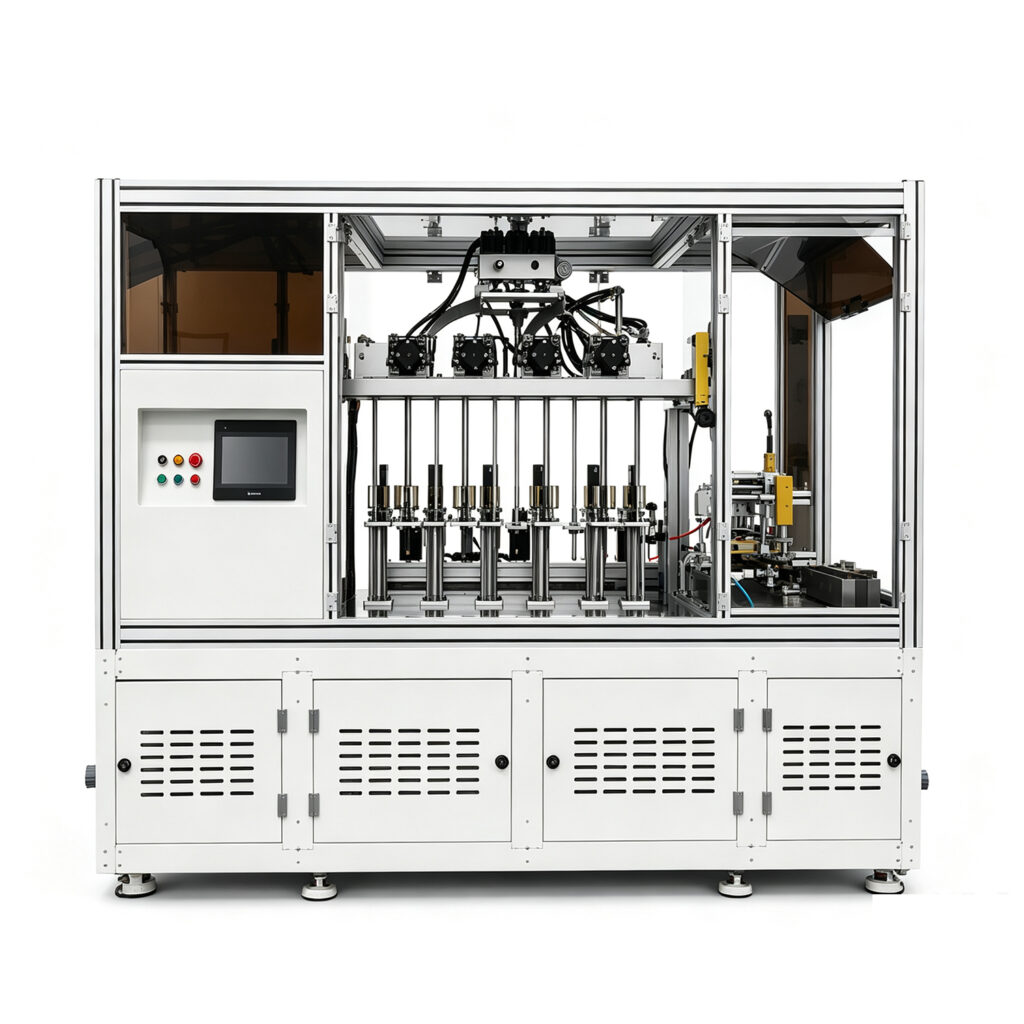
Heat Pipe Filling & Welding Machine: Complete Guide
1. What Is a Heat Pipe Filling & Welding Machine?
A Heat Pipe Filling & Welding Machine is industrial equipment designed to introduce working fluid into a heat pipe and seal its filling opening.
A conventional heat pipe contains three essential elements:
Metal container: Provides the sealed structure.
Wick structure: Returns condensed liquid toward the evaporator.
Working fluid: Transfers heat through evaporation and condensation.
During operation, the working fluid absorbs heat and evaporates. The vapor moves toward a cooler region and releases heat through condensation. The liquid then returns through the wick structure.
This continuous cycle allows heat pipes to transfer thermal energy efficiently.
However, the internal environment must meet the product’s design requirements. Manufacturers need to control fluid quantity, residual gases, and sealing quality.
1.1 Main Functions of the Machine
A typical machine may perform several operations:
- Connect the heat pipe to the filling system.
- Evacuate residual gases when vacuum processing is integrated.
- Introduce a controlled quantity of working fluid.
- Seal the filling opening through a suitable welding process.
- Monitor operating parameters and production status.
Not every machine includes all these functions. Some manufacturers use separate vacuum, filling, and welding stations.
The correct configuration depends on product structure, production capacity, and process requirements.
1.2 Why Is Specialized Equipment Necessary?
Manual filling and sealing can create inconsistent results. Operators must control several parameters during repetitive production.
For example, different fluid quantities may produce different thermal behaviors. Unstable welding conditions may also cause leakage.
Specialized equipment helps standardize these operations. It can reduce manual handling and improve production repeatability.
For manufacturers with large production volumes, automation can also support more efficient workflows.
2. Understanding the Heat Pipe Filling Process
Before selecting equipment, manufacturers should understand what happens inside a heat pipe during production.
The filling process does not simply involve adding liquid to an empty tube. It requires preparation, evacuation, controlled charging, and sealing.
2.1 Working-Fluid Selection
The working fluid must match the heat pipe’s operating temperature range and material system.
Common choices include:
- Water: Widely used in heat pipes designed for suitable temperature ranges.
- Methanol: Used in certain lower-temperature applications.
- Other compatible fluids: Selected according to specific thermal and material requirements.
Manufacturers should consider chemical compatibility, operating temperature, vapor pressure, and safety requirements.
Fluid selection should follow the product design rather than a universal recommendation.
2.2 Determining the Filling Quantity
The correct fluid quantity depends on the internal structure.
Important factors include:
- Tube diameter and length.
- Internal volume.
- Wick material and pore structure.
- Evaporator and condenser dimensions.
- Working-fluid properties.
- Intended operating conditions.
Insufficient fluid may contribute to local dry-out under certain operating conditions. Excessive fluid may reduce available vapor space and affect thermal behavior.
Therefore, manufacturers should establish filling parameters through engineering calculations and production validation.
2.3 Why Vacuum Processing Matters
Residual air and non-condensable gases can interfere with heat transfer.
These gases may accumulate in the condenser section. They can reduce the effective heat transfer area.
Vacuum evacuation helps remove unwanted gases before working-fluid charging.
However, manufacturers should distinguish between the vacuum pump’s rated ultimate pressure and the actual pressure achieved inside a connected workpiece. Real production performance depends on system volume, leakage, temperature, connections, and pumping speed.
3. How Does the Filling and Welding Machine Work?
The machine follows a controlled sequence. Its actual workflow depends on whether vacuum evacuation, fluid charging, and welding share one system.
A common production process includes the following stages.
3.1 Step 1: Workpiece Preparation
Operators prepare the heat pipe before connecting it to the filling machine.
The tube should complete the required forming and internal preparation operations. The wick structure should also meet product specifications.
Typical preparation includes:
- Tube cutting.
- Internal cleaning.
- Wick installation.
- Tube forming.
- Dry-out treatment.
- Workpiece inspection.
Cleanliness matters because contamination can affect internal circulation and product reliability.
3.2 Step 2: Connection and Positioning
The operator places the workpiece into the fixture.
The filling connection must form a reliable seal. Poor connections may cause vacuum leakage or unstable fluid delivery.
The fixture should hold the tube securely during evacuation and filling.
For manufacturers producing different models, adjustable fixtures can reduce product changeover time.
3.3 Step 3: Vacuum Evacuation
If the machine includes a vacuum system, it removes residual air and other unwanted gases.
The process may involve:
- Connecting the workpiece.
- Opening the vacuum valve.
- Starting the vacuum pump.
- Monitoring pressure.
- Reaching the validated process condition.
The required evacuation time depends on workpiece geometry, internal cleanliness, moisture content, and system design.
Manufacturers should validate vacuum performance under actual production conditions.
3.4 Step 4: Working-Fluid Injection
After the required preparation, the machine introduces working fluid.
A controlled metering system helps maintain the specified charging quantity.
The filling process should account for fluid properties and product dimensions.
Important parameters include:
- Target fluid quantity.
- Filling time.
- Fluid temperature, where relevant.
- Metering repeatability.
- Pipeline cleanliness.
- Workpiece positioning.
Manufacturers should define acceptable tolerances based on product specifications.
3.5 Step 5: Welding and Sealing
After filling, the machine seals the filling opening.
Possible methods include resistance welding and laser welding. The choice depends on tube material, thickness, joint geometry, and production requirements.
The sealing process should prevent working-fluid leakage and unwanted gas entry.
3.6 Step 6: Final Inspection
After welding, manufacturers inspect the workpiece.
Inspection may include:
- Weld appearance.
- Dimensional checks.
- Leak testing.
- Process parameter review.
- Thermal performance testing.
A filling and welding machine does not necessarily include all inspection functions. Separate testing equipment may be required.
4. Key Components and Their Functions
The machine configuration varies by manufacturer and production application. However, several functional systems commonly appear.
4.1 Vacuum Pumping System
The vacuum system removes unwanted gases from the workpiece.
It may include vacuum pumps, valves, pipelines, sensors, and connections.
When evaluating this system, manufacturers should check:
- Pumping capacity.
- Target process pressure.
- Evacuation time.
- Leakage performance.
- Maintenance requirements.
- Vacuum measurement location.
The measurement point matters because pressure at the pump inlet may differ from pressure inside the heat pipe.
4.2 Working-Fluid Supply System
This system stores and delivers the selected working fluid.
It should maintain fluid cleanliness and stable delivery.
Depending on the design, the system may include storage containers, valves, pipelines, filters, and fluid supply components.
Material compatibility is important. All parts that contact the working fluid should suit the selected fluid.
4.3 Quantitative Filling Unit
The filling unit controls the amount of working fluid introduced into each workpiece.
Its design may use calibrated metering technology or another controlled dosing method.
Manufacturers should evaluate the system’s accuracy and repeatability. They should also confirm its suitability for the required fluid volume.
4.4 Welding Unit
The welding unit closes the filling opening.
Its configuration depends on the selected welding method.
A resistance welding system may include electrodes, a power supply, and pressure control. A laser welding system may include a laser source, optical components, and positioning equipment.
The correct configuration depends on the workpiece material and joint design.
4.5 Fixture and Positioning System
The fixture supports stable workpiece positioning.
It helps maintain consistent connections during filling and welding.
For multi-product manufacturing, fixture flexibility can be an important purchasing factor.
4.6 Electrical Control System
The control system coordinates machine operation.
Depending on configuration, it may support:
- Parameter setting.
- Automatic process sequences.
- Pressure monitoring.
- Filling control.
- Welding control.
- Alarm management.
- Production data recording.
These functions can help operators maintain consistent procedures.
5. Filling and Welding Technologies
Manufacturers should select suitable technologies according to product requirements.
5.1 Vacuum-Assisted Filling
Vacuum-assisted filling combines evacuation with working-fluid charging.
The system removes unwanted gases before introducing the fluid.
This approach helps control the internal environment of the heat pipe.
However, vacuum conditions must be validated under actual production conditions. A machine’s vacuum pump rating alone cannot confirm process quality.
5.2 Quantitative Fluid Filling
Quantitative filling aims to deliver a specified working-fluid amount.
It supports consistent production across multiple workpieces.
This approach is particularly useful for manufacturers producing repeated models.
The filling method should match the required volume and tolerance. Manufacturers should also establish calibration and verification procedures.
5.3 Resistance Welding
Resistance welding generates heat through electrical resistance at the joint.
The process generally uses electrical current and mechanical pressure.
Its suitability depends on material properties, workpiece geometry, and joint design.
Manufacturers should validate welding current, pressure, time, and electrode condition.
5.4 Laser Welding
Laser welding uses concentrated energy to create a localized weld.
It can suit applications that require precise heat input and controlled joint formation.
However, results depend on material thickness, surface condition, focus position, and welding parameters.
For related manufacturing applications, explore the Laser Welding Machine for Vapor Chamber.
5.5 Choosing Between Welding Methods
Selection Factor | Resistance Welding | Laser Welding |
Heat source | Electrical resistance | Laser energy |
Process control | Current, pressure, and time | Laser power, speed, and focus |
Workpiece compatibility | Depends on material and joint | Depends on material and joint |
Fixture requirements | Stable electrode contact | Accurate workpiece positioning |
Process validation | Required | Required |
Neither method is universally better. Manufacturers should test actual workpieces before finalizing the equipment configuration.
6. Factors That Affect Filling and Welding Quality
Stable equipment is only one part of reliable heat pipe production.
Manufacturers must also control workpiece preparation, process parameters, and inspection.
6.1 Internal Cleanliness
Contamination may interfere with working-fluid behavior.
Residual particles and process residues can affect internal surfaces and wick structures.
Therefore, cleaning and drying should receive appropriate attention before filling.
6.2 Moisture Control
Residual moisture can affect the internal environment.
Manufacturers should establish suitable drying procedures before evacuation and filling.
The required process depends on materials, geometry, and product specifications.
6.3 Filling Accuracy
Incorrect fluid quantity can affect heat pipe performance.
A stable metering system helps control this variable.
Manufacturers should periodically verify filling accuracy and investigate abnormal results.
6.4 Vacuum Stability
Vacuum stability depends on the complete system.
Leaks, unsuitable connections, moisture, and insufficient pumping capacity can affect evacuation.
Routine inspection helps maintain consistent process conditions.
6.5 Welding Consistency
Welding quality depends on process parameters and workpiece condition.
For resistance welding, electrode wear and contact pressure matter. For laser welding, focus position and surface condition require attention.
A validated process window helps reduce variation.
7. Benefits of Using Automated Equipment
A suitable Heat Pipe Filling & Welding Machine can improve manufacturing consistency.
Its benefits depend on automation level and integration with other production equipment.
7.1 More Consistent Fluid Charging
Automated metering helps reduce variation between workpieces.
This supports more repeatable manufacturing results.
7.2 Controlled Sealing Operations
The machine can standardize welding parameters and workpiece positioning.
This helps reduce defects associated with inconsistent manual operations.
7.3 Reduced Manual Handling
Combining filling and welding operations can reduce workpiece transfers.
Fewer transfers may also reduce handling errors.
7.4 Improved Production Management
A machine with process monitoring can help operators review operating conditions.
Production records may support troubleshooting and quality analysis.
7.5 Flexible Manufacturing
Suitable fixtures and adjustable parameters can support different product models.
Manufacturers should confirm the actual supported size range with the equipment supplier.
8. Industrial Applications
Heat pipes serve different industries because they offer compact and efficient heat transfer.
8.1 Computer and Server Cooling
Heat pipes appear in many electronic cooling assemblies.
Applications include:
- Laptop cooling modules.
- Desktop CPU coolers.
- Server heat sinks.
- GPU cooling systems.
- Communication equipment
Consistent filling and sealing help manufacturers maintain product quality.
8.2 Power Electronics
Power electronic devices generate heat during operation.
Heat pipes can help transfer heat away from critical components.
Examples include power conversion systems and industrial control equipment.
8.3 LED Lighting
Some LED products use heat pipes as part of their thermal management structures.
The heat pipe helps move heat toward a larger dissipation area.
8.4 Automotive Electronics
Selected automotive electronic systems may use heat pipes for thermal management.
These applications can require strict process controls and product validation.
8.5 Industrial Cooling Products
Heat pipes also appear in specialized industrial cooling assemblies.
Manufacturers should select working fluids and product structures according to operating conditions.
9. How to Select Suitable Equipment
Selecting a machine requires a clear understanding of product and production requirements.
The following factors can help manufacturers compare suppliers.
9.1 Define the Product Range
Prepare drawings and specifications for the heat pipes.
Include:
- Tube diameter.
- Tube length.
- Wall thickness.
- Filling opening structure.
- Working-fluid type.
- Required filling quantity.
These details help suppliers assess equipment compatibility.
9.2 Confirm Filling Accuracy
Ask the supplier about the filling technology and measurable accuracy.
Also confirm how the machine verifies the charging quantity.
Request testing with actual production materials where possible.
9.3 Evaluate Vacuum Performance
Discuss the target process pressure and evacuation time.
Ask where the system measures pressure. Also request information about leakage checks and pump maintenance.
9.4 Confirm Welding Compatibility
Provide the actual workpiece material and joint design.
Ask the supplier to demonstrate the proposed welding method.
Evaluate weld appearance, sealing performance, and production repeatability.
9.5 Compare Automation Levels
Consider whether the production process requires manual, semi-automatic, or automatic operation.
Compare:
- Cycle time.
- Operator requirements.
- Loading method.
- Product changeover.
- Process monitoring.
- Data recording.
A high automation level does not automatically mean better value. The machine must match actual production needs.
9.6 Evaluate Maintenance and Support
Check the supplier’s service capabilities.
Important factors include spare parts, maintenance instructions, operator training, and technical support.
These factors can influence long-term operating costs.
10. Integration into a Heat Pipe Production Line
A Heat Pipe Filling & Welding Machine usually works alongside other manufacturing equipment.
A typical process may include:
Production Stage | Equipment | Main Purpose |
Tube preparation | Tube Cutting Machine | Cuts tubes to required dimensions |
Wick preparation | Powder Filling Equipment | Supports powder loading for suitable wick structures |
Tube forming | Forming or Necking Machine | Shapes the heat pipe structure |
Cleaning | Cleaning Equipment | Removes process contamination |
Drying | Dry-out Equipment | Removes residual moisture |
Fluid charging | Filling System | Introduces the working fluid |
Final sealing | Welding System | Closes the filling opening |
Leak inspection | Leak Testing Equipment | Checks sealing integrity |
Performance inspection | Thermal Performance Tester | Evaluates thermal behavior |
The exact sequence depends on product design and process technology.
10.1 Heat Pipe Equipment Production Line
A complete Heat Pipe Equipment Production Line may combine tube processing, internal preparation, filling, sealing, and inspection equipment.
Integration can reduce unnecessary transfers between production stages.
It also helps manufacturers coordinate production capacity.
10.2 Heat Pipe Necking Machine
A Heat Pipe Necking Machine shapes or reduces selected tube sections.
The resulting geometry must match downstream processing requirements.
10.3 Heat Pipe Powder Filling Machine
Some heat pipes use sintered powder wick structures.
A Heat Pipe Powder Filling Machine supports powder loading during wick preparation.
Powder quantity and distribution can influence wick performance.
10.4 Heat Pipe Multi-station Dry-out Tester
A Heat Pipe Multi-station Dry-out Tester supports moisture removal from prepared workpieces.
Its functions differ from vacuum evacuation and working-fluid charging.
Manufacturers should define the purpose of each stage clearly.
10.5 Heat Pipe Thermal Performance Tester
A Heat Pipe Thermal Performance Tester evaluates the thermal behavior of finished products.
It provides a separate quality control step after filling and sealing.
11. Common Manufacturing Challenges
Manufacturers may encounter several issues during filling and welding.
Understanding their causes helps improve production stability.
Manufacturing Issue | Possible Cause | Suggested Improvement |
Inconsistent fluid quantity | Metering variation | Calibrate the filling system |
Slow vacuum evacuation | Leakage or insufficient pumping capacity | Inspect connections and pump condition |
Unstable vacuum readings | Sensor or sealing problems | Check measurement points and seals |
Weak welds | Incorrect welding parameters | Validate the process window |
Fluid leakage | Defective sealing | Review joint design and welding quality |
Variable thermal performance | Filling or cleanliness variation | Review upstream and downstream processes |
11.1 Inconsistent Filling Results
Start by checking the fluid supply system.
Inspect metering components and verify the operating settings.
Also confirm that operators use the correct product recipe.
11.2 Vacuum Evacuation Problems
Check the workpiece connection and vacuum pipeline.
Inspect seals and valves for possible leakage.
If the problem continues, evaluate pump performance under actual production conditions.
11.3 Unstable Welding Quality
Review welding parameters and workpiece positioning.
For resistance welding, inspect electrode condition and contact pressure.
For laser welding, verify focus position and surface cleanliness.
11.4 Poor Finished Product Performance
Do not assume that filling equipment is the only possible cause.
Review the entire manufacturing process, including wick structure, internal cleanliness, fluid selection, evacuation, filling, and sealing.
Thermal performance testing can help identify product variation.
12. Frequently Asked Questions
Q1: What is a Heat Pipe Filling & Welding Machine?
It is equipment used to introduce working fluid into heat pipes and seal their filling openings. Some configurations also integrate vacuum evacuation and process monitoring.
Q2: Why do heat pipes require vacuum evacuation?
Vacuum evacuation helps remove residual air and non-condensable gases. These gases can interfere with the internal heat transfer process.
Q3: Which working fluid is suitable for heat pipes?
Water is common in many heat pipe designs. Other fluids may suit different temperature ranges and material systems. Selection requires product-specific evaluation.
Q4: How is the filling quantity determined?
The quantity depends on internal volume, wick structure, working fluid, and operating conditions. Manufacturers should establish the target through product design and process validation.
Q5: Can one machine fill different heat pipe models?
Some machines support multiple models through adjustable fixtures and settings. The supported product range depends on the machine design.
Q6: Which welding technology is better for heat pipes?
Resistance welding and laser welding can both suit specific applications. The correct option depends on material, joint structure, production requirements, and validated results.
Q7: Does filling and welding equipment include leak testing?
Not always. Some systems integrate inspection functions, while others require a separate leak testing station.
Q8: How can manufacturers improve filling consistency?
Use a suitable metering system, maintain stable operating conditions, and calibrate the equipment regularly. Clear operating procedures also help.
Q9: What is the difference between degassing and filling?
Degassing removes unwanted gases from the workpiece. Filling introduces the specified working fluid. These operations have different purposes.
Q10: What information should manufacturers provide when requesting a quotation?
Provide product drawings, tube dimensions, materials, working-fluid type, target filling quantity, production capacity, and welding requirements. These details help suppliers recommend a suitable configuration.
13. Conclusion
A Heat Pipe Filling & Welding Machine supports two critical stages of heat pipe manufacturing.
It helps manufacturers control working-fluid charging and final sealing. Depending on the configuration, it may also integrate vacuum evacuation and production monitoring.
When selecting equipment, manufacturers should focus on filling accuracy, vacuum performance, welding compatibility, product flexibility, and maintenance support.
They should also evaluate the machine as part of the complete manufacturing workflow. Upstream cleaning and drying affect filling quality. Downstream leak inspection and thermal testing help verify finished products.
cncoolingthermal provides equipment solutions for heat pipe and vapor chamber manufacturing. Manufacturers can evaluate suitable configurations according to product drawings, production capacity, and process requirements.