
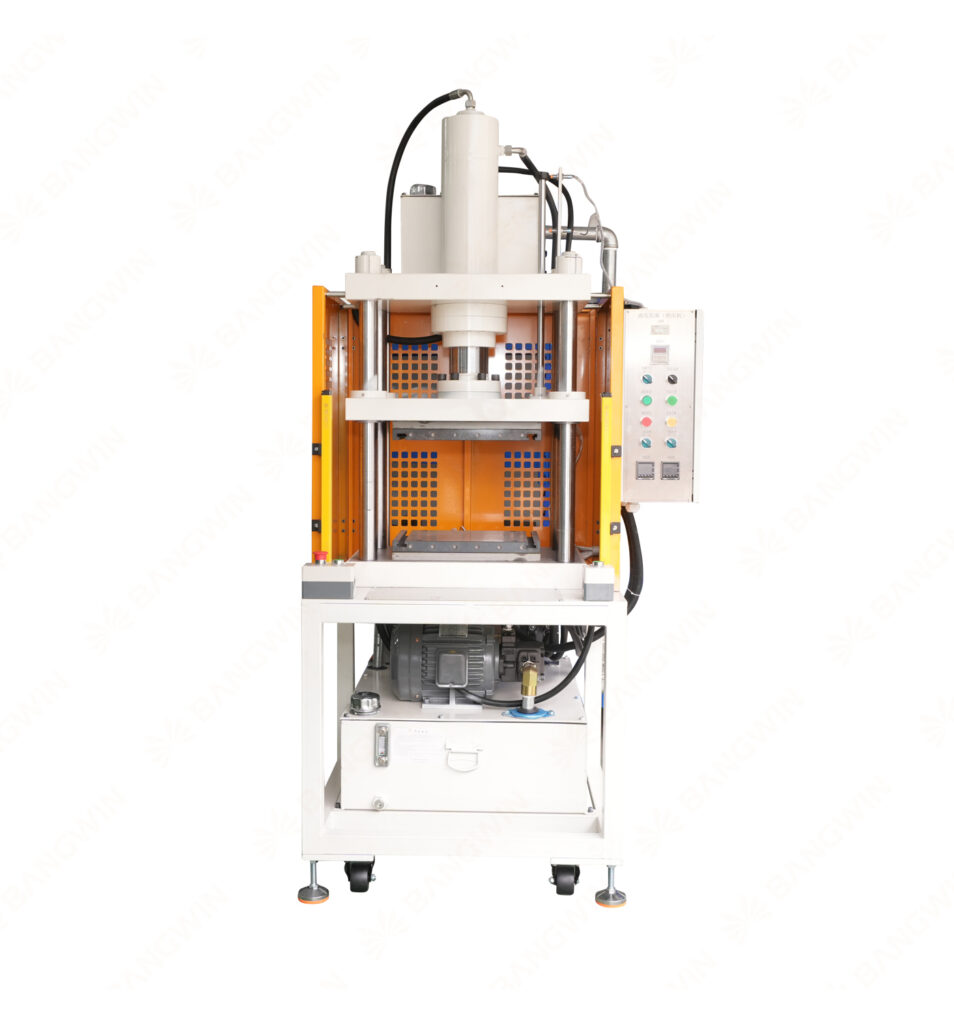
Vapor Chamber Hot Press Hydraulic Machine Guide
Introduction
Modern electronic devices generate more heat than ever before. Therefore, manufacturers need efficient thermal management solutions.
Vapor chambers offer an effective way to spread concentrated heat across a larger surface.
However, manufacturing these components requires precise forming, pressing, and dimensional control.
A Vapor Chamber Hot Press Hydraulic Machine helps manufacturers achieve consistent chamber shapes and controlled pressing results.
The machine combines hydraulic pressure, controlled heating, precision tooling, and automated operation.
Consequently, manufacturers can improve vapor chamber flatness, structural consistency, and production efficiency.
Furthermore, hot pressing can support several manufacturing stages within a vapor chamber production process.
This equipment can work alongside forming, sintering, laser sealing, vacuum, and testing equipment.
Therefore, it plays an important role in an integrated vapor chamber production line.
This guide explains the machine structure, working principle, manufacturing process, advantages, applications, and selection criteria.
It also explains how cncoolingthermal supports vapor chamber manufacturing equipment solutions.
1. What Is a Vapor Chamber Hot Press Hydraulic Machine?
A Vapor Chamber Hot Press Hydraulic Machine uses controlled pressure and heat to process vapor chamber components.
The equipment typically includes a hydraulic pressing system, heating system, precision tooling, control cabinet, and safety structure.
First, operators place the vapor chamber component inside the dedicated fixture.
Next, the machine applies controlled pressure.
Meanwhile, the heating system maintains the required processing temperature.
Then, the hydraulic system maintains the programmed pressure for a defined period.
Finally, the machine releases pressure and allows the component to continue to the next process.
As a result, manufacturers can achieve more consistent dimensions across production batches.
The machine can support different chamber designs through customized tooling.
Therefore, manufacturers should select tooling according to product dimensions and manufacturing requirements.
Typical Functions
A vapor chamber hot press machine can support:
- Chamber flattening
- Shape correction
- Thickness control
- Surface flattening
- Component forming
- Structural stabilization
- Assembly pressing
- Controlled hot pressing
However, the exact function depends on the vapor chamber design.
Consequently, buyers should define the intended process before selecting the equipment.
2. Why Hot Pressing Matters in Vapor Chamber Manufacturing
Vapor chambers require precise geometry to deliver consistent thermal performance.
Even small dimensional differences can affect contact quality and assembly compatibility.
Therefore, manufacturers need controlled forming and pressing processes.
Hot pressing combines pressure and temperature during a controlled manufacturing cycle.
The combination can help improve dimensional consistency for suitable vapor chamber designs.
Furthermore, hydraulic systems can deliver stable pressing force.
Consequently, manufacturers can achieve repeatable processing conditions.
Flatness Matters
Flatness plays an important role in many vapor chamber applications.
For example, CPU and GPU cooling assemblies require close contact between the vapor chamber and heat source.
Poor flatness can increase contact resistance.
Therefore, manufacturers often place strong emphasis on dimensional control.
Thickness Matters
Ultra-thin vapor chambers require particularly careful processing.
Excessive pressure can cause unwanted deformation.
Insufficient pressure can leave dimensional inconsistencies.
Therefore, the machine must provide controlled pressure and suitable tooling.
Consistency Matters
Mass production requires repeatable results.
Manual pressing can introduce variation between operators.
In contrast, programmable hydraulic systems can repeat defined process parameters.
Consequently, manufacturers can improve batch-to-batch consistency.
3. How Does a Vapor Chamber Hot Press Hydraulic Machine Work?
The machine follows a controlled pressing cycle.
The exact sequence depends on product requirements and machine configuration.
Step 1: Product Loading
First, the operator or automatic handling system loads the vapor chamber component.
Next, the fixture positions the product accurately.
Furthermore, locating pins or dedicated tooling can maintain consistent positioning.
Therefore, accurate loading provides a stable foundation for the pressing process.
Step 2: Tool Closing
The hydraulic system moves the upper tooling toward the product.
The controller manages the movement according to the programmed sequence.
Additionally, sensors can monitor the tool position.
Consequently, the machine can control the closing process accurately.
Step 3: Heating
Next, the heating system raises the tooling or workpiece to the required temperature.
Temperature controllers monitor the process continuously.
Furthermore, multiple heating zones can provide more uniform temperature distribution.
Therefore, manufacturers can maintain stable thermal conditions during pressing.
Step 4: Hydraulic Pressing
Once the system reaches the required conditions, hydraulic pressure increases.
The machine applies the programmed force to the vapor chamber.
Meanwhile, the control system monitors pressure and position.
Consequently, the process can maintain stable pressing conditions.
Step 5: Pressure Holding
The hydraulic system maintains pressure for a defined period.
This stage allows the material and structure to stabilize.
However, pressure and holding time depend on the product design.
Therefore, manufacturers should validate these parameters through production trials.
Step 6: Pressure Release
After the holding stage, the machine gradually releases hydraulic pressure.
The tooling then returns to its original position.
Furthermore, controlled release can reduce unwanted mechanical stress.
Step 7: Product Unloading
Finally, the operator or automatic handling system removes the processed component.
The chamber then moves to the next manufacturing stage.
For example, the next step may involve laser sealing, vacuum processing, or thermal testing.
4. Main Components of the Machine
A reliable hydraulic hot press machine combines several systems.
Each system contributes to pressing precision, stability, and production efficiency.
4.1 Hydraulic System
The hydraulic system generates the required pressing force.
It usually includes a hydraulic pump, valves, cylinders, pressure sensors, and related components.
Furthermore, the controller manages pressure according to the selected recipe.
Therefore, hydraulic stability directly affects pressing consistency.
4.2 Heating System
The heating system provides controlled thermal energy.
Depending on the machine design, manufacturers may use electrical heating elements or other suitable heating methods.
Temperature sensors monitor the process.
Additionally, controllers maintain the selected temperature range.
Consequently, the system can support stable hot pressing conditions.
4.3 Precision Tooling
Tooling determines the final geometry of the processed component.
Therefore, tooling design requires careful attention.
Manufacturers can customize the fixture according to chamber dimensions and product structure.
Furthermore, replaceable tooling can improve production flexibility.
4.4 Hydraulic Cylinder
The hydraulic cylinder converts hydraulic pressure into mechanical pressing force.
Its size depends on the required force and operating conditions.
Additionally, cylinder movement must remain stable during the pressing cycle.
Consequently, cylinder selection influences machine performance.
4.5 PLC Control System
A PLC controls the main operating sequence.
For example, it can manage heating, pressure, holding time, and tool movement.
Furthermore, the PLC can monitor alarms and safety conditions.
Therefore, operators can run repeatable production recipes.
4.6 Human-Machine Interface
The HMI provides access to operating parameters.
Operators can monitor temperature, pressure, cycle status, and alarms.
Additionally, authorized personnel can select different product recipes.
Consequently, the HMI simplifies daily operation.
4.7 Safety System
Hydraulic presses require appropriate safety protection.
Therefore, machines should include suitable guarding, emergency stops, and safety interlocks.
Furthermore, operators should follow the equipment manufacturer’s safety procedures.
For industrial machinery safety information, manufacturers can consult ISO standards information.
5. Vapor Chamber Hot Pressing Process
The complete hot pressing process requires careful parameter control.
Furthermore, different chamber designs require different process strategies.
5.1 Material Preparation
First, manufacturers prepare the copper chamber components.
The surfaces should remain clean and free from unwanted contamination.
Additionally, components should meet the required dimensional tolerances.
Therefore, material preparation directly affects downstream processing.
5.2 Component Assembly
Next, manufacturers assemble the chamber components and internal structures.
The assembly may include wick structures and internal support features.
Furthermore, the components require accurate positioning.
Consequently, suitable fixtures can improve assembly repeatability.
5.3 Initial Pressing
The machine begins the pressing cycle with controlled movement.
The tooling approaches the product at the programmed speed.
Therefore, the system can avoid excessive mechanical impact.
5.4 Heating and Pressing
Next, the system combines temperature and hydraulic pressure.
The exact temperature depends on the material and manufacturing process.
Meanwhile, the hydraulic system maintains the required force.
Consequently, the machine creates controlled processing conditions.
5.5 Holding Stage
The machine maintains the selected pressure and temperature.
This stage allows the product to stabilize under controlled conditions.
Additionally, the PLC records process information.
Therefore, manufacturers can improve process traceability.
5.6 Cooling
After hot pressing, the system can reduce the temperature.
The exact cooling method depends on the machine design.
Furthermore, controlled cooling can help reduce unwanted deformation.
5.7 Inspection
Finally, manufacturers inspect the processed chamber.
They may measure thickness, flatness, dimensions, and surface condition.
Additionally, later processes can evaluate sealing integrity and thermal performance.
6. Key Advantages of Hydraulic Hot Pressing
A Vapor Chamber Hot Press Hydraulic Machine offers several advantages for industrial production.
6.1 Controlled Pressing Force
Hydraulic systems provide controllable mechanical force.
Therefore, manufacturers can adjust pressure according to product requirements.
Furthermore, pressure sensors can provide process feedback.
6.2 Stable Processing
Programmable control systems repeat established process parameters.
Consequently, manufacturers can reduce variation caused by manual operations.
6.3 Improved Flatness
Suitable hot pressing can improve dimensional consistency.
This advantage becomes particularly important for thin vapor chamber applications.
Therefore, precise tooling and pressure control remain essential.
6.4 Flexible Production
Manufacturers can use customized tooling for different products.
Additionally, recipe-based control allows quick parameter changes.
Consequently, the machine can support multiple product specifications.
6.5 Lower Manual Work
Automation reduces repetitive pressing operations.
Furthermore, automatic loading can further reduce operator involvement.
Therefore, factories can improve labor efficiency.
6.6 Better Process Traceability
Modern controllers can store process parameters.
For example, the system can record pressure, temperature, and cycle duration.
Consequently, quality teams can analyze production results more effectively.
6.7 Production Line Integration
The machine can work with automated material handling.
It can also connect with upstream and downstream manufacturing stations.
Therefore, manufacturers can build a complete automated vapor chamber production line.
7. Applications of Vapor Chamber Hot Press Machines
Vapor chambers serve many modern thermal management applications.
Consequently, manufacturers require reliable equipment for different product formats.
7.1 CPU Cooling
High-performance CPUs create concentrated heat loads.
Therefore, vapor chambers can spread heat toward larger cooling structures.
Hot pressing helps manufacturers maintain suitable chamber geometry.
7.2 GPU Cooling
Graphics processors require efficient heat spreading.
Furthermore, modern GPUs generate significant thermal loads.
Therefore, vapor chambers can support advanced graphics cooling systems.
7.3 Gaming Laptops
Gaming laptops require powerful cooling within limited spaces.
Consequently, manufacturers often use thin vapor chamber solutions.
The hot press machine can support controlled processing for thin chamber designs.
7.4 Data Center Equipment
Servers generate continuous heat during intensive operation.
Therefore, reliable thermal components support stable data center operation.
Furthermore, consistent manufacturing helps suppliers meet high-volume demand.
7.5 Smartphones
Smartphones require compact thermal solutions.
Ultra-thin vapor chambers can spread heat across limited internal spaces.
Therefore, precise forming and pressing become increasingly important.
7.6 Tablets and Consumer Electronics
Tablets also require lightweight thermal management components.
Consequently, manufacturers can use compact vapor chambers within suitable cooling assemblies.
7.7 Automotive Electronics
Electric vehicles contain many high-power electronic systems.
For example, inverters, controllers, and onboard electronics require effective thermal management.
Therefore, vapor chambers may support specialized automotive cooling solutions.
7.8 Industrial Electronics
Industrial computing and control equipment also generates concentrated heat.
Consequently, compact vapor chambers can support suitable thermal designs.
8. Hot Press Hydraulic Machine vs. Conventional Pressing
Different pressing methods offer different production characteristics.
Feature | Hot Press Hydraulic Machine | Conventional Pressing |
Pressure control | Programmable | Depends on equipment |
Heating control | Integrated | May require separate equipment |
Process automation | High potential | Often lower |
Recipe management | Available | Often limited |
Product consistency | High potential | Depends on process |
Tooling flexibility | Customizable | Depends on machine |
Production efficiency | Suitable for mass production | Varies |
Process monitoring | Digital monitoring possible | Often more limited |
However, manufacturers should not select equipment based on one parameter alone.
Product design, production volume, and required tolerances all influence the decision.
Therefore, buyers should evaluate complete production requirements.
9. Technical Specifications to Consider
Before purchasing a Vapor Chamber Hot Press Hydraulic Machine, manufacturers should review key specifications.
The following parameters provide a practical evaluation framework.
Specification | What to Evaluate |
Maximum pressing force | Match the required forming force |
Working area | Match vapor chamber dimensions |
Temperature range | Match the manufacturing process |
Temperature accuracy | Confirm actual process requirements |
Pressure accuracy | Evaluate repeatability |
Holding time | Support required process duration |
Stroke | Match tooling and product geometry |
Heating method | Confirm suitable heating technology |
Control system | PLC and HMI capabilities |
Tooling | Product-specific or interchangeable |
Automation | Manual, semi-automatic, or automatic |
Safety | Guarding and emergency systems |
Cycle time | Match target production capacity |
Data recording | Support process traceability |
However, actual machine specifications vary by configuration.
Therefore, buyers should request model-specific technical data from the equipment supplier.
10. Integration With a Vapor Chamber Production Line
A hot press machine rarely works alone.
Instead, manufacturers usually integrate it with several complementary machines.
A typical manufacturing workflow may include:
Copper Preparation → Cutting → Cleaning → Forming → Wick Preparation → Sintering → Assembly → Hot Pressing → Laser Sealing → Vacuum Processing → Fluid Charging → Testing
The exact sequence depends on the product design.
Related Equipment
Internal Link: Vapor Chamber Production Line
A complete production line combines multiple manufacturing stations.
Internal Link: Automatic Casing Cutter
This equipment prepares copper enclosure components.
Internal Link: Automatic Powder Filling Machine
This machine controls copper powder distribution for suitable wick structures.
Internal Link: Vacuum Sintering Furnace
The furnace creates porous copper wick structures.
Internal Link: Vapor Chamber Fully Automatic Laser Sealing Machine
The laser system provides precision sealing and welding.
Internal Link: Vacuum Degassing Machine
The equipment removes unwanted gases during vacuum processing.
Internal Link: Multi-Station Thermal Performance Tester
The testing system evaluates thermal performance after production.
Consequently, integrated equipment planning can improve material flow and production efficiency.
11. Quality Control During Hot Pressing
Quality control should cover every important processing stage.
Therefore, manufacturers should establish clear inspection procedures.
11.1 Flatness Inspection
First, manufacturers measure chamber flatness.
This measurement helps evaluate the effect of pressing and thermal processing.
Additionally, manufacturers can compare results against product specifications.
11.2 Thickness Inspection
Next, operators measure finished chamber thickness.
Thin vapor chambers require particularly careful dimensional control.
Therefore, precision measurement remains essential.
11.3 Surface Inspection
Operators should check the chamber surface for scratches, dents, and deformation.
Furthermore, surface defects can affect downstream assembly.
Consequently, visual inspection provides useful process feedback.
11.4 Pressure Monitoring
The hydraulic system should monitor pressing force throughout the cycle.
Additionally, abnormal pressure changes can trigger alarms.
Therefore, process monitoring helps identify equipment problems.
11.5 Temperature Monitoring
Heating systems require accurate temperature measurement.
Furthermore, multiple temperature points can help identify uneven heating.
Consequently, manufacturers can optimize tooling and heating zones.
11.6 Final Thermal Testing
After complete manufacturing, thermal performance testing provides additional verification.
The manufacturer can evaluate temperature distribution and thermal resistance.
Therefore, final testing helps confirm product performance.
12. How to Choose the Right Machine
Selecting the right machine requires a structured evaluation.
12.1 Define Product Dimensions
First, determine the minimum and maximum chamber sizes.
Next, define target thickness and flatness requirements.
These parameters influence tooling and working area.
12.2 Define Production Capacity
Then, calculate expected daily and annual output.
Furthermore, estimate required cycle time.
Consequently, manufacturers can select appropriate machine capacity.
12.3 Define Processing Requirements
Determine whether the machine needs heating, pressing, flattening, or forming functions.
Additionally, identify required temperature and pressure ranges.
Therefore, the equipment configuration can match the manufacturing process.
12.4 Evaluate Automation
Next, determine whether production requires automatic loading and unloading.
For high-volume factories, automation can significantly reduce repetitive work.
Meanwhile, smaller manufacturers may prefer flexible semi-automatic systems.
12.5 Check Tooling Requirements
Tooling directly influences product accuracy.
Therefore, buyers should discuss custom tooling with the supplier.
Additionally, interchangeable tooling can support multiple product models.
12.6 Request Sample Production
Sample production provides valuable technical information.
Manufacturers can evaluate flatness, thickness, appearance, and process stability.
Consequently, sample validation reduces equipment selection risk.
12.7 Evaluate After-Sales Support
Finally, consider installation, commissioning, training, spare parts, and technical service.
Reliable support can improve long-term equipment availability.
Therefore, after-sales service should form part of the purchasing decision.
13. Maintenance and Safety
Regular maintenance helps maintain pressing accuracy.
Furthermore, it extends the service life of hydraulic and heating components.
Hydraulic Maintenance
Operators should monitor hydraulic oil condition and system pressure.
Additionally, they should inspect hoses, valves, and cylinders regularly.
Therefore, early maintenance can prevent unexpected downtime.
Heating System Maintenance
Temperature sensors require periodic inspection.
Furthermore, heating elements should remain clean and functional.
Consequently, temperature stability can remain consistent.
Tooling Maintenance
Precision tooling requires careful cleaning and inspection.
Operators should remove contamination after production cycles.
Additionally, damaged tooling should receive timely replacement or repair.
Electrical Maintenance
Operators should inspect control cabinets and electrical connections according to the maintenance schedule.
Furthermore, alarms should receive prompt investigation.
Safety Maintenance
Emergency stops and safety interlocks require regular testing.
Therefore, manufacturers should include safety checks within routine maintenance.
14. Why Choose cncoolingthermal?
Choosing thermal manufacturing equipment requires careful technical evaluation.
Manufacturers need more than a standard machine catalog.
They need equipment that matches product dimensions, production capacity, and manufacturing processes.
cncoolingthermal focuses on thermal manufacturing solutions and vapor chamber production equipment.
Visit cncoolingthermal.com to explore related equipment and production solutions.
The website can serve as a starting point for manufacturers planning vapor chamber production projects.
Process-Based Equipment Selection
First, manufacturers can identify their complete manufacturing process.
Next, they can determine which machines require automation.
Furthermore, they can evaluate how individual stations should connect.
Customized Equipment
Different vapor chamber products require different tooling and process conditions.
Therefore, customized equipment configurations can provide better process compatibility.
Complete Production Planning
A successful production project requires coordination between several machines.
For example, cutting, powder filling, sintering, pressing, sealing, vacuum processing, and testing must work together.
Consequently, production planning should consider the entire manufacturing workflow.
Contact cncoolingthermal
If you are planning a vapor chamber manufacturing project, prepare the following information:
- Product drawings
- Product dimensions
- Copper material and thickness
- Target production capacity
- Required pressing force
- Heating requirements
- Desired automation level
- Quality requirements
Then, contact cncoolingthermal to discuss a suitable equipment configuration.
15. Frequently Asked Questions
What is a Vapor Chamber Hot Press Hydraulic Machine?
It is industrial equipment that combines hydraulic pressure and controlled heating.
Manufacturers use it for suitable forming, flattening, and dimensional control processes.
What does hot pressing do to a vapor chamber?
Hot pressing can help control chamber geometry and dimensional consistency.
However, the exact function depends on the product design.
Why use hydraulic pressure?
Hydraulic systems provide controllable pressing force.
Therefore, they support repeatable manufacturing conditions.
Can the machine process ultra-thin vapor chambers?
Yes, suitable configurations can support thin chamber manufacturing.
However, tooling and pressure control require careful optimization.
Can one machine process different sizes?
Many machines can support multiple sizes through interchangeable tooling.
Therefore, buyers should confirm the supported dimensions before purchasing.
Does hot pressing replace laser sealing?
No.
Hot pressing and laser sealing normally perform different manufacturing functions.
The hot press controls suitable forming or dimensional processes.
Meanwhile, the laser sealing machine joins or seals specific chamber components.
Can the machine integrate with an automatic production line?
Yes.
Suitable hydraulic presses can integrate with material handling and production control systems.
What factors determine the required pressing force?
Product size, material, thickness, tooling design, and manufacturing process all influence force requirements.
Therefore, engineers should calculate requirements according to the actual product.
How does temperature affect hot pressing?
Temperature influences material behavior and process stability.
Therefore, manufacturers should select temperature settings according to validated process requirements.
How do I select the correct hydraulic hot press?
Start with product dimensions and manufacturing objectives.
Then evaluate pressing force, temperature, tooling, automation, cycle time, and safety.
Finally, request sample production before making the final decision.
How much does a vapor chamber hot press machine cost?
Machine pricing depends on pressing force, heating configuration, tooling, automation, and control systems.
Therefore, manufacturers should request project-specific quotations.
Where can I find vapor chamber production equipment?
You can explore vapor chamber manufacturing solutions through cncoolingthermal.com.
16. Conclusion
A Vapor Chamber Hot Press Hydraulic Machine provides controlled pressure and heating for suitable vapor chamber manufacturing processes.
Its hydraulic system supports controlled force.
Meanwhile, its heating system supports stable thermal processing.
Furthermore, precision tooling helps manufacturers maintain consistent product dimensions.
As demand for compact electronics continues to increase, thermal management requirements also continue to grow.
Therefore, reliable vapor chamber manufacturing equipment has become increasingly important.
A complete manufacturing system may combine hot pressing with powder filling, vacuum sintering, laser sealing, vacuum processing, and thermal testing.
Consequently, manufacturers should evaluate the complete production workflow rather than one machine alone.
For companies developing vapor chamber manufacturing capabilities, cncoolingthermal provides a dedicated platform for exploring thermal production equipment.
Visit cncoolingthermal.com to learn more about vapor chamber manufacturing solutions.