
Product Description
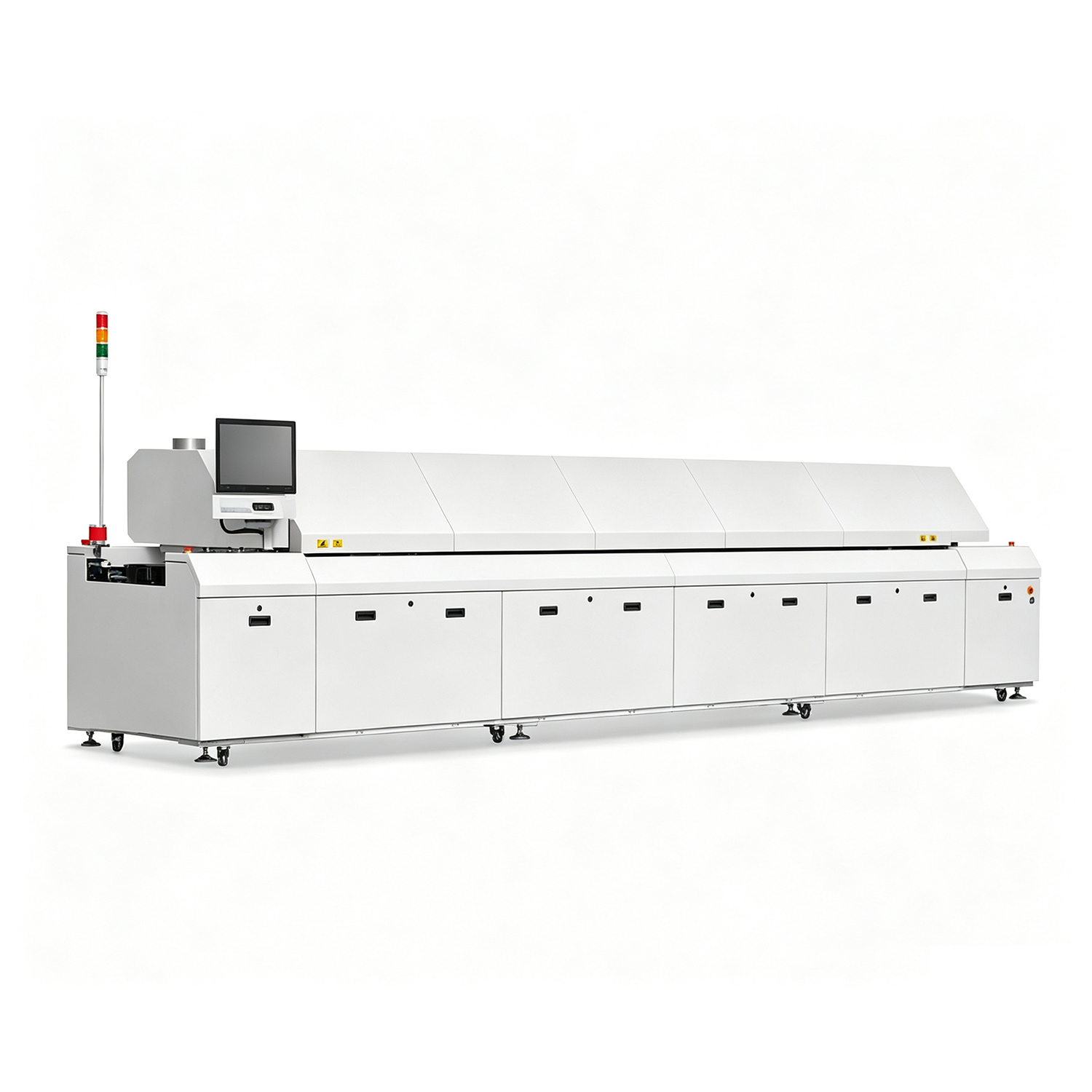
Heat Sink Assembly Reflow Oven — 8-Zone Solder Reflow for Heat Pipe & Fin Bonding
8-zone hot-air convection reflow oven engineered for solder-paste joining of heat sink assemblies — heat pipes to fin stacks, copper bases to fin arrays, vapor chambers to heat spreaders. Built for thermal module production lines, not generic SMT.
Overview
Heat sink performance lives or dies at the joint. A heat pipe pressed into an aluminum fin stack with a poor solder joint can lose 20% or more of its rated thermal performance — and the failure is invisible until the module gets thermally tested. The way the joint forms during reflow soldering decides the long-term thermal resistance of the entire assembly.
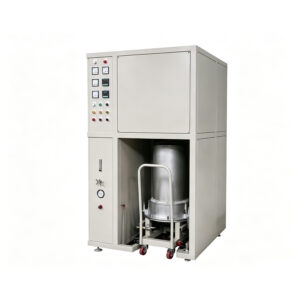
The CT-RFO-8 Heat Sink Assembly Reflow Oven is built for this exact job. Solder paste is applied at the joint interface — heat pipe to fin collar, base to fin array, vapor chamber to top spreader — the assembly is loaded onto the 400 mm conveyor, and the oven runs it through 8 precisely controlled heating zones followed by 2 forced-convection cooling zones. The result is a continuous metallic joint with low thermal resistance and high mechanical strength.
This is not a generic SMT/PCB reflow oven. The temperature profile, zone tuning, and conveyor handling are all engineered for the thermal mass and geometry of heat sink assemblies — which are much larger and heavier than typical PCB loads.
Why Heat Sink Reflow Is Different From SMT Reflow
Most reflow ovens on the market are designed for SMT PCB assembly: small components, low thermal mass, fast belt speeds, narrow temperature windows. A heat sink assembly is fundamentally different:
• 10–100× the thermal mass of a typical PCB — the oven needs much higher heating power to bring the assembly to peak temperature within the recipe window
• Large flat metallic surfaces that radiate heat aggressively — top and bottom heating must be tuned independently to avoid temperature gradients across the part
• Vertical fin arrays that create complex airflow paths — convection-dominant heating (vs IR) gives more uniform fin-to-fin temperature
• Wider conveyor required (typically 400–600 mm) to handle larger heat sink footprints, especially for server and AI cooler assemblies
• Longer dwell at peak to ensure the entire joint interface — not just the surface — reaches the solder liquidus temperature
The CT-RFO-8 is engineered around all of these requirements. It is a production-ready reflow oven for the thermal module industry, not a repurposed SMT oven.
Solder Reflow vs Other Heat Sink Joining Methods
Why solder reflow and not epoxy bonding or mechanical press-fit? Each method has its place — but for high-performance air-cooled heat sinks, reflow soldering produces the lowest thermal resistance and the most stable joint over time:
| Property | Solder Reflow | Epoxy Bonding | Mechanical Press-fit |
| Thermal interface resistance | Very low (metallic joint) | Moderate (polymer layer) | Low to moderate (air gaps possible) |
| Joint shear strength | High | Moderate | Mechanical lock only, no bond |
| Long-term stability | Excellent (no creep) | Degrades over time and heat | May loosen under vibration |
| Production throughput | High (continuous belt) | Medium (curing time) | High |
| Best for | High-performance air-cooled heat sinks | Low-cost, low-power LED | Disposable / low-grade modules |
For AI server, data center, EV power electronics, and high-power LED heat sinks, solder reflow is the dominant joining method because the metallic joint preserves the thermal performance designed into the heat pipe and fin geometry.
Key Features
• 8 top + 8 bottom heating zones, independently controlled — total 16 PID-controlled zones for precise profile shaping (preheat, soak, reflow, peak, cooling)
• 400 mm conveyor belt width (300–600 mm options) — fits most server, laptop, and consumer heat sink footprints; wider option for AI cooler assemblies
• Hot-air forced convection heating — 80% convection / 20% IR option for fast, uniform heating across vertical fin geometries
• Temperature uniformity ±2°C across belt width — eliminates edge-vs-center solder joint quality variation
• PID control ±1°C per zone — recipe-driven profile, stored per product number
• Conveyor speed 0–2000 mm/min with mesh-belt or chain-rail option (chain rail for heavy heat sinks)
• Optional N₂ atmosphere — residual O₂ below 1000 ppm, required for copper heat sink soldering to prevent oxidation
• Profile thermocouple compatibility — supports inline thermal profiling for first-article validation and process audit
• PC profile software — design and store unlimited recipes, simulate against target curves before running production
• Cool-down zones with forced convection — 2 cooling zones bring the assembly below 50°C before exit, ready for handling
• Compact footprint relative to SMT-grade ovens — purpose-built dimensions match thermal module production cells
Technical Specifications
| Parameter | Value |
| Model | CT-RFO-8 |
| Application | Solder reflow for heat sink assemblies (heat pipe + fin, base + fin, VC + fin) |
| Heating zones (top) | 8 zones independently controlled |
| Heating zones (bottom) | 8 zones independently controlled (16 total) |
| Cooling zones | 2 forced-convection cooling zones |
| Conveyor belt width | 400 mm (300, 450, 500, 600 mm available) |
| Heating chamber length | ~ 2800 mm (8 zones × 350 mm) |
| Maximum temperature | 350°C |
| Temperature control accuracy | ±1°C per zone (PID-controlled) |
| Cross-belt temperature uniformity | ±2°C across full belt width |
| Conveyor speed | 0 – 2000 mm/min (recipe-controlled) |
| Heating method | Hot-air forced convection (80% convection / 20% IR option) |
| N₂ atmosphere option | Optional N₂ tunnel, residual O₂ < 1000 ppm |
| Control system | PLC + 15″ HMI touchscreen + PC profile software |
| Recipe storage | Unlimited (USB / Ethernet) |
| Power supply | 380V / 50Hz / 3-phase |
| Maximum power | ~ 70 kW peak / ~ 25 kW average operation |
| Machine dimensions (L×W×H) | ~ 4500 × 1300 × 1500 mm (typical, configurable) |
| Machine weight | ~ 1500 kg |
| Compliance | CE-ready design |
Note: parameters above are typical for the standard CT-RFO-8 configuration. Custom configurations available for wider belts (up to 600 mm), more zones (10/12), full nitrogen tunnel, or integration with upstream fin assembly and downstream thermal performance test stations.
How the Heat Sink Reflow Process Works
Solder Paste Application & Pre-load
Before the assembly enters the oven, solder paste is applied at the joint interfaces — either by stencil printing, dispensing, or pre-formed solder preforms. The assembly is then loaded onto the conveyor belt at the entry end. The assembly’s thermal mass and geometry determine which recipe is selected:
✓ Solder paste applied at joint interface (heat pipe-fin, base-fin, VC-spreader)
✓ Assembly loaded onto 400mm belt (or chain rail for heavy parts)
✓ Recipe auto-selected by barcode or manual entry
✓ Profile thermocouple attached for first-article runs
Preheat Zone (Zones 1–2)
The preheat zones bring the assembly from ambient up to ~150°C at a controlled ramp rate of 1–3°C per second. The goal is to drive off volatile solvents in the solder paste without thermal shocking the assembly:
✓ Ramp rate controlled at 1–3°C per second (recipe-dependent)
✓ Independent top + bottom zone tuning prevents thermal gradients across the assembly
✓ Solvent evaporation completes before reaching soak temperature
✓ Convection-dominant heating reaches the inside of fin arrays, not just the outer surfaces
Soak Zone (Zones 3–5)
The soak zone holds the assembly at 150–180°C for 60–120 seconds. This activates the flux in the solder paste, removes oxides from the joint surfaces, and equalizes temperature across the entire assembly before peak:
✓ Temperature held at 150–180°C for 60–120 seconds
✓ Flux activates and reduces oxide on copper and aluminum surfaces
✓ Thermal mass differences between thin fins and thick base equalize
✓ Cross-belt temperature uniformity ±2°C verified by profiling
Reflow & Peak (Zones 6–7)
The reflow zones bring the assembly above the solder liquidus temperature — typically 217°C for SAC305 lead-free solder, or 183°C for Sn-Pb. Peak temperature is held for 20–60 seconds to ensure complete wetting at every joint interface:
✓ Peak temperature reached above solder liquidus (217°C SAC305 / 183°C SnPb)
✓ Peak dwell 20–60 seconds for complete joint wetting
✓ Solder paste melts, flows into the joint interface, and forms a continuous metallic bond
✓ Top + bottom heating balanced to prevent fin-base temperature differential
Controlled Cooling (Zone 8 + Cooling Zones)
Cooling is as important as heating. Too-fast cooling creates brittle solder grain structure; too-slow cooling causes intermetallic growth that weakens the joint. Controlled forced-convection cooling brings the assembly down at 2–4°C per second:
✓ Cool-down rate controlled at 2–4°C per second
✓ Solder solidifies with optimal grain structure
✓ Assembly exits below 50°C, ready for handling
✓ Profile logged for traceability and process control
Applications
AI Server CPU/GPU Heat Sink Assembly
AI server CPU and GPU heat sinks now combine 6–12 heat pipes with dense skived or folded fin stacks. Each heat pipe must be soldered into the fin collar to eliminate contact resistance — visual joint defects are unacceptable when the chip thermal budget allows almost no margin. Pairs naturally with our CNC skiving fin machine upstream and thermal performance test machine downstream.
Laptop & Mobile Workstation Coolers
Laptop thermal modules combine flattened heat pipes with very thin fin arrays. The reflow recipe needs precise top-vs-bottom balance to avoid warping the thin fin stack while still reaching liquidus at the heat pipe interface.
LED High-Power Lighting
High-bay and stadium LED drivers benefit from solder-reflowed aluminum heat sinks where the LED metal-core PCB joins to the heat sink base. Long-term thermal stability matters more than upfront cost for fixtures rated at 50,000+ hours.
EV Power Electronics & IGBT Coolers
Inverter heat sinks bonded to IGBT modules need stable metallic joints to handle continuous thermal cycling. Solder reflow with N₂ atmosphere is the preferred process for copper-based EV cooler assemblies.
Telecom Base Station & 5G RRU Coolers
Outdoor 5G radio cooling units combine heat pipes and skived fins in sealed enclosures. The reflow oven enables high-volume production with consistent joint quality across thousands of units per shift.
Introduction to reflow soldering oven

Reliable and Stable Conveyor System

Stable and Reliable Electrical Control System

Advanced Heating Technology

Reviews
There are no reviews yet.