
Product Description
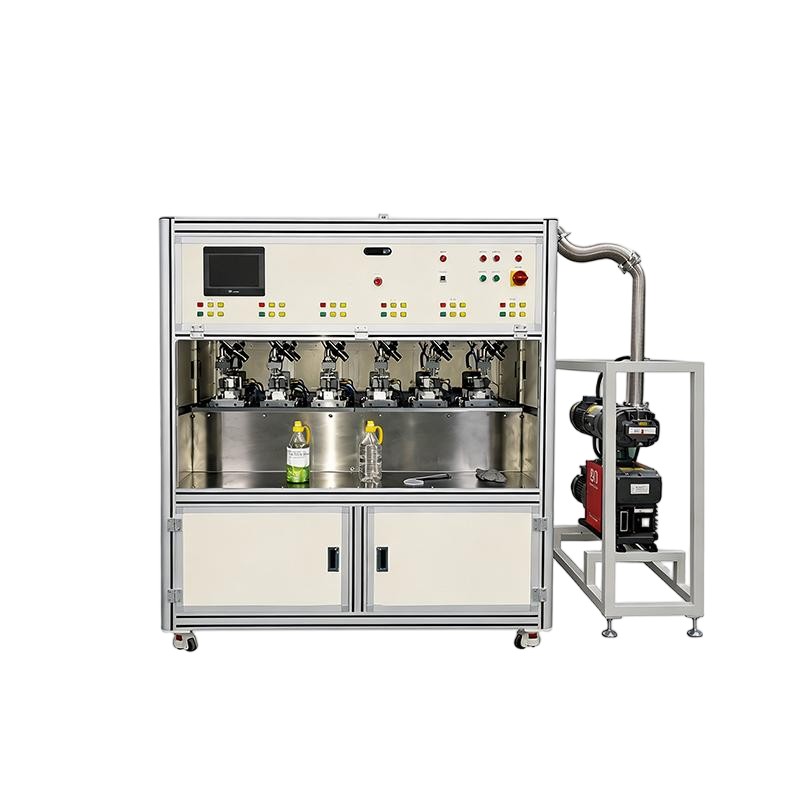
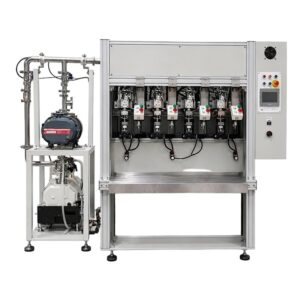
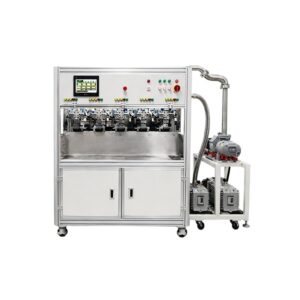
Supporting pipe diameters from Ø4 to Ø10mm and pipe lengths from 80 to 500mm, the machine achieves a water injection accuracy of ±0.05g and acetone accuracy of ±0.2g via a positive displacement pump. Both the vacuum evacuation and injection operations are conducted with the tube immersed in ice water — thermally stabilising the working fluid volume during fill to prevent the expansion-induced inaccuracies that occur when warm tubes are filled. Post-injection vacuum stabilises at 0.3-0.6 torr, ready for immediate tube sealing by the downstream automatic welder.
Key Specifications
| Specification | Details |
| Pipe Diameter | Ø4 to Ø10 mm |
| Pipe Length | 80 – 500 mm |
| Degassing End Length | ≤ 80 mm |
| Vacuum Degree (pre-injection) | 10⁻³ τ (torr) |
| Vacuum Degree (post-injection) | 0.3 – 0.6 τ |
| Vacuum Pump Type | 40 two-stage screw pump |
| Water Volume Range | 0 – 2.5 ml |
| Water Injection Accuracy | ± 0.05g |
| Acetone Injection Accuracy | ± 0.2g |
| Injection Pump Type | Positive displacement type |
| Injection Needle | Ø0.9 × 100L |
| Process Sequence | Evacuate air first → then inject liquid |
| Thermal Stabilisation | Both vacuuming and injection in ice water |
| Anti-suck-back | Working fluid not extracted during filling |
Advantages — Why a Combined Degassing and Filling Machine Outperforms Separate Equipment
1. Zero Air Re-Entry — Vacuum-Environment Injection Eliminates Non-Condensable Gas
The defining technical advantage of a combined degassing and filling machine is that working fluid is injected directly inside the vacuum environment — without ever opening the tube to atmosphere between evacuation and filling. On separate-machine setups, the evacuated tube must be transferred to the filling station, during which ambient air re-enters through the degassing end. Even micro-quantities of residual air act as non-condensable gas inside the sealed heat pipe, accumulating at the condenser over time and progressively degrading thermal performance. By combining both operations in one sealed process, Cooling-Thermal’s machine eliminates this failure mode entirely.
2. ±0.05g Fill Accuracy with Ice Water Thermal Stabilisation
Both the vacuum evacuation and injection operations are conducted with the tube immersed in ice water. This thermal stabilisation prevents the working fluid from expanding due to tube wall temperature — a common source of fill volume inaccuracy when warm tubes are filled in conventional setups. The positive displacement pump delivers ±0.05g water injection accuracy and ±0.2g acetone accuracy regardless of ambient temperature variation, ensuring that every unit leaves the filling station with the correct working fluid volume for its target thermal performance specification.
3. 10⁻³ Torr Pre-Injection Vacuum — Production-Standard Vacuum Depth
The machine evacuates to 10⁻³ torr before injection using a 40 two-stage screw vacuum pump — the vacuum depth required for production-grade heat pipe manufacturing. At 10⁻³ torr, the residual gas pressure is low enough that the working fluid can be introduced without significant non-condensable gas contamination. Post-injection, the vacuum stabilises at 0.3-0.6 torr — the operating vacuum level of a correctly manufactured heat pipe ready for sealing. This vacuum depth is specified and validated against the vacuum requirements of Cooling-Thermal’s clients, including Foxconn and Furukawa Electric.
4. Anti-Suck-Back Design — Working Fluid Stays in the Tube During Filling
A key technical challenge in combined degassing-and-injection machines is preventing the vacuum system from extracting the injected working fluid during the fill cycle. Cooling-Thermal’s machine solves this through a controlled sequence — first evacuate air, then inject liquid — with the vacuum and water volume characteristics controlled by the machine’s internal control board. The working fluid is not sucked back out during filling, ensuring that the programmed volume is the actual volume delivered to the heat pipe.
5. Compact Single-Machine Process — Space and Handling Efficiency
Replacing two separate machines (a vacuum degassing machine and a water injection machine) with a single integrated unit reduces production floor space, eliminates the inter-machine transfer step that introduces air re-entry risk, and simplifies production line management. For B2B procurement teams with constrained floor space or lean production line layouts, the integrated machine delivers the same — and technically superior — result with a smaller capital equipment footprint.
6. Factory-Direct from a Specialist Thermal Solution Automation Manufacturer
Cooling-Thermal is a specialist manufacturer of automation equipment for the thermal solution industry — our degassing and filling machines are designed within the context of a complete heat pipe production line, with direct knowledge of how vacuum depth and fill volume accuracy at this station affect downstream seal quality, leak testing results, and final thermal performance. This integrated production-line knowledge is what a specialist thermal solution manufacturer provides that a general vacuum equipment supplier cannot.
Combined Machine vs. Separate Degassing + Filling Equipment — Technical Comparison
| Cooling-Thermal Degassing + Filling Machine | Separate Machines (Degassing + Filling) | |
| Setup | Single machine — one operation | Two machines — two operations |
| Air re-entry risk | Zero — injection inside vacuum environment | High — tube exposed between two steps |
| Fill accuracy | ±0.05g — vacuum-stabilised | Variable — depends on both machines |
| Vacuum before injection | Yes — 10⁻³ torr before injection | Separate degassing step only |
| Post-injection vacuum | 0.3-0.6τ — stable sealed state | Not controlled |
| Ice water stabilisation | Built-in — both operations | Not available |
| Floor space | Compact — one machine | Larger — two machines |
| Handling between steps | None | Manual transfer — contamination risk |
| OEM/ODM | Available | May require two separate customisations |
The critical quality issue with separate machines is air re-entry between steps. Even a transfer time of 5-10 seconds between degassing and filling allows micro-quantities of air to enter the evacuated tube. Over thousands of production cycles, even a small percentage of units with residual air contamination creates quality variability that only shows up at end-of-line thermal performance testing — after all upstream production steps have already been completed on that unit.
Production Line Position — Where Degassing and Water Injection Fit in Heat Pipe & Thermal Solution Manufacturing
The combined degassing and injection machine occupies one of the most critical positions in the heat pipe production sequence — it is the step that transforms a sintered but empty tube into a vacuum-sealed, working-fluid-filled tube ready for permanent sealing. The quality of everything that follows — seal integrity, leak test results, thermal performance — depends on the vacuum depth and fill accuracy achieved at this station.
| Production Step | Equipment |
| Tube forming | Automatic Shrinking Tube Machine (500 pcs/hr) |
| Powder filling | Copper Powder Filling Machine (4,000 pcs/hr) |
| Sintering | Vacuum Sintering Furnace (850-1000°C) |
| Vacuum degassing + injection | Heat Pipe Degassing Machine with Water Injection |
| Tube sealing | Automatic Welder (550 pcs/hr, D3-D8) |
| Flattening | Hot Press Machine (±0.05mm, 15t) |
| Bending | Automatic Bending Machine (99% yield, 2D/3D) |
| Leak testing | Helium Leak Testing Machine (1,000 pcs/hr) |
| Performance test | Automatic Performance Testing Machine (250 pcs/hr) |
Why This Position Is the Quality Foundation of the Production Line
Every production step before this station — tube forming, powder filling, sintering — builds the physical structure of the heat pipe. Every production step after this station — sealing, hot pressing, bending, leak testing, performance testing — either locks in or reveals the quality of what was done here. A tube with incorrect fill volume or residual air contamination will fail thermal performance testing at the end of the line — after consuming the processing time of every downstream station. Getting degassing and filling right, precisely and consistently, is the single most important quality determinant in heat pipe production.
Why Choose Cooling-Thermal— B2B Procurement of Heat Pipe Degassing and Filling Equipment
Cooling-Thermal has delivered degassing and water injection equipment as part of complete heat pipe production lines to Foxconn (25 lines), Nidec (20 lines), Furukawa Electric, and Cooler Master. Our machines operate at the 10⁻³ torr vacuum depth and ±0.05g fill accuracy required by these manufacturers’ thermal solution product quality standards. This validated performance record in high-volume, high-quality thermal solution production is what distinguishes Cooling-Thermal from general vacuum equipment or fluid dispensing suppliers.
Delivery, Installation & After-Sales Support — Heat Pipe Degassing Machine Service
Factory Acceptance Test (FAT)
Full FAT at Kunshan: vacuum depth achievement (10⁻³ torr), fill accuracy (±0.05g), ice water stabilisation function, anti-suck-back performance, post-injection vacuum stability (0.3-0.6τ), and compatibility with your specified working fluid — all verified before shipment.
On-Site Installation & Commissioning
Engineers travel to your facility: install the machine, connect the vacuum pump system, configure fill volume programs for your heat pipe specifications, run production trials verifying ±0.05g accuracy with your actual working fluid and tube dimensions. Commissioning is complete when the machine consistently achieves target vacuum depth and fill accuracy under your production conditions.
Operator Training & Documentation
Training covers: vacuum pump operation and maintenance, fill volume programme setup, working fluid changeover (water/acetone), ice water system management, anti-suck-back parameter adjustment, and routine maintenance. Full English documentation provided. Maintenance schedule for the vacuum pump system included.
Long-Term Maintenance
5-person in-house maintenance team: vacuum pump servicing, injection needle replacement, control board calibration, ice water system maintenance, fill accuracy re-verification. Critical for thermal solution production: vacuum depth degradation over time must be detected and corrected before it affects heat pipe quality. Remote response within 24 hours.
Export & Shipping
FOB/CIF/DDP. Exported to Japan, Korea, India, Turkey, Vietnam, Taiwan. Vacuum system components and precision injection elements packaged to international standards for sensitive equipment transit.

Tube Loading & Ice Water Immersion

Vacuum Evacuation to 10⁻³ Torr

Precision Injection Inside Vacuum

Post-Injection Vacuum Stabilisation

Reviews
There are no reviews yet.