
Product Description
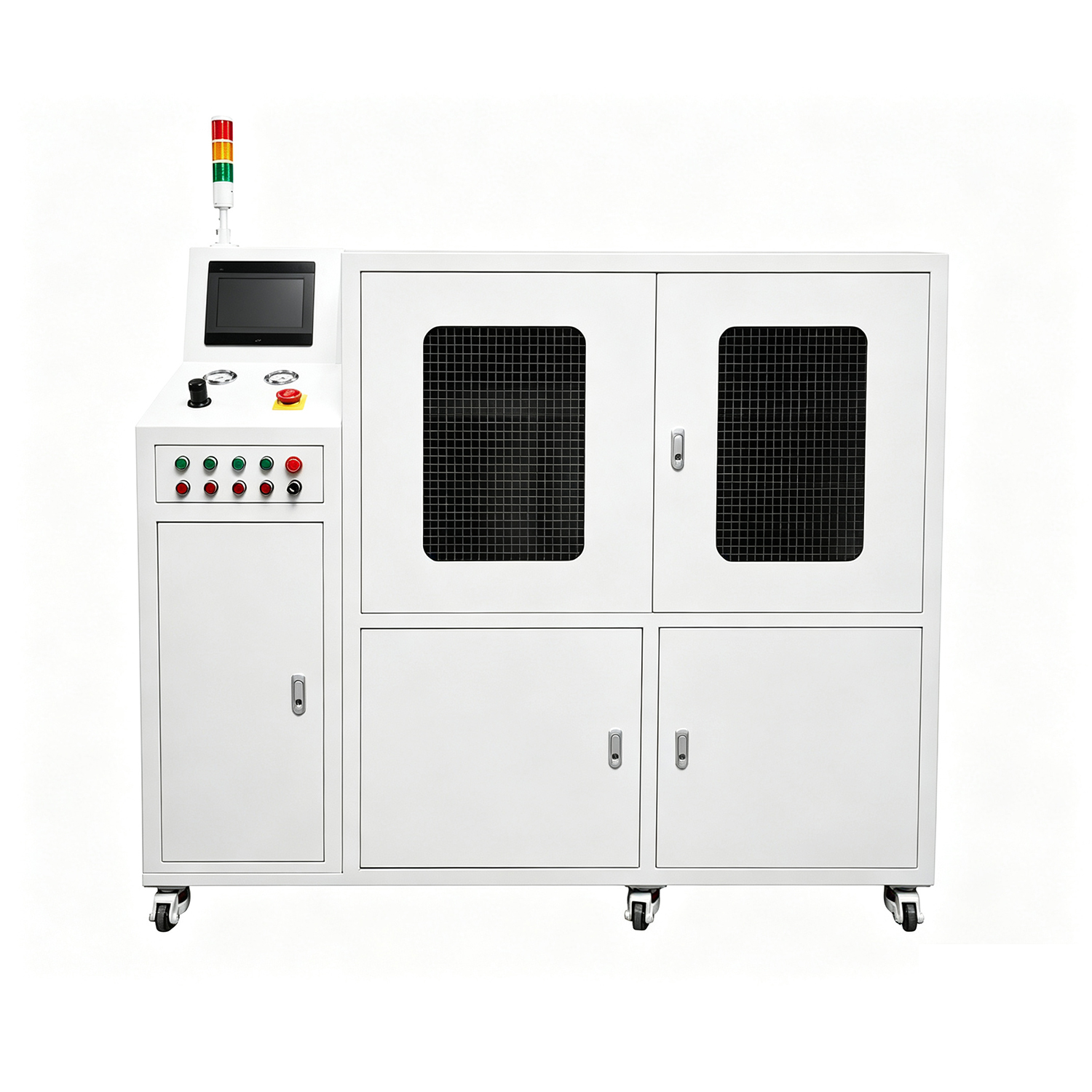
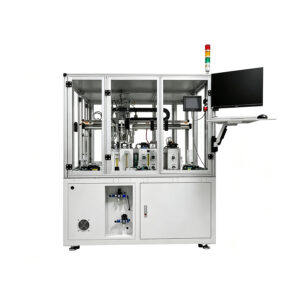
Four-Channel Liquid Cooling Plate Leak Test Machine — Parallel Automatic Hermeticity Testing System for Cooling Blocks & Manifolds
A four-channel liquid cooling plate leak test machine is automated production equipment that simultaneously tests up to four cooling plates, manifolds, or liquid cooling modules in parallel for internal leakage using pressure decay or differential pressure methods. Utilizing PLC-controlled high-precision sensors (±0.5% accuracy) and proportional pressure control (0.1–2.0 MPa), the machine independently tests four different cooling components with separate parameters and real-time monitoring on a unified touchscreen interface. Four-channel parallel testing increases production efficiency 3–4 times compared to single-channel equipment while reducing unit product costs, making this system essential for high-volume cooling plate manufacturers supplying data centers, AI accelerators, and automotive thermal solutions.
Why Manufacturers Choose Our Four-Channel Liquid Cooling Plate Leak Test Machine
1.Four-Channel Parallel Testing Increases Efficiency 3–4 Times
Single-channel leak test systems process one cooling plate every 5–10 minutes. Our four-channel machine tests four cooling plates simultaneously in the same 5–10 minute cycle. Result: 3–4x throughput without proportional equipment costs. A manufacturer processing 200+ cooling plates per shift can be served by one four-channel machine instead of 3–4 single-channel units, reducing capital investment and floor space.
2.Fully Automatic PLC Control Eliminates Manual Intervention
Siemens PLC-based automation handles all operations: pressure ramp-up, pressure maintenance, leak detection, result determination, and data output — all without manual intervention. Operators simply load four cooling plates, select test parameters, and the system executes complete testing cycle automatically. Real-time monitoring on touchscreen shows all four channels’ pressure curves simultaneously. Reduces operator training and human error.
3.High-Precision ±0.5% Pressure Accuracy with Dual Detection Methods
Each channel is equipped with high-precision pressure sensors (±0.5%FS accuracy) supporting two detection methods: (1) Pressure Decay Method — monitors pressure drop over time to calculate leak rate, and (2) Differential Pressure Method — measures pressure differential to detect micro-leaks. This dual-method approach ensures even microscopic leaks (<0.001 mL/min) are detected. No cooling plate with internal leakage escapes to customers.
4.Independent Station Control for Mixed Production Flexibility
Each of the four channels operates with completely independent parameters: pressure setpoint (0.1–2.0 MPa), test duration, detection method, and pass/fail criteria. Test four different cooling plate models with different specifications in a single cycle — no batch processing required. Channel 1 tests 0.5 MPa manifold, Channel 2 tests 1.5 MPa cold plate, Channel 3 tests 2.0 MPa cooling module, Channel 4 tests liquid cooling tubes, all simultaneously.
5.Intelligent Touchscreen & Data Management for Full Production Traceability
Centralized touchscreen interface displays real-time pressure curves for all four channels with intuitive color-coded pass/fail status. Integrated barcode scanner logs cooling plate ID, test parameters, results, and timestamp. Data exports to CSV/Excel for SPC analysis and regulatory compliance (ISO standards, automotive IATF 16949, aerospace AS9100). Supports MES integration for seamless production tracking.
Machine Specification
| Specification | Details |
| Channel Configuration | 4 independent parallel testing stations |
| Boost System | Drive air pressure ≥7 MPa, 1 N/mm²/min |
| Explosion Pressure Range | 0.1 – 2.0 MPa (proportional control) |
| Pressure Source | High-pressure nitrogen (external supply) |
| Pressure Control Accuracy | ±1% FS (full scale) |
| Pressure Measurement Accuracy | ±0.5% FS (high-precision transducers) |
| Pressure Control Method | Electrical proportional control with auto relief |
| Test Medium | High-pressure nitrogen |
| Detection Methods | Pressure decay method + differential pressure method |
| Leak Detection Sensitivity | Can detect leaks < 0.001 mL/min |
| Test Piece Types | Manifolds, liquid cooling modules, cooling plates, liquid cooling tubes, quick connectors |
| Independent Station Configuration | 1–10 stations selectable (standard 4-channel) |
| Test Duration per Cycle | 2 – 15 minutes (adjustable per channel) |
| Real-Time Monitoring Display | Intelligent touchscreen with live pressure curves for all 4 channels |
| Control System | Siemens PLC with fully automatic control |
| Alarm & Safety Features | Pressure over-limit alarm, leakage sound/light alarm, emergency shutdown, liquid level alarm |
| Data Logging & Export | CSV, Excel formats; supports MES integration |
| Barcode Scanner | Integrated USB barcode reader for cooling plate ID tracking |
| Statistical Reports | SPC-ready reports with pass/fail analysis |
| Input Voltage | AC 220V, 3-phase (110V or 380V available on request) |
| Power Consumption | 2–4 kW (depending on pressure demand) |
| Machine Dimensions | 1,200 × 900 × 1,400 mm (standard 4-channel) |
| Machine Weight | 350 kg |
| Gas Supply Requirements | 0.5–1.0 bar nitrogen source (external regulator provided) |
| Network Connectivity | MES integration support for production data synchronization |
| Software | Specialized testing software with user-friendly interface |
| Compliance Standards | ISO 13849-1, IATF 16949 (automotive), AS9100 (aerospace) |
Where the Four-Channel Leak Test Machine Fits in Cooling Plate Production
The four-channel leak test machine is positioned as the critical final quality verification step before cooling plates ship to customers. This is where 100% of production must be tested to ensure zero internal leakage and guaranteed hermetic integrity.
In a typical cooling plate/cooling module production line, the process flow is:
Aluminum/Copper Block Machining → Internal Channel Drilling → Deburring & Cleaning → Pressure Test & Leak Detection → Final Inspection & Packaging → Shipment to Data Center/AI/Automotive Customers
The four-channel leak test machine sits at Step 4 (Pressure Test & Leak Detection), directly after cleaning and before final inspection. Its ability to detect even microscopic leaks through dual detection methods is mission-critical — any cooling plate with internal leakage that reaches a customer causes catastrophic system failure, data center downtime, and expensive thermal fluid cleanup.
CoolingThermal supplies complete cooling plate production and testing solutions. The four-channel leak test machine can be ordered as a standalone upgrade for existing production lines or integrated with our block machining, channel drilling, and finishing equipment as a complete turnkey solution.
Industry Applications for Leak Testing:
Liquid Cooling System Components
Liquid cooling tubes, liquid cooling plates, liquid cooling modules, quick connectors, water distributors, CDU (coolant distribution unit), manifolds. Essential for data center, AI accelerator, and high-performance computing thermal solutions where cooling system integrity is non-negotiable.
Data Center & Server Thermal Solutions
Enterprise CPUs and GPUs require liquid cooling to manage 300–500W+ thermal loads. Cooling plates with 100% hermeticity verified by four-channel leak testing ensure zero internal leakage. Even micro-leaks cause data center downtime, hardware damage, and expensive thermal fluid cleanup. Four-channel parallel testing enables data center OEMs to validate supply from multiple cooling plate manufacturers simultaneously.
AI Accelerator & GPU Thermal Modules
Next-generation AI accelerators (NVIDIA A100/H100, AMD MI300) use advanced liquid cooling for 500W+ thermal management. Four-channel testing validates manifolds, cold plates, and integrated cooling modules before integration into multi-GPU systems. High hermeticity requirements (no tolerance for field leaks) make automatic four-channel testing essential.
Automotive Thermal Management (EV Battery & Power Electronics)
EV battery thermal modules, power electronics cooling plates, and thermal spreaders require zero-leak design. Four-channel testing enables automotive OEMs (Tesla, BYD, NIO, Porsche) to validate supplier cooling plates at scale. IATF 16949 compliance via automated data logging ensures traceability and regulatory conformance.
Energy & Heavy Industry Pressure Equipment
Valves, pipelines, high-pressure vessels, blowout preventers, wellhead equipment, choke and kill manifolds in oil & gas applications. Four-channel parallel testing validates critical pressure-sealed components before deployment in extreme pressure environments where failure is catastrophic.
Aviation & Aerospace Thermal Systems
Aerospace thermal modules, heat exchangers, and manifolds require AS9100 compliance and <1×10⁻⁷ Pa·m³/s hermeticity verification. Four-channel testing with complete data logging meets aerospace qualification requirements and enables parallel testing of multiple thermal components per cycle.
How the Four-Channel Liquid Cooling Plate Leak Test Machine Works

Four-Plate Loading

Independent Pressurization

Dual-Method Leak Detection

Reviews
There are no reviews yet.