
Product Description
Overview
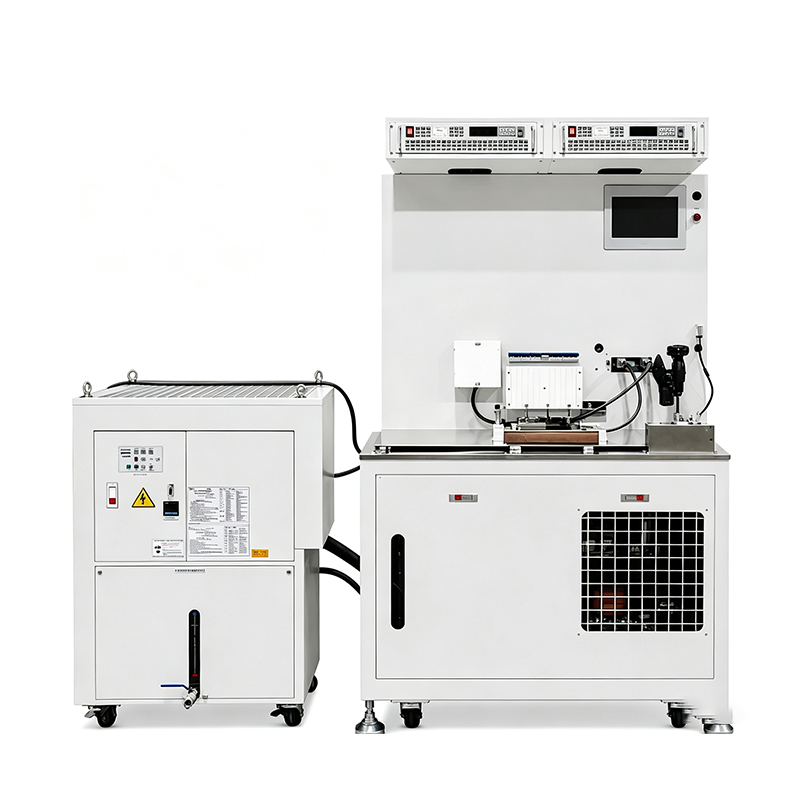
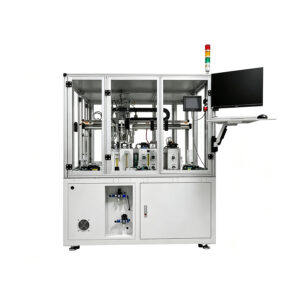
A cold plate can pass a leak test and still underperform in the field — a partially blocked channel or a poor thermal interface rarely shows up as a leak, but it shows up as a hot chip. This station is built to catch exactly that: it clamps the cold plate through quick-disconnect fittings, drives a controlled flow of test fluid through it, and reads pressure, flow, and temperature simultaneously to confirm the part performs to spec before it ships.
| Parameter | Specification |
|---|---|
| Model | CT-CPP-24 |
| Max Cold Plate Size | 445 x 220mm (900 x 500mm work area, configurable) |
| Fixture | Quick-disconnect mount (UQD4-class) |
| Test Pressure Range | 1–5 bar (pressure sensor 0–500 kPa, configurable) |
| Pressure Sensor Accuracy | ±0.2% FS |
| Differential Pressure Range | Up to 500 kPa (configurable) |
| Differential Pressure Accuracy | ±0.1% FS |
| Flow Rate Range | 0.5–15 LPM |
| Flow Meter Repeatability | ±0.071mL over a 10-second dispense |
| Compatible Fluids | Deionized water, PG25 glycol-water mixture |
| Fluid Temperature Range | Ambient to 60°C (±0.5°C) |
| Power Supply | 2 x 4800W heaters |
| Cooling Capacity | 7.5 kW |
| Reported Data | Inlet/outlet differential pressure, inlet pressure, inlet flow rate, and all monitored temperatures |
| Temperature Channels | 16 channels (8 in standard use: ambient, supply, return, over-temperature x2, cold-plate TC x2, reservoir; 8 reserved for expansion) |
| Temperature Sensor Type | T-type thermocouple |
| Traceability | Barcode scan per part (up to 35 characters), result logged by part ID |
Key Advantages
One Clamp, Three Measurements
Pressure drop, flow rate, and temperature are read in the same test cycle instead of three separate setups. A cold plate that shows a normal pressure drop but an abnormal temperature rise gets flagged immediately, which is exactly the failure mode a flow-only or thermal-only check can miss on its own.
Built-In Cold Plate Sensor Reading
Two of the sixteen temperature channels are reserved for the cold plate’s own embedded thermocouples, so if your product ships with onboard TC leads, the station reads them directly rather than relying only on external sensors at the fluid ports.
Glycol-Ready Fluid Handling
Running PG25 glycol-water mixtures alongside pure water means the same station qualifies parts for both data-center-style DI water loops and automotive or outdoor applications that need freeze protection, without swapping test fluid systems.
Full Traceability by Part ID
Every test starts with a barcode scan, and every reading is logged against that part ID. When a customer reports a field failure months later, you can pull the exact pressure, flow, and temperature record for that specific unit instead of relying on a batch-level pass rate.
How It Works
Stage 1: Load and Connect
The cold plate is scanned by barcode for part-ID logging, then clamped into the fixture and connected through quick-disconnect fittings on the inlet and outlet.
Stage 2: Conditioned Flow
Test fluid is driven through the plate at the flow rate and temperature set in the recipe, with the reservoir and supply lines conditioned by the station’s own heating and cooling capacity.
Stage 3: Simultaneous Measurement
Inlet pressure, differential pressure, flow rate, and all monitored temperatures are read together once conditions stabilize, including any onboard cold-plate thermocouples.
Stage 4: Pass/Fail and Logging
Results are compared against the recipe limits, a pass/fail is assigned, and the full data set is logged against the scanned part ID.
Applications
This station fits cold plate and liquid cooling module manufacturers who need a single functional gate before shipment — AI server and GPU cold plates, EV battery and power-electronics cold plates, and industrial liquid cooling modules where both hydraulic and thermal performance have to be confirmed together.
Why Choose Cooling-Thermal
We configure the pressure range, flow range, fixture, and temperature channel count around your specific cold plate before build, and validate the test recipe on your own parts. It runs well alongside our dedicated flow resistance test and thermal resistance test stations where a deeper single-property measurement is needed beyond this station’s combined functional check, and downstream of leak testing in a full cold plate QC line.
The Test Cycle: Load, Condition, Measure, Log

Load and Connect

Conditioned Flow

Reviews
There are no reviews yet.