
Product Description
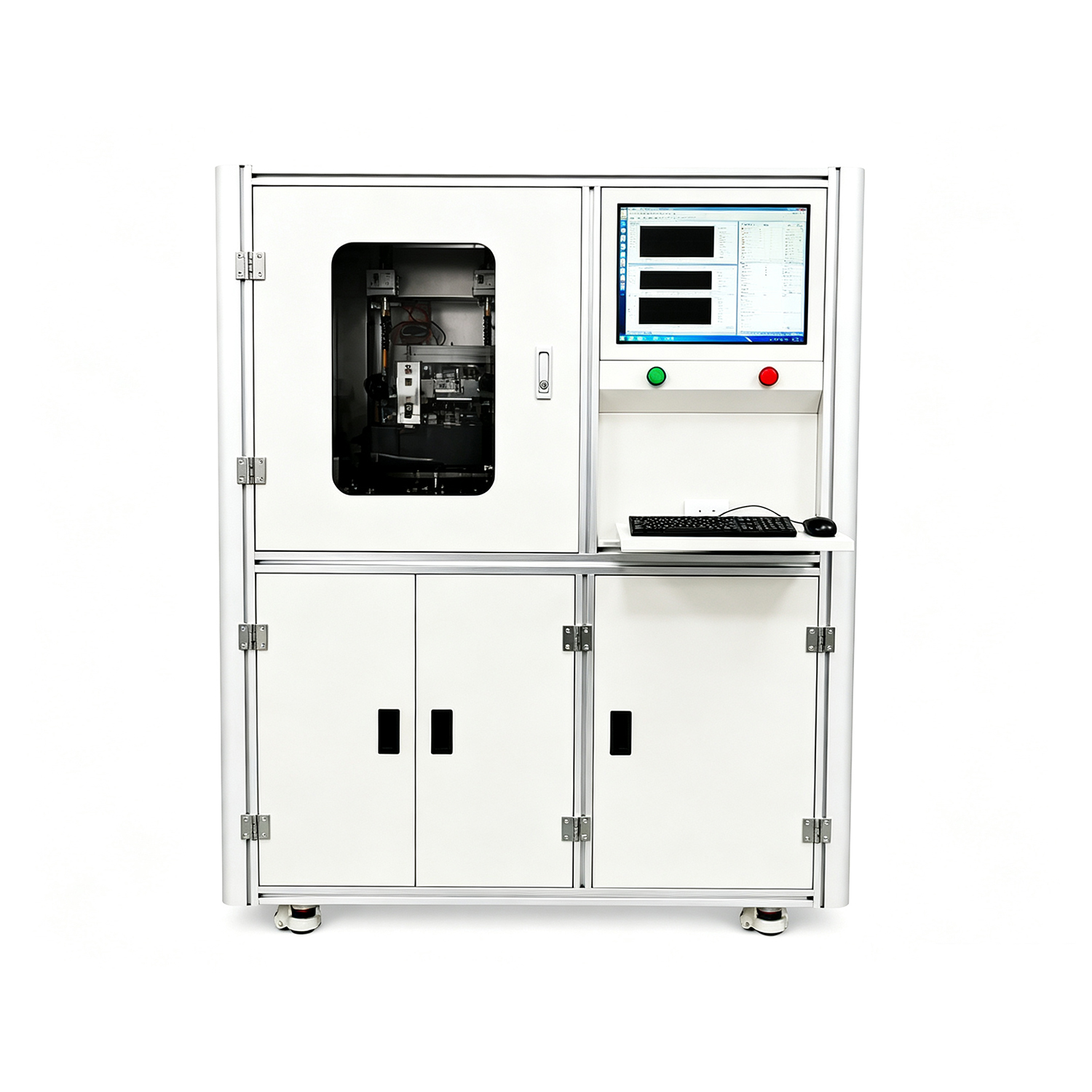
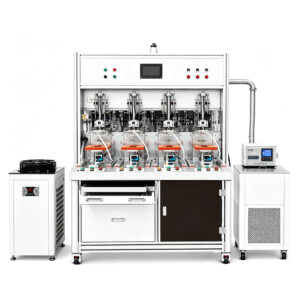
Cold Plate Thermal Resistance Test Machine — Automated Rth Measurement for Liquid Cold Plates
Production-grade test station that measures liquid cold plate thermal resistance (Rth in °C/W) with controlled heat load, chiller-stabilized coolant flow, and repeatable clamping force — automatic steady-state detection, pass/fail decision, and per-plate data logging. The final quality gate that catches defects leak and flow testing miss.
What This Machine Does
Thermal resistance is the number that decides whether a liquid cold plate does its job. A cold plate can pass leak testing and flow testing and still fail in the field — because an internal brazing void, a warped base, or a partially blocked channel raises thermal resistance without showing up in pressure or leak data. This machine measures the actual Rth of every plate so those defects are caught before shipment.
The CT-CPT-4CH applies a controlled heat load to the cold plate through a calibrated copper heater block, runs coolant through the plate at a recipe-defined flow rate and inlet temperature, waits for thermal steady state, and computes thermal resistance:
Rth = (T_heater − T_coolant_inlet) / Q [°C/W]
The result is compared automatically against the design specification, pass/fail is assigned, and every measurement is logged by part ID. For modern AI GPU cold plates the working targets are below 0.03°C/W at 700W and below 0.02°C/W at 1000W — tolerances tight enough that the measurement method itself has to be controlled, which is what this machine is built for.
Why Cold Plate Rth Must Be Measured, Not Just Simulated
A CFD simulation predicts Rth. A good prototype proves the design. Neither proves the production line. The defects that matter most are invisible to every other test:
| Defect | Passes leak & flow test? | Caught by Rth test |
| Internal brazing void over die zone | Yes — invisible | Rth reads high vs spec |
| Base plate warpage / poor flatness | Often yes | Rth high from TIM gap |
| Partial channel blockage (debris) | Maybe — small ΔP shift | Rth high from flow loss |
| Fin collapse / detachment inside | Yes | Rth high from lost area |
| Wrong material / alloy mix-up | Yes | Rth deviates from copper baseline |
This is why high-reliability cold plate production runs three tests in sequence: 100% leak test, flow resistance test, and Rth test. Each catches a different failure mode — a plate can pass the first two and still fail thermally because of an internal void over the die zone.
Why Measurement Accuracy Depends on the Machine
Rth measurement goes wrong in predictable ways. This machine is engineered to remove each error source:
✓ Heater block with embedded sensors (ASTM D5470 gradient method) — surface-mounted sensors skip the interface and understate Rth
✓ Pneumatic clamping with calibrated, repeatable force — TIM resistance shifts ±50% with contact pressure, so uncontrolled clamping makes results meaningless
✓ Chiller-stabilized inlet to ±0.1°C and calibrated flow meter — Rth without a fixed, logged flow rate is not comparable between tests
✓ Automatic steady-state detection — readings taken before steady state flatter Rth by 10–30%; the machine advances only when drift < 0.1°C over 60 seconds
✓ Per-plate data logging — part ID, power, flow, inlet, Rth, full curve, timestamp, exportable for customer audits
Key Features
• 4 independent test channels (1/2/6/8 options) — parallel testing to match production throughput
• Heater power 0–500W per channel (extendable to 1000W) — covers CPU, GPU, IGBT, and next-gen AI accelerator plates
• Custom heater block footprint — sized to your chip die (10×10 to 50×50mm) for realistic Rth, not a generic contact
• ±0.1°C sensor accuracy with Pt100 RTD + thermocouple measurement
• Integrated chiller with ±0.1°C inlet stability across a 10–60°C range
• Calibrated flow meter ±1% — Rth always recorded against a known flow rate
• Automatic steady-state + pass/fail — no operator judgment, repeatable results across shifts
• Full data logging + MES export — per-plate traceability for customer audits
• Compatible with all cold plate types — micro-channel, mini-channel, tubed, FSW, and vacuum-brazed; copper and aluminum
Technical Specifications
| Parameter | Value |
| Model | CT-CPT-4CH |
| Application | Thermal resistance (Rth) testing of liquid cold plates, cold plate assemblies, and thermal modules |
| Measured outputs | Thermal resistance Rth (°C/W), temperature rise ΔT (°C), heater/inlet/outlet temperatures, heat load Q (W) |
| Test method | Gradient heater-block method per ASTM D5470 principle |
| Test channels | 4 channels standard (1 / 2 / 6 / 8 channel options) |
| Heater power per channel | 0 – 500W (extendable to 1000W for high-TDP GPU plates) |
| Heater control accuracy | ±0.5% of setpoint |
| Heater block contact area | 25 × 25mm standard (10×10 to 50×50mm custom to match die footprint) |
| Temperature sensors | Pt100 RTD + Type-T thermocouple, ±0.1°C accuracy |
| Coolant inlet control | Integrated chiller, ±0.1°C inlet stability, 10 – 60°C range |
| Flow rate range | 0.2 – 10 L/min, calibrated flow meter ±1% |
| Clamping force | Pneumatic, calibrated and repeatable (recipe-set per plate) |
| Steady-state detection | Automatic — advances when temperature drift < 0.1°C / 60s |
| Cycle time | 5 – 10 minutes per plate (thermal-mass dependent) |
| Pass/fail decision | Automatic against recipe Rth limit |
| Data logging | Per plate: part ID, Q, flow, inlet temp, Rth, full curve, timestamp; CSV / MES export |
| Control system | PLC + industrial PC + touchscreen HMI; CFD/test data comparison software |
| Compatible plates | Copper / aluminum, micro-channel / mini-channel / tubed / FSW / vacuum-brazed cold plates |
| Power supply | 380V / 50Hz / 3-phase (220V option) |
| Compliance | CE-ready design |
Note: specifications are for the standard CT-CPT-4CH. Heater footprint, power range, channel count, and flow range are all configurable to your product mix.
How the Test Cycle Works
Stage 1: Load & Clamp
✓ Cold plate placed in fixture, coolant lines connected
✓ Pneumatic clamp applies recipe-defined, calibrated contact force
✓ Heater block (sized to die footprint) contacts the plate through TIM
Stage 2: Establish Conditions
✓ Chiller brings coolant inlet to recipe temperature (±0.1°C)
✓ Flow set and verified by calibrated meter at recipe L/min
✓ Heater ramps to recipe power (e.g. 500W or 1000W)
Stage 3: Steady State & Measure
✓ System waits for automatic steady-state (drift < 0.1°C / 60s)
✓ Heater, inlet, and outlet temperatures logged
✓ Rth = (T_heater − T_inlet) / Q computed automatically
Stage 4: Judge & Log
✓ Rth compared to recipe limit — automatic pass/fail
✓ Full result + curve stored by part ID
✓ Plate released; next channel cycles in parallel
Applications
This tester is the thermal quality gate for any liquid cold plate production line: AI GPU cold plates (NVIDIA H100/GB200 class), server CPU cold plates (AMD SP5 class), IGBT and power electronics cold plates, EV battery cold plates, and optical module cold plates. It pairs with our cold plate flow resistance test machine and leak test equipment to form the complete three-gate cold plate QC line. For the engineering background on what these numbers mean, see our cold plate thermal resistance guide.
Why Choose Cooling Thermal
• We build the full cold plate test line — Rth, flow resistance, and leak testing from one supplier with matched fixtures and data systems
• Method-correct by design — the machine enforces the measurement discipline (steady state, clamping, flow control) that makes Rth data trustworthy
• Configured to your product — heater footprint and power matched to your actual chips, not a generic fixture
• Engineer-led commissioning — installation, correlation to your reference plates, operator training, 12-month warranty
Reviews
There are no reviews yet.