
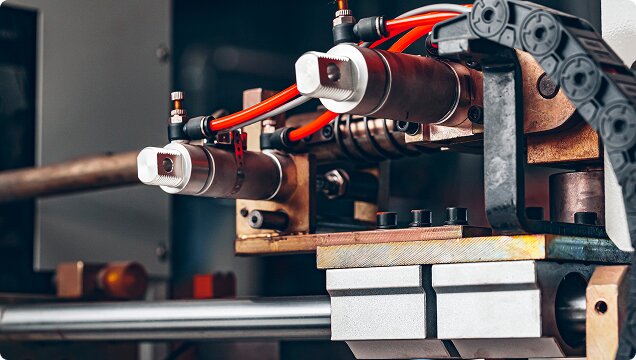
Vapor Chamber Fully Automatic Laser Sealing Machine Guide
1. Introduction to Vapor Chamber Fully Automatic Laser Welding Machine
1. What Is Vapor Chamber Fully Automatic Laser Sealing Machine?
A Vapor Chamber Fully Automatic Laser Sealing Machine directs focused laser energy toward weld joints for vapor chamber sealing. Manufacturers typically employ this technology to seal copper enclosures or charging ports when manufacturing vapor chambers. The machine integrates several subsystems including laser source, precision motion system, workholding fixtures, and controls.
The system positions the vapor chamber within loading fixtures.
The laser traverses along the programmed welding path.
The focused energy melts the joining surfaces together to form a metallurgical bond.
Once completed, the machine completes the cycle and readies parts for inspection or unloading.
Consequently, vapor chamber manufacturers can perform repeatable welds with less manual operation.
Key Functions
Typical applications of this equipment require support for multiple manufacturing functions such as:
– Welding copper components with accuracy
– Automating laser movement along a fixed path
– Providing repeatable sealing quality
– Eliminating excessive operator handling
– Programming weld paths and parameters
– Integrating into automated material transfer systems
– Repeatability of welding cycles
– Monitoring process conditions and quality assurance
Moreover, many manufacturers can benefit from automation when producing high volumes of vapor chambers.
However, appropriate material and component preparation, sealing parameters, and joint design remain critical to successful welds.
2. How Does Automatic Laser Sealing Machine Work?
Automation of laser sealing processes utilizes a concentrated beam of laser energy and controlled movement between weld surfaces. As mentioned previously, the primary benefit of laser welding is the ability to precisely deliver energy to a small targeted area. This allows manufacturers to establish weld geometry through a combination of laser power, focus, and travel speed.
Step 1: Automatic Loading
Initially, the operator loads the vapor chamber into the sealing machine. Next, fixtures secure the part for welding and locate the weld joint to the desired position on the laser processing path. Therefore, ensuring rigid workholding can help improve weld accuracy.
Step 2: Position Detection
The controller verifies proper part location before welding begins. Cameras or position sensors may also assist with weld alignment depending on machine configuration. Once in place, the controller also loads the specific welding program. Therefore, the system is now ready to perform the sealing operation.
Step 3: Laser Welding
The laser generates the appropriate amount of energy to commence welding. A focused laser beam then heats the joining copper edges to form a molten weld pool. At the same time, the motion system moves the laser beam along the programmed sealing path. As the molten weld pool cools, it creates a continuous weld bead between both workpieces.
Step 4: Cooling and Inspection
As mentioned above, the weld joint then cools and solidifies to form a metallurgical bond. Optical inspection systems may review weld bead appearance and geometry. Leak testing may also occur to verify sealing requirements. Therefore, if defects are detected, manufacturers can identify and address concerns before moving the part to further production stages.
Step 5: Automatic Unloading
The machine then unlocks and releases the finished vapor chamber. An operator or robot system then moves the chamber towards the next production station. As a result, automating material transfer reduces repetitive operator tasks.
3. Vapor Chamber Fully Automatic Laser Welding Machine Components
Different mechanical and electrical systems comprise a fully automated laser welding machine.
Understanding how each component works together can help designers establish production requirements and equipment specifications.
3.1 Laser Source
The laser generates heat to form weld beads on vapor chamber joints. Most industrial laser sealing systems use fiber lasers due to their energy efficiency and lightweight design. However, copper is a reflective material with high thermal conductivity. Therefore, choosing the proper laser and welding parameters can be challenging.
3.2 Laser Welding Head
The welding head focuses and directs laser energy to the workpiece. Specific optics also allow manufacturers to adjust beam diameter and focus depth. Some laser welding heads also include protective optics and surveillance capabilities. As a result, the welding head significantly influences weld repeatability.
3.3 Precision Motion System
Motors and guides enable relative movement between the weld joint and laser source. Therefore, servo motors and precision guides allow the laser to follow a pre-programmed path. Furthermore, advanced motion controllers allow synchronization of feed rates and weld paths. Consistent motion allows for even weld bead formation.
3.4 Automatic Positioning System
Fixtures hold vapor chamber components in place during welding. Furthermore, positioning aids limit movement within the weld joint. Vision systems can also aid in adjusting misaligned workpieces. As a result, proper part location ensures repeatable weld accuracy.
3.5 PLC Control System
A programmable logic controller (PLC) synchronizes system motion and executes welding programs. First, the controller activates the movement sequences and safety features. Next, the PLC performs the welding operation based on the chosen program. Additionally, controllers can log alarms and process details during production. As a result, operators can adjust machine functions using a centralized control screen.
3.6 Human Machine Interface (HMI)
Manufacturers can access machine functions and reports using the HMI or touchscreen interface. For instance, users can initiate specific welding programs and monitor system alarms. Moreover, proper credentials allow operators to change relevant machine settings. Therefore, a user-friendly interface allows operators to quickly manage equipment functions.
3.7 Cooling System
Cooling prevents overheating of the laser source and optical system. As a result, industrial laser welding machines require proper cooling methods to protect internal components. Some systems use a water chiller to regulate temperatures. Moreover, temperature sensors allow monitoring of machine conditions.
3.8 Safety Protection System
Lasers create optical, burn, and electrical hazards within the workplace. Therefore, manufacturers should design proper machine guarding and safety interlocks. Additionally, review emergency stops, fume extraction systems, and laser safety standards. For more information, please visit our Industrial Laser Safety Standards page.
4. Features and Benefits of Vapor Chamber Fully Automatic Laser Welding Machine
4.1 High Welding Accuracy
Because laser welding focuses energy into a small area, weld geometries can be very accurate. Furthermore, automated motion systems ensure part location remains consistent from weld to weld. However, actual welding tolerances vary by machine configuration and process development.
4.2 Welding Consistency
Machine automation replicates welding parameters across multiple production runs. As a result, there is less variation caused by manual operators. Process monitoring also allows for detection of abnormal welds.
4.3 Minimized Thermal Distortion
Due to the small processing area of laser welding, the heat affected zone can be quite small. Therefore, under the correct welding parameters, there is a potential to minimize thermal distortion. However, heat input, joint design, and workholding can still play a significant role in part distortion.
4.4 Increase Production Efficiency
Automated positioning and welding decreases the amount of required manual labor. Moreover, automatic loading systems can reduce loading times. As a result, manufacturers can increase production output if machine cycle times meet production demands.
4.5 Versatile Welding Recipes
Programmable controls allow manufacturers to store different weld paths. For example, changing welding parameters allows for different vapor chamber sizes. Furthermore, tooling changes can allow for additional part programming. Therefore, manufacturers can create and use multiple welding recipes to service various products.
4.6 Production Tracking
Some advanced controllers allow manufacturers to track welding parameters and alarms. Furthermore, linking production databases to individual parts creates production history. As a result, part traceability and quality becomes much easier to manage.
5. Laser Sealing Process Example for Vapor Chamber Production
Producing reliable seals on vapor chambers involves proper part preparation and stable welding conditions. Each step of the manufacturing process can affect the overall functionality of the device.
5.1 Preparation of Copper Surface
Manufacturers should begin by inspecting all copper surfaces for contaminants and defects. A vapor chamber cleaning system then removes impurities from surface preparation. Furthermore, adequately preparing copper surfaces allows for stable welding. Therefore, cleaning ensures manufacturers can create reliable weld joints.
Learn More: Vapor Chamber Cleaning Equipment
5.2 Positioning of Parts
Next, the operator loads cleaned components into locating fixtures. Positioning screws then locate the area to be welded. Clamp force is then applied to prevent movement during the laser sealing process. As a result, rigidly positioning vapor chambers allows for consistent welds.
5.3 Selection of Welding Parameters
The machine controller then loads the chosen welding parameters or laser welding recipe. Important welding parameters include laser power, welding speed, focal point, and shielding. Furthermore, pulsed and burst parameters can also be changed based on the laser configuration. Therefore, weld parameter development should consider copper properties and joint design.
5.4 Perform Automatic Laser Sealing Process
Once preparations are complete, the machine performs the welding operation. The laser melts both joining surfaces together to form a weld bead. During this time, the laser also moves at a specific rate along the joint. Once the molten metal cools, a continuous weld forms between vapor chamber joints.
5.5 Inspection of Weld
Following welding, technicians can inspect the weld bead for appearance. Visual defects can be identified during this process. However, visual inspection does not guarantee leak-free welds. Therefore, engineers should conduct appropriate leak tests when necessary.
5.6 Verification of Completed Product
Finally, technicians should verify the completed vapor chamber meets all design specifications. This may include additional processes such as vacuum processing or thermal conditioning. As a result, the finished vapor chamber advances through the certified production process.
6. Laser Sealing vs. Traditional Welding
Different welding methods offer different manufacturing advantages.
Therefore, manufacturers should compare process requirements before selecting equipment.
Feature | Automatic Laser Sealing | Conventional Manual Welding |
Welding precision | High potential precision | Operator-dependent |
Automation | Supports automated operation | Usually limited |
Heat input | Highly localized potential | Depends on process |
Repeatability | Programmable and consistent | Depends on operator skill |
Production efficiency | Suitable for repeated operations | Depends on manual cycle time |
Initial investment | Generally higher | Often lower |
Process monitoring | Supports digital integration | Often more limited |
Best application | Precision production and repeatable batches | Repairs and flexible small batches |
However, laser welding does not automatically guarantee superior results.
For example, poor joint preparation can still cause porosity or incomplete fusion.
Therefore, manufacturers must validate welding quality under actual production conditions.
7. Vapor Chamber Sealing Applications
7.1 Production of Vapor Chambers
The most common use of laser vapor chamber sealing machines is closing flat vapor chamber packages.
Additionally, repeatability allows for slim thermal system designs.
As a result, some machines integrate into automatic vapor chamber production lines.
7.2 Thin Vapor Chambers
Thin form factors need precise management of energy input and distortion.
As a result, the right laser sealing system allows manufacturers to meet tight dimensional tolerances.
In addition, fixtures allow for accurate part alignment.
7.3 Cooling Systems for CPUs/GPUs
CPUs and GPUs create hotspots that need to be dissipated.
As a result, vapor chambers allow for effective heat spreading within these cooling systems.
In addition, uniform seal strength allows for uniform thermal conductivity.
7.4 Heat Sinks for Data Centers
Data center applications demand reliable heat sink operation.
As a result, vapor chamber manufacturers often incorporate advanced heat spreaders into these thermal solutions.
In addition, automated sealing allows for repeatable quality.
7.5 Mobile Devices
Mobile devices like smartphones benefit from small form-factor cooling.
As a result, thin vapor chambers allow for compact heat spreaders.
In addition, accurate laser welding allows for very small form factors.
7.6 Heat Pipes
Some laser sealing systems are also used for sealing heat pipes.
Keep in mind that not all laser sealing machines are capable of sealing heat pipes.
As a result, you will need to confirm your specific application before selecting a system.
Internal Link: Heat Pipe Production Line
8. Vapor Chamber Production Lines
Lasers are typically only one component of a vapor chamber production line.
As a result, you will need to evaluate the interfaces to other equipment.
Standard Vapor Chamber Production Steps
– Vacuum process and charge with fluid
Keep in mind that this is not a one-size-fits-all solution. Many steps can be moved around based on your vapor chamber design.
For instance, some vapor chamber manufacturers will weld the entire enclosure before charging with coolant.
Others will perform the final seal of the charging-port after filling.
As a result of these variations, it is important to understand the difference between sealing the enclosure and applying the final production seal.
Related Equipment Links
Vapor Chamber Production Line – Complete set of equipment to produce vapor chambers.
Automatic Powder Filling Machine – Machine used to distribute the powder into wicks.
Vacuum Sintering Furnace – Furnace used to create the porous copper wick.
Vapor Chamber Hot Press Hydraulic Machine – Used for various pressing operations.
Vacuum Degassing Machine – Extracts dissolved or unwanted gases.
Multi-Station Thermal Performance Tester – Device used for testing thermal performance.
|
|
9. Important Technical Specifications
Buyers should evaluate technical specifications according to their actual product requirements.
The following table identifies common selection parameters rather than verified specifications for a particular model.
Parameter | Selection Considerations |
Laser type | Fiber or other suitable laser configuration |
Laser power | Match copper thickness and joint geometry |
Welding method | Continuous or pulsed operation |
Positioning system | Servo-controlled axes or robotic motion |
Control system | PLC or industrial motion controller |
Welding accuracy | Confirm through sample testing |
Product dimensions | Match required chamber size |
Cooling method | Suitable laser cooling configuration |
Loading system | Manual, semi-automatic, or automatic |
Safety system | Enclosure, interlocks, emergency protection |
Inspection options | Vision monitoring and leak testing integration |
Production capacity | Determine through validated cycle time |
Therefore, manufacturers should request model-specific specifications before purchasing equipment.
Additionally, sample welding helps verify suitability for actual copper components.
10. Quality Control and Welding Inspection
Quality control is essential to produce reliable vapor chambers.
Hermetic sealing also affects thermal performance over time.
10.1 Visual Weld Inspection
Inspectors should visually examine weld quality and seam continuity.
Inspectors should also look for obvious cracks, undercut, and surface variation.
It is important to note that some defects can be present but not visible to the naked eye.
10.2 Leak Testing
Manufacturers must also confirm proper sealing through appropriate leak testing.
Helium leak test equipment can identify extremely small leaks under specific conditions.
Buyers should establish pass/fail criteria based on acceptable leakage rates.
10.3 Weld Cross-Section Analysis
Cross-section samples may be reviewed during process development.
Weld cross-section analysis can be used to verify weld penetration and fusion.
Analysis of weld seams can help to optimize welding parameters.
10.4 Dimensional Inspection
Precision measuring equipment can be used to confirm part dimensions.
Measurement of flatness can reveal unexpected thermal deformation.
Dimensional inspection should account for any critical requirements downstream.
10.5 Thermal Performance Verification
Once the vapor chamber has completed manufacturing, testing should be performed to verify thermal performance specifications.
Consistent testing conditions allow for repeatable comparison between products.
Defective pieces that do not meet thermal requirements can be removed from the production line.
11. How to Choose the Right Laser Sealing Machine
11.1 Define Product Requirements
Determine the size of the vapor chamber and copper thickness.
Identify the necessary weld joints and their locations on the vapor chamber.
Also consider how many vapor chambers you need to produce and quality standards.
11.2 Evaluate Laser Compatibility
Opaque metals like copper absorb laser energy quickly.
You should validate laser performance by running welding trials as soon as possible.
Beam shape and process monitoring are also important to consider.
11.3 Consider Automation Level
Fully-automatic machines can consistently weld large production batches.
Semi-automatic laser sealing equipment may be more suitable for lower volumes.
Buyers should consider how much they will need to automate based on production needs.
11.4 Review Welding Quality
Ask to see sample welds your self if its possible before buying.
Consider seam quality, dimensional stability, and leak testing.
Technical validation reduces risk when you invest in a new piece of equipment.
11.5 Evaluate Technical Support
Service and installation support can affect machine uptime.
Training allows operators to become familiar with the machine.
Talk to the vendor about user manuals, spare parts, and service contracts.
12. Maintenance and Operational Considerations
Consistent laser welding output can be maintained with proper maintenance.
Establishing routine maintenance will ensure nothing is overlooked.
Optical Component Maintenance
Clean and inspect laser protective optics as recommended by the manufacturer.
Keep the area around the laser system clean and free of debris.
The better you keep your machine the fewer optical issues you’ll have.
Cooling System Inspection
Monitor coolant temperature and flow rates to ensure proper cooling.
Maintain cooling system as recommended by the machine manufacturer.
Laser sources should be properly cooled to ensure longevity of the laser.
Motion System Maintenance
Tracks and other motion components should be inspected periodically.
Repeatable positioning should be verified to ensure the machine stays calibrated.
The motion system is what allows for consistent laser welding paths.
Safety System Verification
Safety interlocks and door enclosures should be inspected regularly.
Operators should always follow proper laser safety guidelines.
Maintenance and operational procedures should include safety checks.
13. Why Choose cncoolingthermal?
Builders of vapor chamber manufacturing processes require manufacturing equipment to match their process and product needs.
cncoolingthermal offers a website that provides information about thermal manufacturing equipment and vapor chamber production machines.
Visit cncoolingthermal.com to learn more about vapor chamber laser sealing machines and other thermal equipment.
Let’s take a closer look at the equipment selection process.
Manufacturing Process Planning
Manufacturers should understand their process and target products.
Equipment can then be selected to meet production needs.
Planning the entire manufacturing process will make integration easier.
Equipment Selection
Not all vapor chambers are the same, and not all sealing machines are either.
Match the capabilities of the machine to your manufacturing requirements.
Ask the manufacturer if sample testing is possible to verify machine compatibility.
Production Line Integration
Suppliers of laser sealing machines often do not manufacture peripheral equipment.
Proper integration includes material handling, control interfaces, and inspection equipment.
Contact cncoolingthermal to learn more about vapor chamber laser sealing machines.
Request Equipment Information
Do you have a project in the works that requires a laser sealing machine?
Visit cncoolingthermal.com and browse equipment specifications and ask about laser sealing machines for vapor chambers.
To receive a more detailed technical proposal reach out to us with product drawings, copper thickness, welding specifications, and expected output per day.
14. Frequently Asked Questions
14.1 What is a vapor chamber fully automatic laser sealing machine?
A vapor chamber fully automatic laser sealing machine uses laser energy to automatically weld the vapor chamber.
Programmable controls allow for repeatable laser weld cycles.
14.2 Why do manufacturers use laser sealing for vapor chambers?
Laser energy is precise and can be focused to a small area.
With the correct process parameters, manufacturers are able to produce repeatable seams.
14.3 Can laser sealing machines weld copper vapor chambers?
Lasers are able to weld copper however, not all lasers are able to weld copper vapor chambers.
Lasers with sufficient power and wavelength can be used to weld copper but they must be chosen carefully.
14.4 Is laser sealing better than manual welding?
Laser sealing provides greater repeatability compared to manual welding.
Manual welding may be more suitable for your process depending on your volume, joint design, and budget.
14.5 Can one laser sealing machine handle multiple vapor chamber sizes?
Depending on the machine model, you may be able to seal multiple sizes of vapor chambers.
This is done by using different fixturing and programming the machine for each size.
Ask the machine manufacturer what vapor chamber dimensions their machine can handle.
14.6 Does laser sealing guarantee leak proof sealing?
Laser sealing does not ensure a leak free vapor chamber.
After vapor chambers are welded, leak testing should be done to ensure your welding parameters were correct.
14.7 What are some of the main factors that affect welding quality?
Surface copper cleanliness, joint geometry, laser power, focal distance, and welding speed all affect weld quality.
The fixture holding the copper together will also affect consistency.
14.8 Can laser sealing machines be integrated into fully automatic production lines?
Yes, most laser sealing machines can be integrated into fully automatic production lines.
Controllers can be used to synchronize all parts of the production line.
14.9 How much do vapor chamber laser sealing machines cost?
Prices vary from manufacturer to manufacturer based on configuration and optional features.
Request a quotation based on your process requirements.
14.10 What maintenance is required on a laser sealing machine?
Maintenance includes inspection of the optics, cooling system, motion system, and safety systems.
Consult your machine’s service manual for a detailed maintenance schedule.
14.11 How can manufacturers ensure sealing quality?
Visual inspection, dimensional inspections, and leak testing are just a few methods of verifying weld quality.
Cross-section analysis can be used to validate the process.
14.12 Where can I learn more about vapor chamber laser sealing machines?
Visit cncoolingthermal.com to learn about vapor chamber laser sealing machines and other thermal equipment.
You can request a quote once you have your product drawing and technical specifications.
15. Conclusion
A Vapor Chamber Fully Automatic Laser Sealing Machine is a device used to weld a vapor chamber using laser technology.
Lasers provide energy to weld the two sides of a vapor chamber together.
The machine also includes automated movement and programmable controls.
Fully automatic laser sealing machines allow manufacturers to create repeatable and consistent welds.
Determining the correct welding parameters will ensure a consistent weld every time.
cncoolingthermal.com is your resource for learning about vapor chamber machine technology.
Visit us at https://cncoolingthermal.com/.