
Product Description
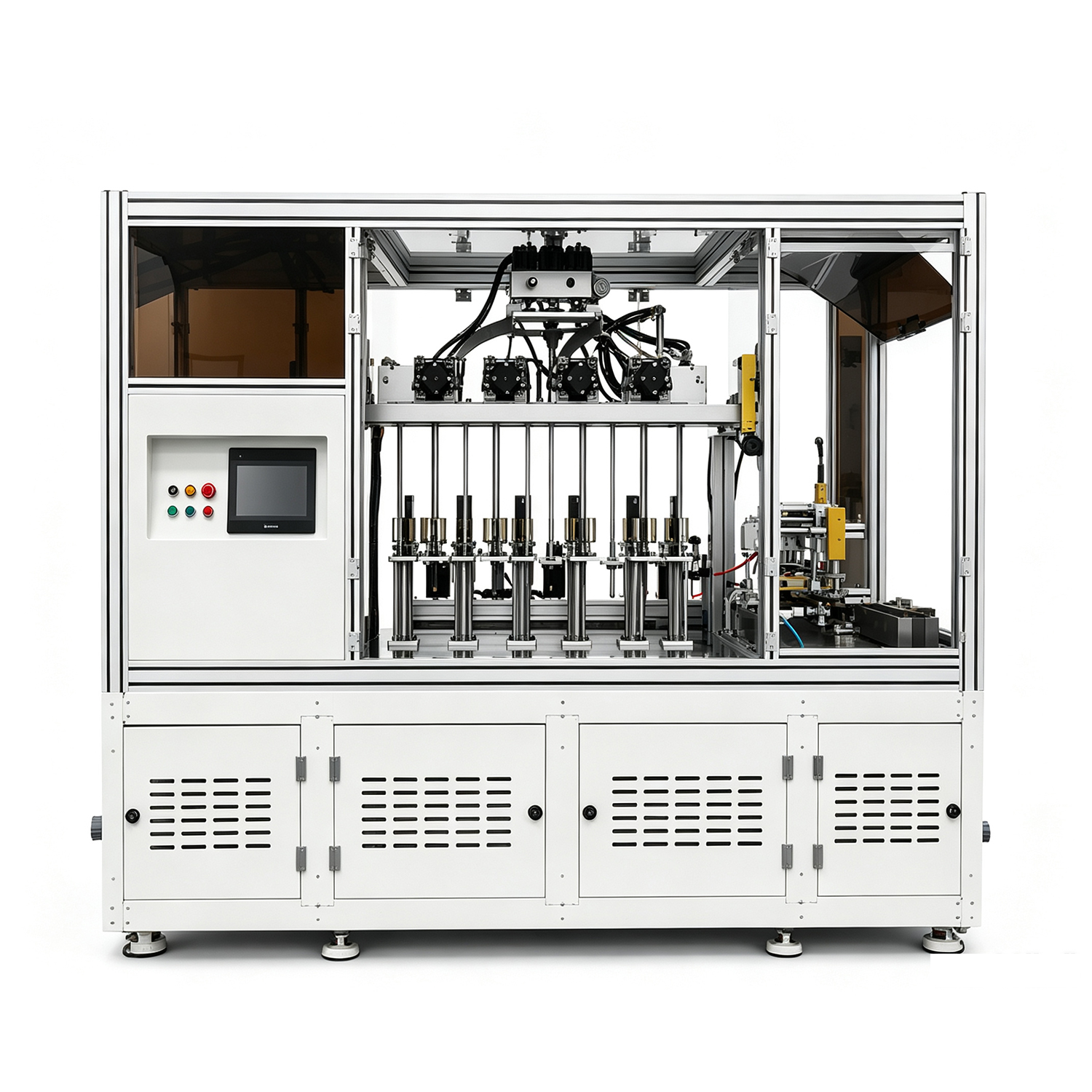
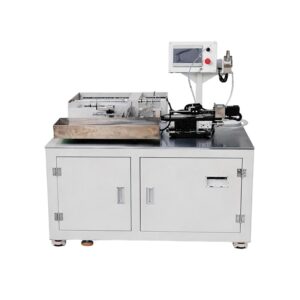
Automatic Secondary Degassing, Cutting & Tail Welding Machine for Heat Pipe Production
Four operations in one automated cycle: secondary degassing, straightening, fixed-length tail cutting, and TIG tail welding — with the vacuum held continuously from degas to weld. Replaces 3 standalone stations and 2-3 operators with one machine and one loading position.
Overview
The final sealing sequence is where heat pipe quality is won or lost. After working fluid injection, the pipe must be degassed a second time to drive out residual non-condensable gases, then cut to final tail length and welded shut — and the vacuum must survive every step. On lines using separate stations, the pipe leaves the vacuum environment between degassing and welding. That transfer window is where gas re-entry happens, and it is the single most common root cause when finished heat pipes show degraded performance after weeks in the field.
The CT-SDW-6 closes that window. It integrates secondary degassing, straightening, fixed-length cutting, and TIG tail welding into one automated cycle, with the weld completed while the vacuum is still held. The pipe never leaves the controlled environment between degas and seal. Cycle time is 8–15 seconds per pipe depending on size — 240 to 450 pipes per hour from a single loading position.
Why an All-in-One Machine Instead of Separate Stations
| Dimension | 3 separate stations | All-in-one machine (CT-SDW-6) |
| Operators per shift | 2–3 | 1 (loading/unloading only) |
| Floor space | ~25–35 m² | ~8–10 m² |
| Vacuum exposure between degas and weld | Pipe leaves vacuum, risk of gas re-entry | Continuous — weld happens while vacuum held |
| Handling damage risk | 2 manual transfers between stations | Zero — automatic transfer inside machine |
| Cycle consistency | Operator-dependent timing | Machine-controlled, ±0.5 sec repeatability |
| Per-pipe data traceability | Manual records, often incomplete | Automatic logging per pipe |
The vacuum continuity row is the one that matters most for quality. Floor space and labor savings recover the investment; vacuum continuity is what removes a failure mode that separate stations cannot eliminate.
Key Features
• 4-in-1 integration — secondary degassing, straightening, fixed-length cutting, and tail welding in one automatic sequence
• Continuous vacuum from degas to weld — ≤ 5 × 10⁻³ Pa held through the entire sequence, eliminating gas re-entry between stations
• 8–15 second cycle time — 240–450 pipes per hour with one operator handling loading only
• TIG welding with process monitoring — current, voltage, and arc duration logged per weld; helium-tight result ≤ 1 × 10⁻⁸ Pa·m³/s
• Tail length accuracy ±0.2mm — servo-positioned cutting for consistent finished length across the batch
• Dedicated programming system — touchscreen HMI with simple recipe editing, data storage and recall by product number
• Per-pipe data logging — vacuum level, weld parameters, and cycle result recorded for every pipe, exportable for customer audits
• Two-frame layout — main machine frame plus separate vacuum pump / hydraulic station frame, keeping pump vibration and heat away from the process zone
• Quick-change tooling — Φ4–Φ10mm pipe range covered with fixture swap in under 15 minutes
Technical Specifications
| Parameter | Value |
| Model | CT-SDW-6 |
| Integrated functions | Secondary degassing + straightening + fixed-length cutting + tail welding (4-in-1) |
| Stations replaced | 3 standalone stations (degassing, cutting, welding) + 2-3 operators |
| Compatible pipe diameter | Φ4mm – Φ10mm (Φ12mm option) |
| Compatible pipe length | 100mm – 600mm |
| Cycle time | 8 – 15 seconds per pipe (size dependent) |
| Throughput | 240 – 450 pipes per hour |
| Degassing heating temperature | 120°C – 160°C (recipe-controlled) |
| Vacuum level during degassing | ≤ 5 × 10⁻³ Pa |
| Tail length after cutting | Configurable, tolerance ±0.2mm |
| Welding method | Argon arc welding (TIG) with current/voltage monitoring |
| Weld leak rate | ≤ 1 × 10⁻⁸ Pa·m³/s (helium-tight) |
| Straightening accuracy | ±0.3mm over pipe length |
| Control system | PLC + touchscreen HMI, dedicated programming system |
| Recipe storage | Unlimited, with data storage and recall function |
| Data logging | Per-pipe: vacuum level, weld current, cycle result, timestamp |
| Frame configuration | Main machine frame + separate vacuum pump / hydraulic station frame |
| Power supply | 380V / 50Hz / 3-phase, ~15kW |
| Compressed air | 0.5 – 0.7 MPa |
| Machine dimensions | ~2400 × 1500 × 1900mm (main frame) |
| Compliance | CE-ready design |
Note: parameters above are for the standard CT-SDW-6 configuration. Custom configurations available for Φ12mm pipes, longer pipe ranges, and integration with upstream filling equipment.
How It Works
Stage 1: Loading & Secondary Degassing
The operator loads filled heat pipes (working fluid already injected, primary degassing complete) into the fixture. The machine connects the open tail to the vacuum system and heats the pipe body to the recipe temperature:
✓ Pipe heated to 120–160°C — working fluid boils, driving dissolved gases out of solution
✓ Vacuum system extracts liberated gases through the open tail
✓ Vacuum level monitored in real time; cycle advances only when ≤ 5 × 10⁻³ Pa is reached
✓ Per-pipe vacuum reading logged for traceability
Stage 2: Straightening
While still in the fixture, the pipe passes through the straightening section:
✓ Multi-point correction brings pipe straightness to ±0.3mm
✓ Correction force limited by recipe to protect the sintered wick
✓ No separate handling step — straightening happens inside the machine sequence
Stage 3: Fixed-Length Cutting
The tail is cut to the final product length while vacuum is maintained at the crimp point:
✓ Crimp seal applied below the cut point before the blade contacts the tube
✓ Servo-positioned cut delivers tail length tolerance ±0.2mm
✓ Cut scrap collected automatically; no copper debris at the weld zone
Stage 4: TIG Tail Welding & Unload
The crimped tail tip is fused by TIG arc into a permanent hermetic seal:
✓ Argon-shielded TIG arc fuses the crimped tip — no filler material
✓ Weld current, voltage, and arc duration logged per pipe
✓ Result: helium-tight seal ≤ 1 × 10⁻⁸ Pa·m³/s
✓ Finished pipe ejected to output tray; cycle restarts automatically
Applications
This machine serves the final sealing section of any sintered or mesh wick heat pipe production line: AI server cooler heat pipes, laptop thermal module pipes, EV battery cooling pipes, and LED heat sink pipes. It is the automation upgrade path for factories currently running separate degassing, sealing, and welding stations — and the standard configuration for new lines targeting 240+ pipes per hour. For full line planning context, see our guide on how to set up a heat pipe production line.
Why Choose Cooling Thermal
• Full production line scope — we build the equipment for the entire heat pipe process, so this machine arrives with tooling matched to your upstream filling and shrinking stations
• Engineer-led commissioning — on-site installation, recipe tuning on your actual pipes, operator training, 12-month warranty
• Proven in production — our equipment runs in heat pipe factories supplying Foxconn, Nidec, Furukawa Electric, and Samsung supply chains
• Custom configurations — pipe size range, automation level, and upstream integration specified at order time
How the Degassing & Sealing Process Works

Loading and Fixture Clamping

Secondary Degassing Under Vacuum

Reviews
There are no reviews yet.